
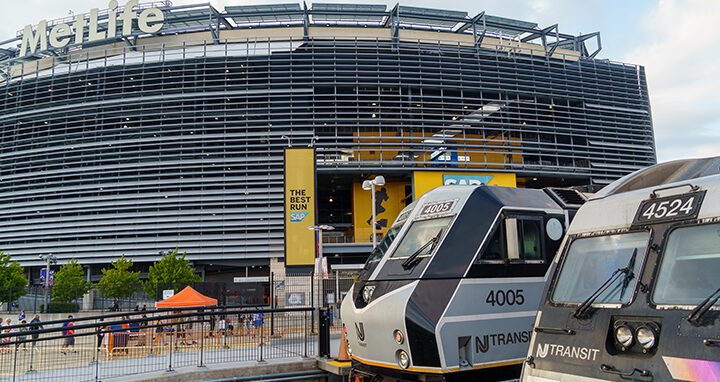
A round-trip train ticket to see World Cup matches at MetLife Stadium this summer will cost ticket holders $150, NJ Transit officials confirmed Friday as they unveiled their plans to move tens of thousands of soccer fans to and from the Meadowlands.
The heightened fare will apply to anyone taking a NJ Transit train into Secaucus Junction, where they will transfer to a train headed for MetLife Stadium in East Rutherford. NJ Transit CEO Kris Kolluri said the dramatic price hike is an effort to prevent New Jerseyans from being saddled with the extra costs associated with the World Cup.
The World Cup doesn’t need any more of NJ’s tax dollars
“When you net out how we are thinking about this, this isn’t profit-making. We’re not trying to gouge anybody. We’re trying to recover the cost of $48 million that it’s going to cost, by charging $150 a ticket, period,” he said at a press conference in Newark Friday.
Normally, an NJ Transit train ticket from MetLife to New York Penn Station costs $12.90.
MetLife will host eight World Cup matches over three weeks in June and July. World Cup ticket holders will not be able to park at the stadium.
World Cup attendees will be able to purchase train tickets for the World Cup beginning May 13, and must purchase them in advance. They will not be sold at train stations or ticket vending machines. Only 40,000 people will be able to buy those tickets.
Fans coming from New York will have to use New York Penn Station to travel via rail to MetLife Stadium. Tickets will come with specific boarding times. And parts of New York Penn Station will be restricted to World Cup ticket holders during the four hours before a match.
Trains will run four hours before each match and three hours after a game ends. Alex Lasry, the CEO of the New York New Jersey Host Committee, said there will be ample time for people to make it through MetLife security before kick-off.
Shuttle bus tickets will also be available for $80 beginning Friday, April 17. The shuttles will leave from Hackensack Meridian School of Medicine in Clifton and take passengers to MetLife, where attendees will be dropped off about a mile away from the stadium at the Meadowlands Racetrack.
Tickets for shuttle buses and trains will be non-transferrable and non-refundable.
Soccer fans can take Uber or other similar services to MetLife, where there will be a designated spot for drop-offs and pick-ups. The nearby American Dream mall will offer some parking, with prices beginning at $225.
Lasry said about 78,000 spectators will attend each match. He called this World Cup a “public transportation-first event” that requires “unprecedented planning.”
“This is going to be the biggest World Cup that FIFA has ever put on,” he said.
Commuters can take other NJ Transit trains during the matches for the regular price, although NJ Transit officials are urging people to work from home if they can, particularly on June 22 and June 30, when match times will coincide with regular evening commuting hours. Commuters on those days will see a 20% discount on their tickets, and monthly commuters will receive a 3% discount for June.
New Jersey is not alone in dramatically raising transit prices to cover the costs of the tournament. Massachusetts’ transportation authority said round-trip tickets for World Cup ticket holders will cost $80, four times the usual price. But transit agencies in Los Angeles and Philadelphia have said they will not raise standard fares.
In New Jersey, the $150 cost of a train ticket will help the state recoup the $48 million it will spend on upgrades to the trains ahead of the matches and security, Kolluri said.
“This isn’t about trying to make a profit,” he said. “We are trying to literally recover our cost.”
If tickets remained at the normal price, New Jersey commuters would subsidize the cost of FIFA travelers by 92%, Kolluri said, calling it “an untenable option” at a time when the transit agency faces a multimillion-dollar structural deficit.
NJ Transit has come under fire from state officials and soccer fans alike who believe the steep increase is an unfair surprise.
“I just don’t understand how anyone can justify such an egregious price scheme when it’s already going to be so difficult to get to and from the World Cup,” said Sen. Mike Testa (R-Cumberland).
FIFA officials are also attacking New Jersey’s plan, saying it will have a “chilling effect.”
“Elevated fares inevitably push fans toward alternative transportation options. This increases concerns of congestion, late arrivals, and creates broader ripple effects that ultimately diminish the economic benefit and lasting legacy the entire region stands to gain from hosting the World Cup,” Heimo Schirgi, chief operating officer for FIFA World Cup 2026, said in a statement.
Gov. Mikie Sherrill, a Democrat who took office in January, has repeatedly defended the increase while taking shots at FIFA for not chipping in more for transpiration costs. Almost of the planning for this year’s World Cup was done under Sherrill’s predecessor, Phil Murphy (a Murphy spokesman did not return a call seeking comment).
“We inherited an agreement where FIFA is providing $0 for transportation to the World Cup. And while NJ Transit is stuck with a $48 million bill to safely get fans to and from games, FIFA is making $11 billion. I’m not going to stick New Jersey commuters with that tab for years to come,” she said on social media.
GET THE MORNING HEADLINES.



