
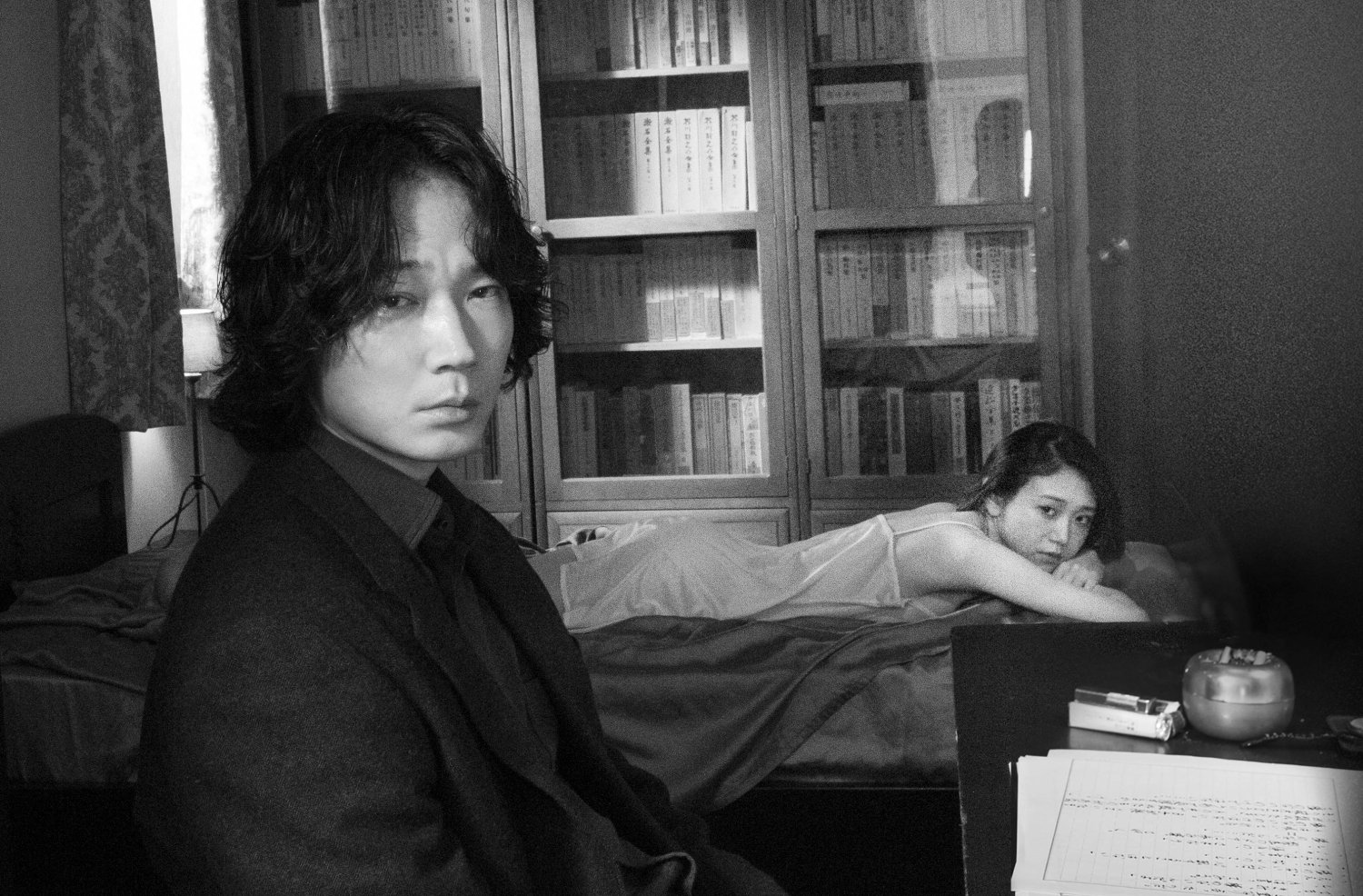
Haruhiko Arai’s “The Stars and the Moon Are Holes in the Sky” (“Hoshi to tsuki wa ten no ana”) is a Japanese film that recently had its international premiere at the Hong Kong Film Festival. It was released in Japan in December 2025.
Haruhiko Arai is a veteran of Japanese cinema, primarily known as a screenwriter, especially in the genre of softcore sex films (“pink eiga”), which have also long been known in the West. This comes as no surprise, considering that Arai began his career as an assistant at the studio of the legendary Koji Wakamatsu, who brought the genre to an early golden age with radical and scandalous films such as “Violated Angels” (1967) and “Ecstasy of the Angels” (1972). Arai’s own screenplays, including those for directors like Tatsumi Kumashiro (“The Woman with Red Hair,” 1979) and Ryuichi Hiroki (“Vibrator,” 2003), largely adhere to the conventions of the genre. It wasn’t until 1997, at the age of 50, that he directed his first feature film, “Body and Soul”. Apart from them being erotic dramas, he also imbued this film and his four subsequent directorial efforts with a certain arthouse feel.
This is also true of “The Stars and the Moon Are Holes in the Sky.” Visually, the film is reminiscent of the works of the so-called Japanese New Wave of the 1960s and 70s, the heyday of the Art Theatre Guild production company, and directors like Oshima, Imamura, Okamoto, Jissoji, Matsumoto, and Terayama. It is certainly no coincidence that the story is set in 1969, a year that saw the release of groundbreaking Japanese films such as “Boy,” “Double Suicide,” and “Funeral Parade of Roses.” The source material, a novel by Junnosuke Yoshiyuki, also dates back to 1966. Grainy black and white, images that aren’t always explicitly focused, and occasional splashes of red (such as a child’s lips licking a stamp before posting a letter) underscore the film’s slightly experimental nature, and the narrative style also strives to avoid strict conventionality. For instance, texts by the main character, the writer Katsuji Yazoe (played by Go Ayano), are shown on screen for minutes at a time while the action comes to a standstill.
This Yazoe, as he’s exclusively called in the film, is quite at home in 1969, because he sustains an image of women (and ultimately, of men) that was probably already outdated back then: for him, women are primarily objects of sex and study; he judges them solely on their appearance, and he rejects any deeper relationship with them. That this emotional armor he’s built up isn’t as impenetrable as it seems, gradually becomes clear over the course of the film. As it turns out, he may be outwardly a macho man, but he carries emotional wounds with him. This is partly due to his ex-wife, who left him 13 years earlier, and partly—and this is where things get a bit obscure—to the fact that, despite being 43, he already wears a full set of dentures. He’s frantically trying to ensure that the women he’s with don’t notice.
The women: First of all, there’s the prostitute Chieko (Rena Tanaka), with whom he has a kind of “long-term relationship” and who doesn’t bother to take him too seriously. Then, in an art gallery, he meets the student Noriko (played by Sakuya), who seems to be devoted to him, and the two share, among other things, rather strange sexual preferences. Over time, Yazoe discovers that Noriko also develops a mind of her own. And finally, there’s a very young girl (Akari Misaki) who is introduced to him by Chieko’s boss. Yazoe calls her “B-ko”; he believes he will mold her, and that she will become the female protagonist in his long-unfinished autobiographical novel.
Overall, there are a little too many inconsistencies for a movie. While the female characters are all interesting and well-developed, it’s not really clear why they are all so attracted to the moderately attractive and moderately successful Yazoe and repeatedly put up with his rather boorish manner. Sexual passion, as in the case of the seemingly harmless Noriko, doesn’t explain it all. Yazoe’s vain self-pity ultimately makes the film unbearable and maudlin more than once. And even if one is aware that a male character like this is out of touch with the times and that much of Haruhiko Arai’s film serves primarily to provoke, it’s still hard to stomach.
Moreover, this provocation lacks sufficient edge; so after a while, it becomes rather annoying. The film’s leisurely pace and 122-minute runtime don’t help matters. The technical aspects are all fine. Cinematographer Koichi Kawakami, who had previously worked with Arai, gives the film its arthouse look. The music is by the popular composer Itsuro Shimoda, who, at the age of 23, in 1971 provided the score for Shuji Terayama’s legendary pamphlet “Throw Away Your Books, Rally in the Streets.” He, too, had previously worked with Arai on “It Feels So Good” in 2018.
The film’s greatest asset are its actresses. They are truly excellent, especially the robust Rena Tanaka, who is the least blinded by Yazoe’s macho bullshit. The two young women are also convincing in their challenging roles. Go Ayano himself, an experienced television and film actor with over a hundred credits, occasionally seems a little annoyed by his character because Arai gives him so little room to escape his strangely whiny existence.



