
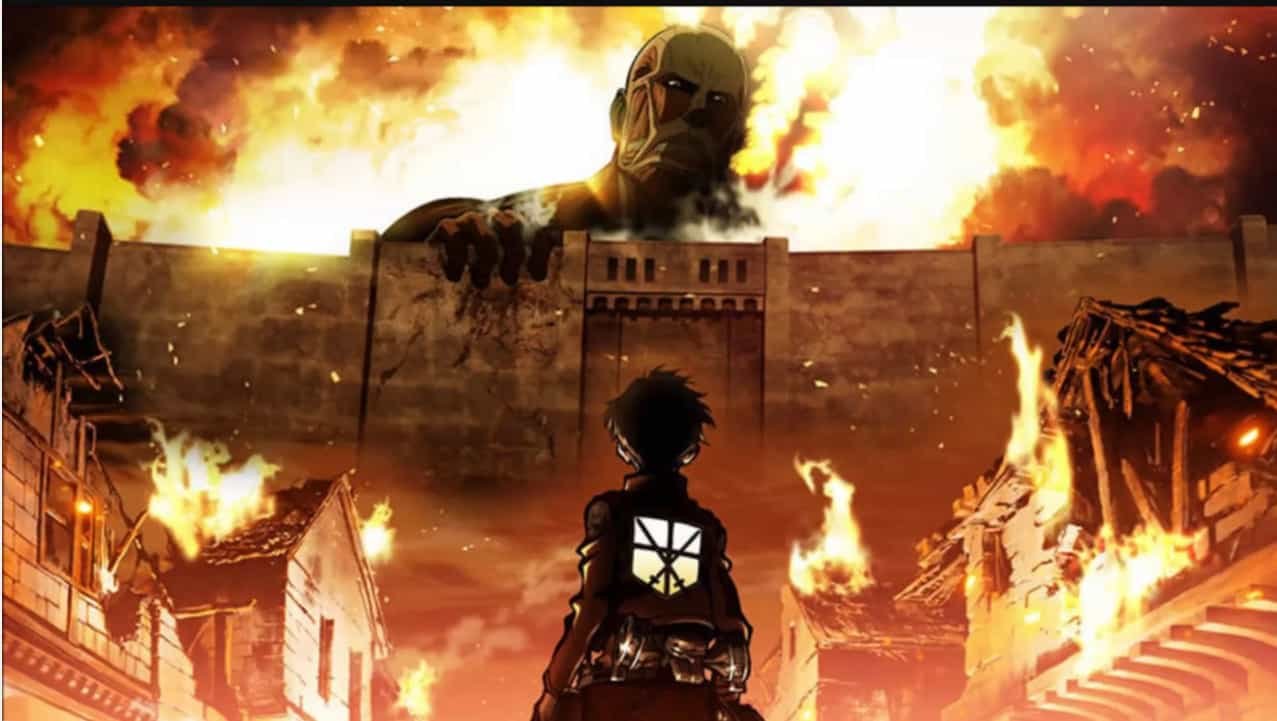
Few anime titles of the last decades have managed to leave such a profound global impact as “Attack on Titan.” Adapted from Hajime Isayama’s best-selling manga, the series debuted in 2013 and quickly established itself as one of the most influential works in contemporary animation. Combining elements of horror, fantasy, war drama, and political allegory, it evolved from a relatively straightforward survival narrative into one of the most ambitious and debated anime epics ever produced. Initially animated by Wit Studio and later continued by MAPPA, with directors such as Tetsuro Araki, Masashi Koizuka, and eventually Yuichiro Hayashi, the series represents a rare case of sustained excellence, even as it underwent significant stylistic and narrative transformations.
Watch This Title on Crunchyroll
by clicking on the image below
Over the years, the title garnered numerous accolades, both in Japan and internationally, including recognition at the Tokyo Anime Awards and massive global popularity that extended far beyond traditional anime audiences. Its cultural penetration is evident not only in its commercial success but also in the extensive discourse surrounding its themes, particularly in its later arcs. The release of “Attack on Titan: The Last Attack,” a compilation feature re-editing the final episodes into a theatrical experience, further confirmed that the ending of the series was not bound to be the finale of the franchise, but rather another extension of its enduring legacy.
The story begins with one of the most memorable premises in anime history. Humanity is on the brink of extinction, forced to live behind massive walls to protect itself from Titans, gigantic humanoid creatures that devour humans without apparent reason. The narrative initially follows Eren Yeager, a young boy whose life is shattered when the wall is breached and his mother is brutally killed. Driven by rage and a thirst for vengeance, he joins the Survey Corps, alongside his childhood friends Mikasa Ackerman and Armin Arlert, determined to eradicate the Titans.
The first season is essentially split into three parts, with the opening focusing on the introduction of the main trio and their training within the military. From the outset, the series establishes its tone through a brutal depiction of violence and loss, where characters are introduced, developed, and often killed shortly after, enhancing the sense of unpredictability. This great combination of thriller, horror, mystery, fantasy, and drama gives the narrative its rich context, with each revelation shedding light on the world while simultaneously raising new questions.
As the story progresses, the focus expands beyond the immediate threat of the Titans. The second season deepens the mystery, revealing that the walls themselves hold secrets and that some of the characters may not be what they seem. The introduction of the Beast Titan and the shocking revelations surrounding Reiner and Bertholdt significantly alter the narrative’s direction, shifting it from a simple battle for survival to a layered exploration of identity and betrayal. At the same time, relationships such as those between Ymir and Historia add emotional nuance, while the continuous deaths of key characters shape the psychological evolution of the survivors.
The third season represents a turning point, moving heavily into political territory. Split into two parts, it sheds intense light on what and why it is happening, unraveling the complex network of power structures within the human world. The internal conflicts within the military, the role of the royal family, and the coup d’état led by Erwin transform the series into a political thriller. This approach allows for a deeper analysis of characters, particularly Levi and Historia, while also delivering some of the most memorable action sequences, including the confrontation between Levi and the Beast Titan.
The second part of the third season returns to large-scale action, culminating in the battle to retake Wall Maria. This arc combines emotional intensity with spectacular animation, particularly in moments such as Armin’s sacrifice and the moral dilemma faced by the protagonists in choosing who to save. These sequences highlight the series’ ability to merge personal drama with epic storytelling, reinforcing its status as a landmark anime.
The final season introduces a significant shift in perspective, focusing on Marley and the broader geopolitical context. The narrative takes place four years after the events of the previous season, presenting a world where the dominance of Titans is challenged by technological advancements. The story becomes more intricate, dealing with themes of racism, colonialism, and propaganda, while exploring the perspectives of characters previously considered antagonists.
This shift is particularly effective in adding depth to the narrative, as the reasoning behind the actions of both sides is revealed. The portrayal of refugees, systemic oppression, and inherited hatred transforms the series into a complex sociopolitical drama. However, this increased complexity also introduces issues, as the number of plot threads and characters grows significantly, sometimes making the narrative difficult to follow.
The culmination of the story, particularly in “The Final Chapters” and “The Last Attack,” brings all these elements together in an all-out battle. The Rumbling, orchestrated by Eren, aims to destroy all humanity outside Paradis Island, with colossal Titans annihilating entire civilizations. This apocalyptic scenario provides a dramatic backdrop for the final confrontation, where former enemies unite in an attempt to stop him.
At this stage, the story has truly gone off the rails, becoming rather convoluted but most of all, not fully meeting the expectations the initial seasons provided. The attempt to portray Eren as a morally ambiguous figure, despite his genocidal actions, is not always convincing, particularly as the narrative tries to justify his motivations. However, the inclusion of the parents of some protagonists, and the regret they feel for setting their children on a path of revenge, adds a compelling emotional layer. The somewhat realistic ending regarding the end of war moves in the same direction, offering closure even if it is not entirely satisfying.
From a technical standpoint, “Attack on Titan” remains exceptional throughout its run. The animation by Wit Studio is outstanding, particularly in the depiction of movement. The use of omni-directional mobility gear allows for dynamic sequences where characters appear to fly through the air, creating some of the most exhilarating action scenes in anime. The brutality of the Titan attacks is portrayed with striking detail, combining grotesque imagery with fluid animation.
With the transition to MAPPA, the visual style undergoes a noticeable change. The focus shifts toward a darker palette and more grounded movement, reflecting the narrative’s increasing seriousness. While some fans criticized the use of CGI in certain Titan sequences, the overall quality remains high, particularly in large-scale battles. The animation thrives on the speed of the characters during combat, with both heroes and villains moving in a way that emphasizes intensity and chaos.
Character design is another strong point. Early work by Kyoji Asano establishes a distinctive look, particularly in the design of the Titans, whose unsettling appearance combines human-like features with monstrous distortions. Later, Tomohiro Kishi introduces sharper lines and more detailed expressions, reflecting the aging characters and darker tone. While some designs in the final season make certain characters look similar, the overall level of detail remains impressive, particularly in the differentiation between major and minor figures.
The backgrounds and environmental design further enhance the series. The early medieval aesthetic, characterized by towering walls and rural landscapes, gradually gives way to more industrial and modern settings, particularly in the depiction of Marley. The destruction caused by the Rumbling is presented on a massive scale, with entire cities reduced to ruins, reinforcing the narrative’s apocalyptic tone. The backgrounds are impressive on occasion, both in drawing and coloring, finding their apogee in the aftermath of battle.
Sound design and music also play a crucial role. The soundtrack, composed by Hiroyuki Sawano and Kohta Yamamoto, combines orchestral elements with electronic influences, creating a powerful and memorable audio experience. The use of silence in key moments adds to the tension, while the opening and ending themes contribute to the series’ identity.
Despite its many strengths, the series is not without flaws. The increasing complexity of the narrative in the later seasons can be overwhelming, with numerous plot twists and character arcs that are not always fully developed. The pacing, particularly in the final arcs, can feel uneven, with moments of intense action followed by lengthy exposition. Additionally, the decision to extend the final season into multiple parts has been criticized for disrupting the narrative flow.
Nevertheless, the emotional impact of the series remains undeniable. The continuous sacrifice of characters, the moral dilemmas faced by the protagonists, and the exploration of themes such as freedom, revenge, and the cycle of violence ensure that “Attack on Titan” resonates on multiple levels. Even when the narrative falters, the strength of its characters and the intensity of its key moments maintain audience engagement.
“Attack on Titan” is a monumental achievement in anime, a series that redefined what the medium could accomplish in terms of storytelling and thematic depth. Its journey, from a brutal survival story to a complex exploration of war and humanity, is both impressive and, at times, frustrating. While the final chapters may not fully satisfy every viewer, they do not diminish the significance of the work as a whole. Ultimately, it is a title that can be appreciated even without being fully understood, a rare quality that speaks to its ambition and enduring legacy.



