
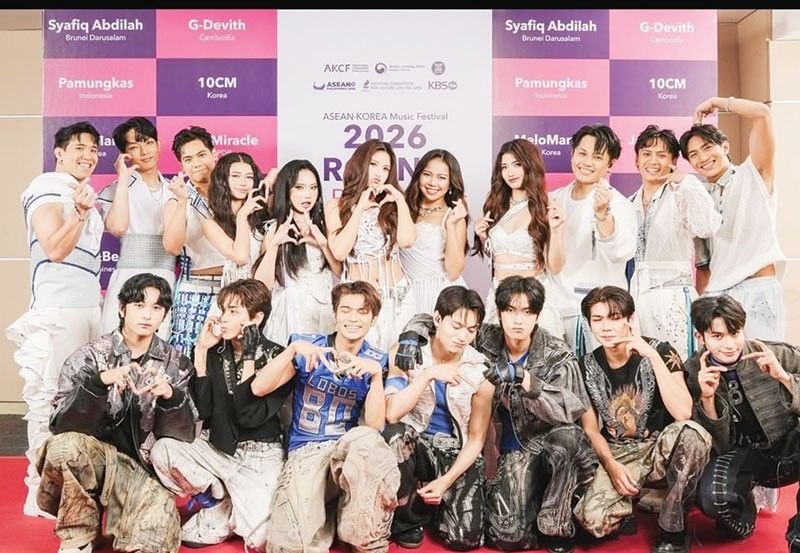
There are nights when a concert feels like entertainment, and then there are those rare occasions when it feels like something more — a gathering, almost a convention of shared emotion.
The 2026 ASEAN-Korea ROUND Festival, held at the Smart Araneta Coliseum last April 18 and 19, managed to be both. More than that, it became a meeting of voices from different lands, each carrying its own story, yet somehow converging into one.
Experiencing the first night alongside family, colleagues and strangers bound by a common love for music, it was difficult not to see the event as a kind of fellowship — one formed not to destroy the One Ring, but to create harmony.
Myanmar’s hard-rocking Velocity delivers a heart-thumping set.
The timing felt deliberate. With the Philippines serving as ASEAN chair this year, it was only fitting that the region’s soundtrack would be entrusted to a country where singing is second nature. Filipinos do not simply listen to music; they inhabit it. From the pre-show, host Hyeonhyul Kim drew out this instinct, inviting audience members to sing; they happily obliged and they did not disappoint. It set the tone for the rest of the evening.
Throughout the night, the usual performer-audience dynamic dissolved. The arena reverberated with voices in full chorus, with fans not just singing along for themselves but for the artists. It was a role reversal that did not go unnoticed. TJ Monterde summed it up simply: “We have the best crowd.”

Among the artists are the ‘Princes of K-drama OST’ MeloMance.
The Filipino lineup felt less like representation and more like a home-field advantage. TJ delivered one of the evening’s most poignant moments with Silver, a tribute to fur babies, where he was joined by 10CM, whose Korean lines added a gentle cross-cultural texture. He closed the set with a personal serenade to his wife, KZ Tandingan, through the love ballad Palagi. The ever-romantic crowd went wild with kilig.
Across the program, the regional lineup revealed the festival’s deeper intent: not merely to showcase but to connect. Myanmar’s Velocity powered through with a heart-pounding set; Malaysia’s Mimifly marked a confident resurgence with both familiar and new material, accompanied by lively choreography that evoked Bollywood with a smattering of Indonesian pop; Brunei Darussalam’s Syafiq Abdilah bridged cultures with a heartfelt rendition of Filipino favorite Ikaw; and Indonesia’s Pamungkas injected fresh energy at the fourth hour of the festival with intricate guitar work and lingering melodies. I was mildly surprised when the audience knew the lyrics to his finale, To the Bone. That’s purely on me.
Millennial ‘It Girl’ Gabbi Garcia co-hosts the event with South Korean artist 10CM.
I was unable to attend the second night, but its lineup alone suggested a continuation of that same spirit. Ben&Ben, known for turning introspection into communal experience, shared the stage with HORI7ON, whose sound sits comfortably at the intersection of P-pop and K-pop. They were joined by artists from across the region — G-Devith (Cambodia), JoJo Miracle (Lao PDR), Regina Song (Singapore), Tilly Birds (Thailand) and Chillies (Viet Nam) — reinforcing the festival’s pan-ASEAN character.
Korea’s presence, in particular, anchored the festival with quiet confidence. MeloMance, known for their evocative K-drama soundtracks, delivered the kind of restrained, emotionally layered performance that has become a hallmark of Korean emotive theme songs. And when 10CM returned as the Korean representative on the second night — after co-hosting with Gabbi Garcia on the first — it completed a neat arc from facilitator to performer.
TJ Monterde’s Palagi, a love song for his wife, the equally talented KZ Tandingan, sends the audience into a swooning karaoke mode with a collective wave of kilig.
Only toward the end did the evening settle into its natural crescendo. Cup of Joe closed the first night with a set that balanced polish and momentum, affirming their rapid rise and leaving the audience on a high that felt both celebratory and complete.
Each act arrived with its own identity intact. Yet what emerged was not a collage but a chorus. That is the nature of any true fellowship. Whether in the worlds imagined by J.R.R. Tolkien or Stan Lee, unity is never about sameness. It is about varying fortes coming together to form an even more powerful combination, like The Avengers or The Fellowship of the Ring. Our neighbors may have tones, styles and tongues that are slightly dissimilar to the Original Pilipino Music (OPM) we’re used to, but the appreciation is the same. A Korean ballad carries the stamp of K-pop, and yet, we love them with equal passion. Placed side by side, they do not compete — they complete.
Brunei Darussalam’s Syafiq Abdilah woos the crowd with a cover of Ikaw.
Even the production reinforced this idea of shared experience. The synchronized LED wristbands — now a fixture in large-scale concerts — transformed the audience into part of the performance itself. Waves of light rippled across the arena in beautiful synchronicity, serving as a subtle but commanding reminder: in this space, everyone belonged to the same moment.
The festival, presented by KBS World and supported by the ASEAN-Korea Cooperation Fund, was also a study in cultural connection. Korea’s global cultural reach, through its dramas, music and the enduring appeal of acts like BTS, has made it less a foreign presence than a familiar one. What once was novel is now a shared vocabulary.
The roar inside the coliseum rivaled even the loudest performances, but it was a joyful kind of noise — one that explains why people travel great distances to watch concerts in the Philippines. There is something distinct about a crowd that sings not out of obligation, but out of instinct.
Mimifly does a ‘soaring’ performance.
By the end of the night, a familiar line from Henry Wadsworth Longfellow came to mind: “Music is the universal language of mankind.” It is a sentence often repeated, sometimes too easily. But in that arena, which was filled with thousands from different countries, speaking different languages yet understanding each other perfectly, it felt less like a metaphor and more like a reality worth nurturing.
Music, after all, moves in the opposite direction of division. Like sport, it unites without demanding uniformity. It asks only that we listen — and, occasionally, that we sing along. If you allowed yourself a moment, you could sense it clearly: the energy of performance, the gentle and enduring flow of humanity, and perhaps even a reminder of what people can create when they choose harmony over discord.
That was the quiet triumph of this fellowship.



