
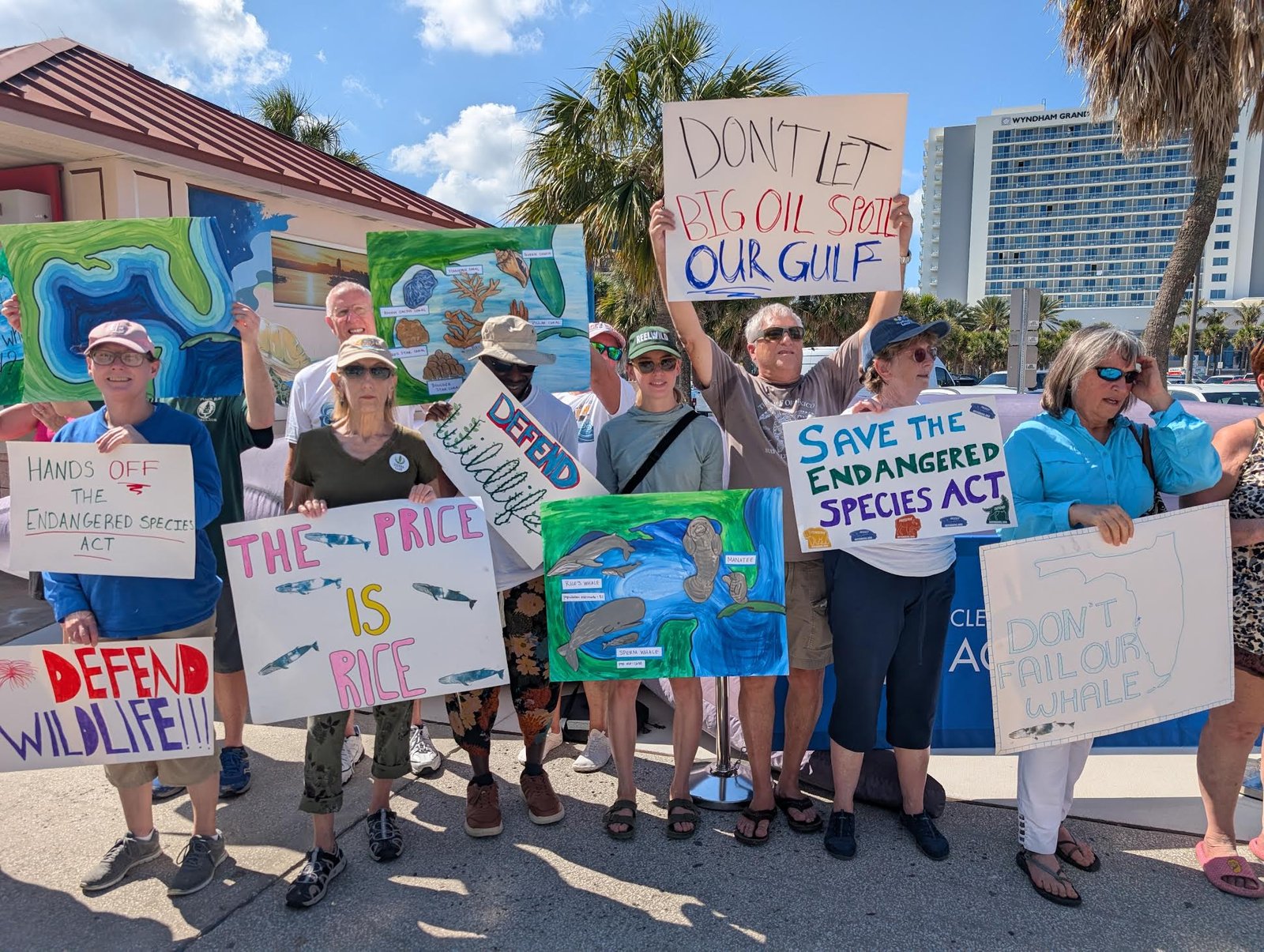
CLEARWATER BEACH — As Floridians prepare for Earth Day on Wednesday, environmental advocates are attempting to raise awareness about a Trump administration plan to bypass compliance with the Endangered Species Act for all oil and gas activities in the Gulf of Mexico.
Last month, U.S. Interior Department’s Endangered Species Committee voted unanimously to exempt oil and gas drilling in the Gulf from environmental standards put in place to protect endangered wildlife in its waters.
It was only the fourth time that the committee has met in its near-50 years in existence, and it’s spurred at least two lawsuits by environmental groups contending that more than two dozen species now protected as either threatened or endangered are directly at risk.
“We need decisive action from our elected leaders — we cannot afford to go backward and expand offshore drilling in the critical habitat of the Rice’s whale, or by weakening the Endangered Species Act in ways that push this species, and so many others, closer to extinction,” Michael McGrath, lead organizer for Sierra Club Florida, said during a press conference at Pier 60 on Clearwater Beach Saturday.
“As we reflect on the legacy of Deepwater Horizon and look ahead to Earth Day, we’re here not just to remember, but to act — to ensure we don’t repeat the mistakes of the past and to show what’s possible when communities come together to protect what we love.”
Joining McGrath were some two dozen citizens who held a community beach cleanup and the subsequent press conference to discuss threats to marine wildlife that could result from the weakening of the environmental law, first and foremost the highly endangered Rice’s whale.
“Today it’s estimated that there’s as few as 51 remaining. And it’s the Gulf’s only year-end resident whale, and we’re dangerously close to losing that whale forever,” McGrath said.
“And it’s not just our whales — it’s our sea turtles, it’s our Gulf sturgeons, all the wildlife that we all care about. This is why we’re here today, because we’re seeing rollbacks to the Endangered Species Act in the name of the fossil fuel industry.”
“The Rice’s whale lives exclusively in our Gulf, and it is our responsibility to do what we can to protect its habitat,” added Dr. Kelly McAdams, VP for conservation education for the Clearwater Marine Aquarium.
The Endangered Species Committee, created in 1978 under the Endangered Species Act, comprises seven high-level government officials. According to the department’s website, it was created to address “extremely rare situations” in which proposed federal action conflicts with the protection of an endangered or threatened species and no workable alternatives appear to exist.
It’s sometimes called the “God Squad” because it’s powerful enough to condemn species to extinction.
Court filings show that Energy Department Secretary Doug Burgum called the committee to meet last month in response to a notification from Secretary of Defense Pete Hegseth that he “found it necessary for reasons of national security” to exempt from the law’s requirements all Gulf of Mexico oil and gas exploration under the Outer Continental Shelf Oil and Gas program.
That’s according to a brief filed by the Center for Biological Diversity in its lawsuit against Hegseth, Burgum, and the five other Trump administration officials who met as the Endangered Species Committee.
The Center for Biological Diversity contends Hegseth’s “national security findings” have yet to be unveiled to the public.
Legislation pending
Speakers on Saturday on Clearwater Beach also referenced proposed legislation in Congress that they allege would gut protections for species already on the verge of extinction. That’s the ESA Amendments Act of 2025, sponsored by Arkansas Republican Rep. Bruce Westerman. Among its provisions:
- Allows states to develop and submit recovery strategies for species that are candidates for listing or listed as threatened.
- Requires federal agencies to establish objective, incremental recovery goals for threatened species and provide regulatory relief as recovery goals are met. Once all recovery goals are met, the agencies shall provide for state management of the species in preparation for delisting.
- Requires agencies to act on five-year review determinations of listed species.
- Prohibits judicial review within the five-year monitoring period after a species is delisted.
- Requires agencies to disclose to Congress all costs associated with Endangered Species Act-related lawsuits.
Independent Journalism for All
As a nonprofit newsroom, our articles are free for everyone to access. Readers like you make that possible. Can you help sustain our watchdog reporting today?



