
The Florida context
Last year, the Florida Legislature approved HB 1105, which implemented a high school bell-to-bell cell phone ban pilot study in six counties’ high schools and outright bans phone use for elementary and middle school students during the school day statewide.
In 2023, lawmakers passed a bill that bans phones during instructional time. According to Education Week, 29 states have bell-to-bell cellphone bans. The Education Week report gives Florida credit as being the first.
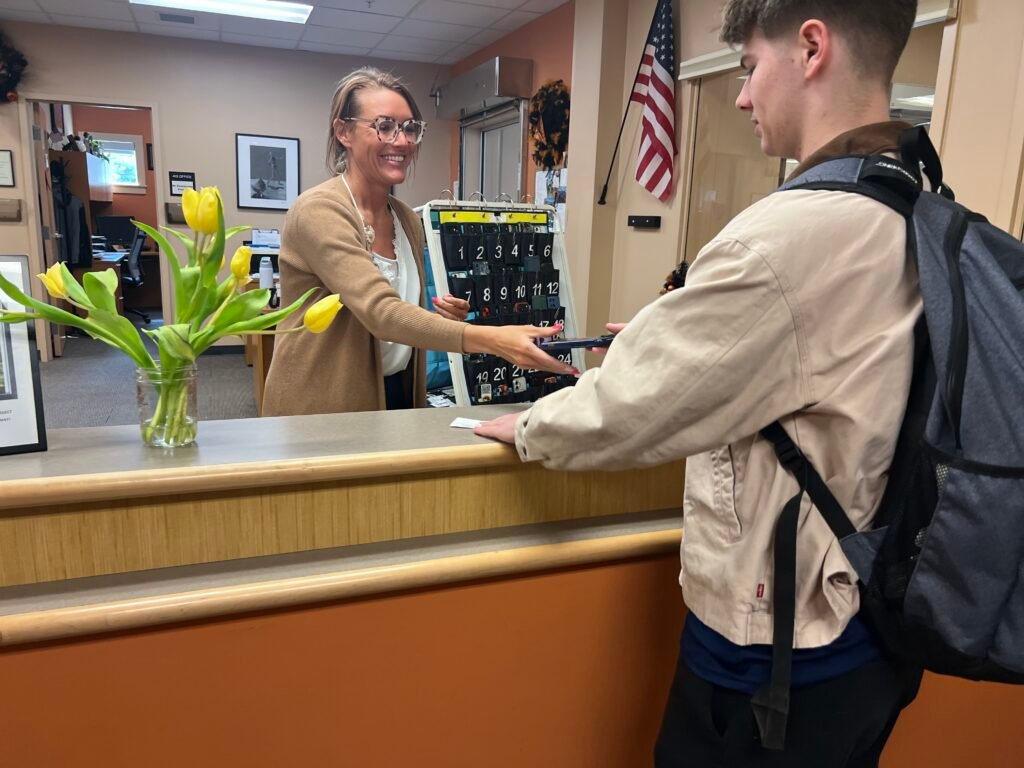
Just after 9 a.m. on a Thursday morning in April, Brewer High School student Dylan Unobskey walked into the main office and handed his cell phone to Office Secretary Megan Gobeil.
Gobeil slipped the phone into a caddy alongside two dozen others and handed Unobskey a claim ticket he could use to retrieve it at the end of the day. When students return to school this fall, districts will need systems of their own for collecting and storing students’ phones as they prepare to implement a statewide cell phone ban.
At Brewer High School, administrators and students have already spent months adjusting to a similar policy that they first implemented in January. District leaders told Maine Morning Star the restrictions seem to have improved classroom engagement, encouraged students to socialize at lunch and in school hallways and even helped streamline the school’s response to emergencies.
“Cell phones and social media have reinforcement loops to make them addictive, reinforce you to keep using them, and so I think we were asking something that was just difficult to do,” said Superintendent Gregg Palmer. “So I think it was good for us to develop our policy and implement it before the statute took effect, because we were probably more prepared as a result, and had more conversations with students and families.”
But even five months after implementing the policy, not all students are convinced a bell-to-bell ban is necessary. Some Brewer and Westbrook students who spoke with Maine Morning Star disputed the claim that they’re addicted to their devices, and several raised concerns about the impacts of the new law, particularly how it will be enforced and how it will ultimately benefit their learning.
“I don’t think phones were ever really the problem for people paying attention,” said Nikolas Long, a 16-year-old Brewer High School junior. “If you want to pay attention, you’ll pay attention. And if you don’t, you can always find something else to do with your time, even if it doesn’t involve a phone.”
Mixed reviews on phone ban
Gov. Janet Mills and a majority of the Democratic-led Maine Legislature have been proponents of a cell phone ban. During the 2025 legislative session, lawmakers asked school boards to start developing plans to limit cell phone use in schools. Brewer first implemented a policy asking students to leave their phones in a phone caddy when entering the classroom, and taking it with them when they left.
That system worked much better than an outright ban, according to Long and other students.
However, this session, Mills’ supplemental budget included language for a bell-to-bell ban based on a model policy developed jointly by the Maine School Management Association, Maine Department of Education and Maine Principal’s Association.
Late last month, several lawmakers joined the governor at Westbrook High School for a ceremony celebrating the ban that included speeches from teachers and students.
“Students socializing together, instead of endlessly scrolling alone. Building a strong community, instead of basing their self-esteem on social media. Spending time on learning, not struggling to let go of an addictive phone,” Mills said. “That’s what getting cell phones out of the classrooms will do.”
The ban will improve student performance, test scores, behavior, attendance, and social dynamics, she added.

But some students are not convinced. After Mills’ speech, Westbrook sophomores Emma Rice and Elyse Broad said students currently only use phones during lunch and between classes. Both 16-year-olds don’t consider themselves addicted to their devices, but some students might be, they added.
“I don’t really know how to feel about it, because it’s kind of just being thrown at us right now,” Rice said.
“I feel like it’s going to be a really hard adjustment at first,” Broad added.
Long in Brewer said while the state might’ve given school boards time to come up with their policies before passing the statewide law, “the state is not working with the kids, they’re just going straight to an ultimatum.”
“I feel like if they actually worked with the students, there’d be something that we all would actually agree with and want to follow.”
Brewer High School senior Carmen Bryant nodded, adding, “they should do a study comparing the results before versus after the policy was put in place. Does it actually improve learning?”
What cell phone bans actually do
Based on national research, the results are mixed. A comprehensive national study released by the National Bureau of Economic Research this April found that in the short-term, cell phone bans caused an increase in disciplinary incidents while overall student well-being dipped. However, it found that over time, well-being became positive and disciplinary effects faded. Average effects test scores remained more or less the same, with the most positive effects being on high school math, while middle schools saw minor negative effects on achievement. However, the study did not find much evidence of effects on school attendance, self-reported classroom attention, or perceived online bullying.
However, Brewer Assistant Principal Fred Lower said he’s seen some unexpected benefits. Students are texting each other far less to meet up in bathrooms or hallways, he said. As a result, there’s been “a drastic decline in vaping,” he said.
“We’ve also definitely seen a decrease in reports of bullying and harassment,” Lower said. “A lot of that was going on with phones in school. Now it still happens, but it seems like it’s outside of school hours.”

Because of the state’s foundation of local control, there is no language in Maine’s law about enforcement, leaving districts to determine their own punishments. Brewer has a system that scales up punishments based on how many times students are caught using phones, Lower said. If it’s a first offense, the student gets a warning and their phone is confiscated until the end of the day. On a second offense, a parent or guardian has to come get the device and the student might receive a detention. If they’re caught with a phone a third time, they face in-school suspension.
“We haven’t gone past that … which is telling me that kids, once they get to that second or third offense, they know we’re serious about this, and it changes behavior,” Lower said.
The safety argument
Rice, the sophomore from Westbrook, said she’s concerned about what the ban means for students being able to reach their families. “If a serious emergency happens,” she said, “we can’t really do anything about it.”
That concern was shared by some lawmakers who opposed the bell-to-bell ban, including Rep. Barbara Bagshaw, a Republican from Windham, who told Maine Morning Star last month that her primary concerns are due to “parents saying there are things happening in those hallways that children need to be able to document,” referencing constituents’ complaints about bullying.
However, the National Association of School Research Officers said in a statement last October that cell phone bans promote safety, not hinder it.
“During school emergencies, worried parents understandably want desperately to contact their children and be reassured that the children are safe,” said Mo Canady, the group’s executive director. “The risks posed by phone access during school emergencies are even greater, however, than during normal times.”
During an emergency, students should ideally be focused on instructions and information provided by teachers and administrators, he said, which phones can district from, especially when students are using their devices to communicate with parents.
When Brewer High School had to evacuate during a roof fire last fall, Palmer said he saw the benefits of streamlined communication instead of multiple students using their phones to send out information.

According to Palmer, one student used a cell phone to contact family members, who arrived at the school and picked the student up, rather than following the district’s emergency plan, which called for students to be transported by bus to a designated reunification site. The school was briefly reopened so staff could retrieve students’ devices, he said, but the family that had left showed back up later when the school was locked asking for their student’s belongings, and got upset with the district when they were not let in.
That incident reinforced Palmer’s belief that emergency information is best communicated through school officials, rather than hundreds of students sharing their own accounts of a fast moving situation.
“I think the safest thing we can do is not have everyone have a cell phone sending out various messages that are not perfectly accurate,” Palmer said. “That creates confusion, jams up networks, and causes reactions from people who are receiving those messages who are taking actions on what is often inaccurate information.”
This story was originally produced by Maine Morning Star, which is part of States Newsroom, a nonprofit news network which includes Florida Phoenix, and is supported by grants and a coalition of donors as a 501c(3) public charity.



