
Summary
- Trump is said to be unhappy with Iran’s nuclear proposal, with Secretary of State Rubio reiterating that preventing Iran from obtaining a nuclear weapon remains Washington’s core demand; no deal, no resumption of war, Hormuz stays shut
- The Bank of Japan held rates at 0.75% in a 6-3 vote, with three members pushing for an immediate hike to 1.0%; the BOJ upgraded its inflation outlook sharply and downgraded growth, putting a June hike in play and July looking close to certain
- Japanese Finance Minister Katayama reiterated round-the-clock readiness to act on yen volatility in coordination with the U.S., though her comments provided little tangible support for the currency
- USD/JPY edged lower after the BOJ decision; the dollar softened modestly across major FX pairs
- Foreign automakers including Nissan, Hyundai and Toyota warned the Trump administration they may pull affordable models from the U.S. market if USMCA is not renewed or is watered down
- Meta Platforms is preparing to unwind its acquisition of AI startup Manus after Chinese authorities blocked the deal, with founders set to depart and Beijing imposing a deadline of several weeks to reverse the transaction
- South Korea’s KOSPI hit a record intraday high, up more than 1.2%, led by automakers and steel stocks, with investor attention turning to major U.S. technology earnings for clues on AI investment and semiconductor demand
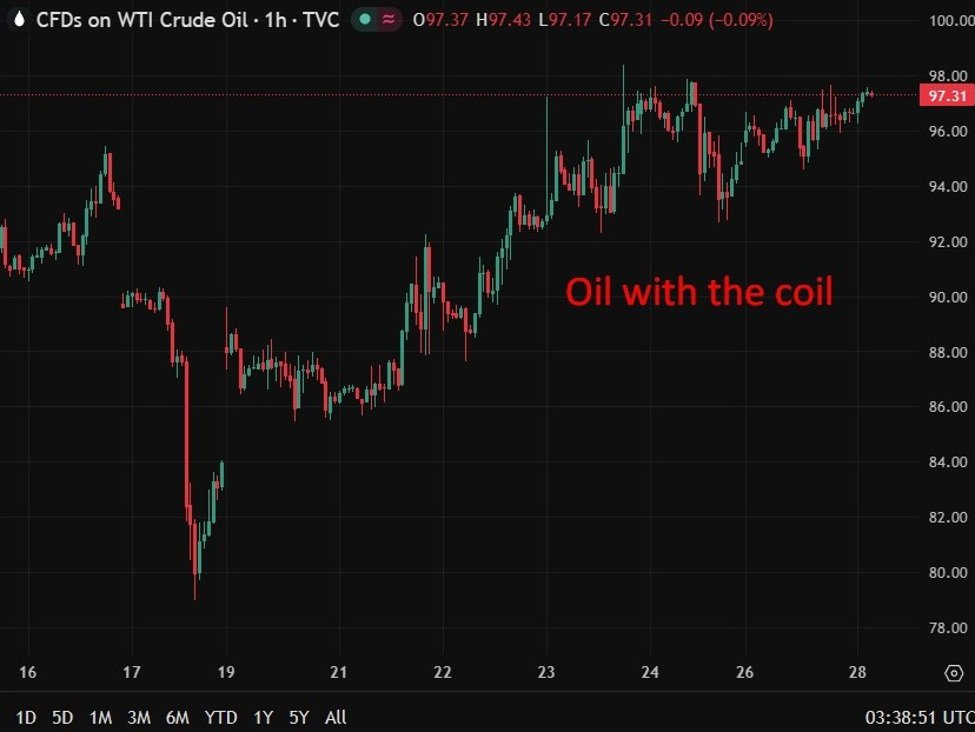
Markets ended Tuesday’s session with crude futures pushing higher and equity and fixed income futures under pressure, as further reports confirmed that U.S. President Donald Trump is dissatisfied with Iran’s latest proposal to end the war.
Reuters, citing a U.S. official, reported that Trump does not love the proposal, echoing earlier accounts from the Wall Street Journal and the New York Times. The sticking point is the same one it has been throughout: Iran’s offer focuses on reopening the Strait of Hormuz and restoring pre-war conditions without addressing the nuclear programme. Secretary of State Marco Rubio made Washington’s position plain, saying that preventing Iran from acquiring a nuclear weapon remains the core concern and that any framework which sidesteps enrichment is insufficient.
The background context helps explain why the gap is so wide. Iran’s proposal, as characterised by those familiar with its content, would amount to a restoration of its pre-war revenue position, including the potential to levy tolls on Hormuz traffic worth billions of dollars annually, combined with the retention of full enrichment capability. For Washington, accepting those terms would effectively confer on Tehran the status of a fourth major centre of global power. It is little wonder Trump is pushing back. The White House is expected to deliver a counterproposal in the coming days. For now, no deal, no resumption of hostilities, and the Strait of Hormuz remains closed.
Away from the war:
Ahead of the Bank of Japan’s policy statement, Finance Minister Satsuki Katayama reiterated that the government was standing by around the clock and ready to act against foreign exchange volatility in close coordination with the United States. The verbal support offered the yen little traction in practice.
The BOJ decision, when it came later, carried more substance than the headline “hold” suggested. The bank kept its short-term rate at 0.75% as expected, but the vote was split 6-3, with Nakagawa, Takata and Tamura all advocating an immediate 25 basis point rise to 1.0%. The dissenting trio cited upward risks to inflation and argued that the conditions for tightening had already arrived. The majority disagreed, pointing to the uncertain growth outlook created by elevated crude oil prices and the Middle East conflict. The BOJ sharply upgraded its inflation forecasts, lifting the fiscal 2026 core CPI projection to 2.8% from 1.9% in January, while trimming its growth outlook. The hawkish tone of the statement, combined with the scale of the dissent, has put a June rate hike firmly in play, with July looking close to a certainty if the data holds. USD/JPY moved modestly lower in the wake of the decision, while the dollar softened slightly across other major pairs.
Away from the macro headlines, the Wall Street Journal reported that foreign automakers including Nissan, Hyundai and Toyota have warned the Trump administration they may withdraw their most affordable models from the U.S. market if the USMCA trade agreement is not renewed or is materially weakened. Trump’s second-term tariffs have rendered many entry-level models unprofitable, and manufacturers say the uncertainty is also freezing investment decisions on new U.S. manufacturing capacity.
In corporate news, Meta Platforms is said to be preparing to unwind its acquisition of AI startup Manus after Chinese authorities moved to block the deal. The Wall Street Journal reported that Manus’ founders would leave Meta as part of the reversal, with complex investor payouts and technical integration work complicating the process. Beijing has set a preliminary deadline of several weeks to undo the transaction.
On the equity side, South Korea’s KOSPI closed at a record intraday high, gaining more than 1.2% on the session, led by strength in automakers and steel manufacturers. Investor attention is turning to major U.S. technology earnings, with results from the sector expected to provide clues on the trajectory of global artificial intelligence investment and its downstream impact on semiconductor demand.



