
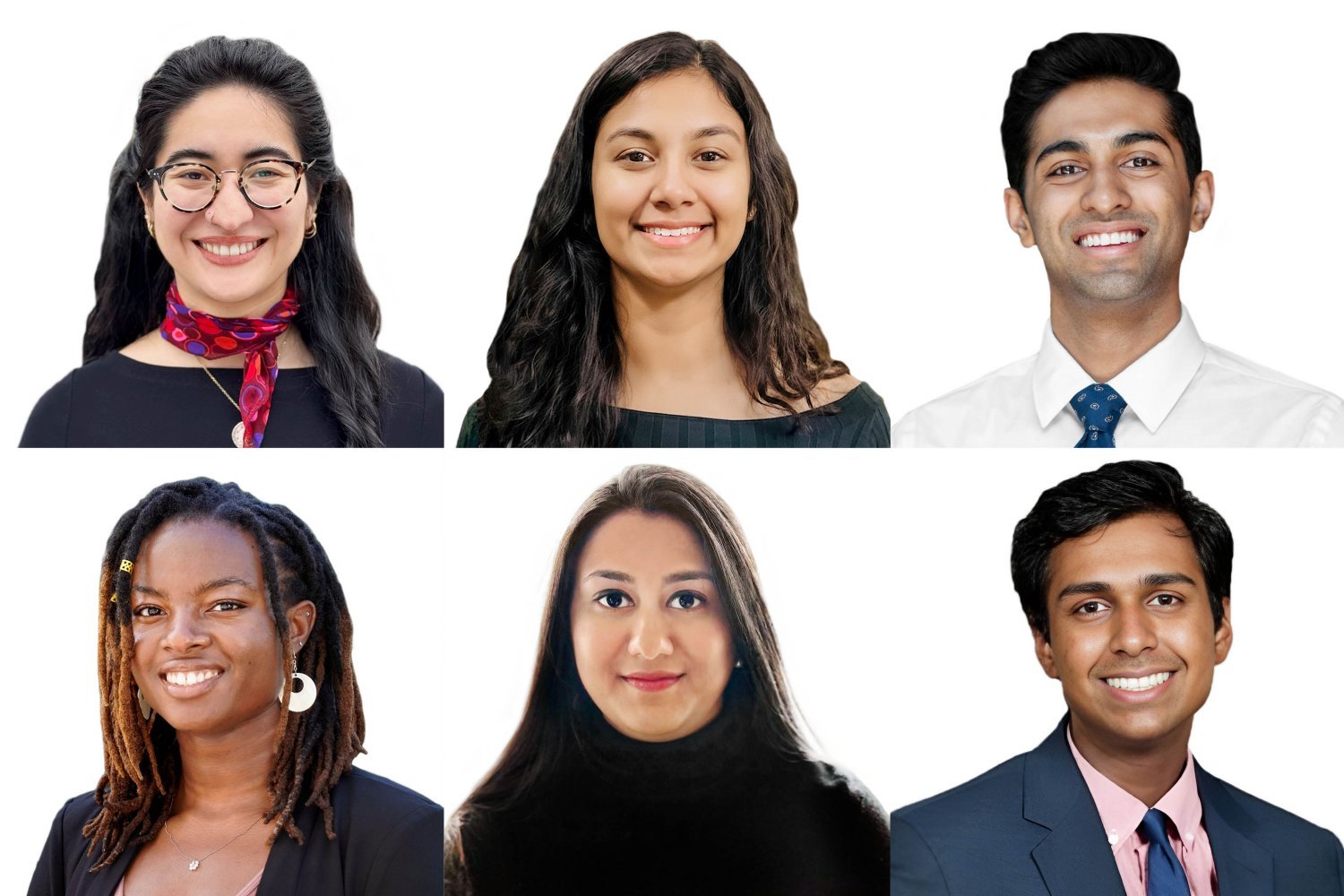
Six MIT affiliates — Denisse Córdova Carrizales SM ’26; Ria Das ’21, MNG ’22; Ronak Desai; Stacy Godfreey-Igwe ’22; Arya Rao; and Ananthan Sadagopan ’24 — have been named 2026 P.D. Soros Fellows. In addition, P.D. Soros Fellow Avinash Vadali will begin a PhD in condensed-matter physics at MIT this fall.
The fellowship provides immigrants and the children of immigrants up to $90,000 in tuition and stipend support for up to two years of graduate studies. Interested students should contact Kim Benard, associate dean of distinguished fellowships in Career Advising and Professional Development.
Denisse Córdova Carrizales
Córdova Carrizales SM ’26 is a PhD student in nuclear science and engineering in the lab of Professor Mingda Li, where she completed her master’s work earlier this year. She is working on synthesizing and characterizing quantum materials with the goal of bridging fundamental science and industry to make our technology more energy-efficient and sustainable.
Córdova Carrizales, who is of Mexican descent, grew up in Houston, Texas, before attending Harvard University, where she graduated in 2023 with a BA in physics. At Harvard, she dove into experimental condensed-matter research. She also conducted research with the Princeton Plasma Physics Laboratory, Commonwealth Fusion Systems, and VEIR, spanning computational plasma physics and high-temperature superconducting magnet and cable engineering.
Her work includes coauthored papers in Nature Physics, Nature Materials, and Advanced Materials, as well as lead-author publications in Nano Letters and Physical Review Materials. In 2023, she received the LeRoy Apker Award from the American Physical Society.
Beyond research, Córdova Carrizales has advocated in Congress for nuclear disarmament and risk reduction and has written a piece on the nuclear stockpile stewardship program. At Harvard, she founded an organization to support first-generation college students studying physics. In a completely different arena, she performed as the lead in an off-Broadway show in New York.
Ria Das
Das ’21, MNG ’22 is a PhD student in the MIT Department of Electrical Engineering and Computer Science. She graduated from MIT in 2021 with a BS dual degree in mathematics along with electrical engineering and computer science, and received her master of engineering degree in 2022.
The daughter of Indian immigrant parents, Das grew up in Nashua, New Hampshire, where she struggled with issues of belonging and identity. These questions came to the forefront during her PhD studies at Stanford University. Das decided to step off the academic treadmill by taking a leave from her PhD to think more deeply about these topics.
During her leave, she traveled around the country before moving to New York to work at Basis Research Institute, an AI research nonprofit. As a research associate, Das developed an urban data team that worked with federal and municipal government agencies on issues of economic and housing equity, blending her interests in science and social problems. She then returned to MIT to complete her doctoral studies.
Today, Das works with Professor Joshua Tenenbaum in the Department of Brain and Cognitive Sciences to study how people undergo conceptual change to build more robust, accessible systems for automated (social) science and improved educational design. Looking ahead, she hopes to become a professor, collaborating closely with policy practitioners.
Ronak Desai
Desai is currently a student in the Harvard/MIT MD-PhD program, where his PhD focuses on chemistry. The son of immigrants from Gujarat, India, Desai was born in Tyler, Texas, and grew up in nearby Lindale. He earned his undergraduate degree at the University of Texas at Austin.
Desai spent a semester interning at the U.S. House of Representatives as a Bill Archer Fellow. He also completed biomedical research focused on studying and engineering novel polyketide synthases, aspiring to produce next-generation antibiotics by harnessing such newly engineered synthases.
Desai graduated with degrees in chemistry and biochemistry as a first-generation college student, Health Science Scholar, and Dean’s Honored Graduate, receiving nine scholarships throughout college. His research has resulted in publications in journals such as Cell and Nature Communications.
Desai hopes to combine his passions for medicine, science, and public policy in his career to advance the treatment of infectious diseases. He is conducting his doctoral research under Professor James J. Collins in the MIT Department of Biological Engineering and the Harvard-MIT Program in Health Sciences and Technology. Desai’s research centers on using artificial intelligence to discover and design novel antibiotics, an opportunity to advance treatments for patients worldwide.
Stacy Godfreey-Igwe
Godfreey-Igwe ’22 attended MIT as a QuestBridge and Gates Scholar, graduating in 2022 with a BS in mechanical engineering and a concentration in sustainable design. A Burchard Scholar, she also became the first student at MIT to complete a major in African and African diaspora studies. After graduating, she pursued a science policy fellowship in Washington and interned at the U.S. Department of Energy’s Building Technologies Office, where she worked to broaden adoption of heat pump technologies across diverse stakeholders.
Growing up in Richardson, Texas, as the daughter of Nigerian immigrants, Godfreey-Igwe developed an early awareness of structural inequality, particularly in how families like hers managed the burden of the severe Texas heat and high electricity costs. These experiences formed the basis of her lifelong journey seeking to address systemic inequities embedded in everyday systems.
Godfreey-Igwe is currently a doctoral student in the joint engineering and public policy – civil and environmental engineering program at Carnegie Mellon University (CMU), where she was selected for the inaugural CMU Rales Fellowship cohort. At CMU, she studies the impact of extreme heat on household energy use, particularly in vulnerable communities.
Beyond her research, Godfreey-Igwe organizes outreach and programming for local underrepresented students in STEM and participates in institutional efforts to expand access and belonging among graduate students. She aims to be a scholar and advocate whose work, drawing on her personal experiences, informs equitable energy solutions in a warming world.
Arya Rao
Rao is a student in the Harvard/MIT MD-PhD program. She completed her undergraduate degrees in biochemistry and computer science at Columbia University. Working with professors Pardis Sabeti (Harvard University) and Sangeeta Bhatia (MIT), Rao uses evolution as a lens for therapeutic design, developing artificial intelligence methods that read the genetic record and guide new intervention strategies.
Leveraging her dual training in medicine and computer science, Rao also leads the MESH AI Research Group at Mass General Brigham, where she develops simulation-based tools that test clinical AI systems in realistic educational settings before they reach patients.
Rao has been recognized for her work with a Forbes 30 Under 30 honor, the Massachusetts Medical Society Information Technology Award, the Harvard Presidential Public Service Fellowship, a Harvard Medical School Dean’s Innovation Award, and a Ladders to Cures Accelerator Award. She has published more than 30 manuscripts in publications including JAMA, Nature, and NEJM AI.
Growing up in rural northern Michigan, Rao was inspired by her parents, Konkani immigrants from India, who served as two of the area’s only physicians. She has always imagined a career that could leverage scientific innovation to improve patient care, especially for communities without access like her own. Going forward, she envisions a career as a surgeon-scientist that keeps her close to patients while taking on leadership that shapes how new technologies are evaluated, implemented, and made usable in the places that need them most.
Ananthan Sadagopan
Sadagopan ’24 grew up in Westborough, Massachusetts, as the child of immigrants from Chennai, India. He participated in chemistry competitions, winning the You Be the Chemist Challenge in middle school and earning a gold medal at the International Chemistry Olympiad for the United States in high school. He attended MIT for college, graduating in three years in 2024 with a bachelor’s degree in chemistry and biology.
At MIT, Sadagopan worked with Srinivas Viswanathan on computational biology projects and with William Gibson, Matthew Meyerson, and Stuart Schreiber on chemical biology projects. He led projects characterizing somatic perturbations of X chromosome inactivation in cancer, developing a machine-learning tool for cancer dependency prediction, using small molecules to relocalize proteins in cells, and creating a generalizable strategy to drug the most mutated gene in cancer, TP53. Sadagopan’s work has been patented and published in journals such as Cell and Nature Chemical Biology.
Sadogopan was president of the chemistry undergraduate association and led the events committee for MIT Science Olympiad. He is currently pursuing a PhD in biological and biomedical science at Harvard University as a Hertz Fellow and Herchel Smith Fellow. He is interested in de-risking new therapeutic strategies and hopes that his work will inspire pharma companies to bring first-in-class therapies to patients.



