
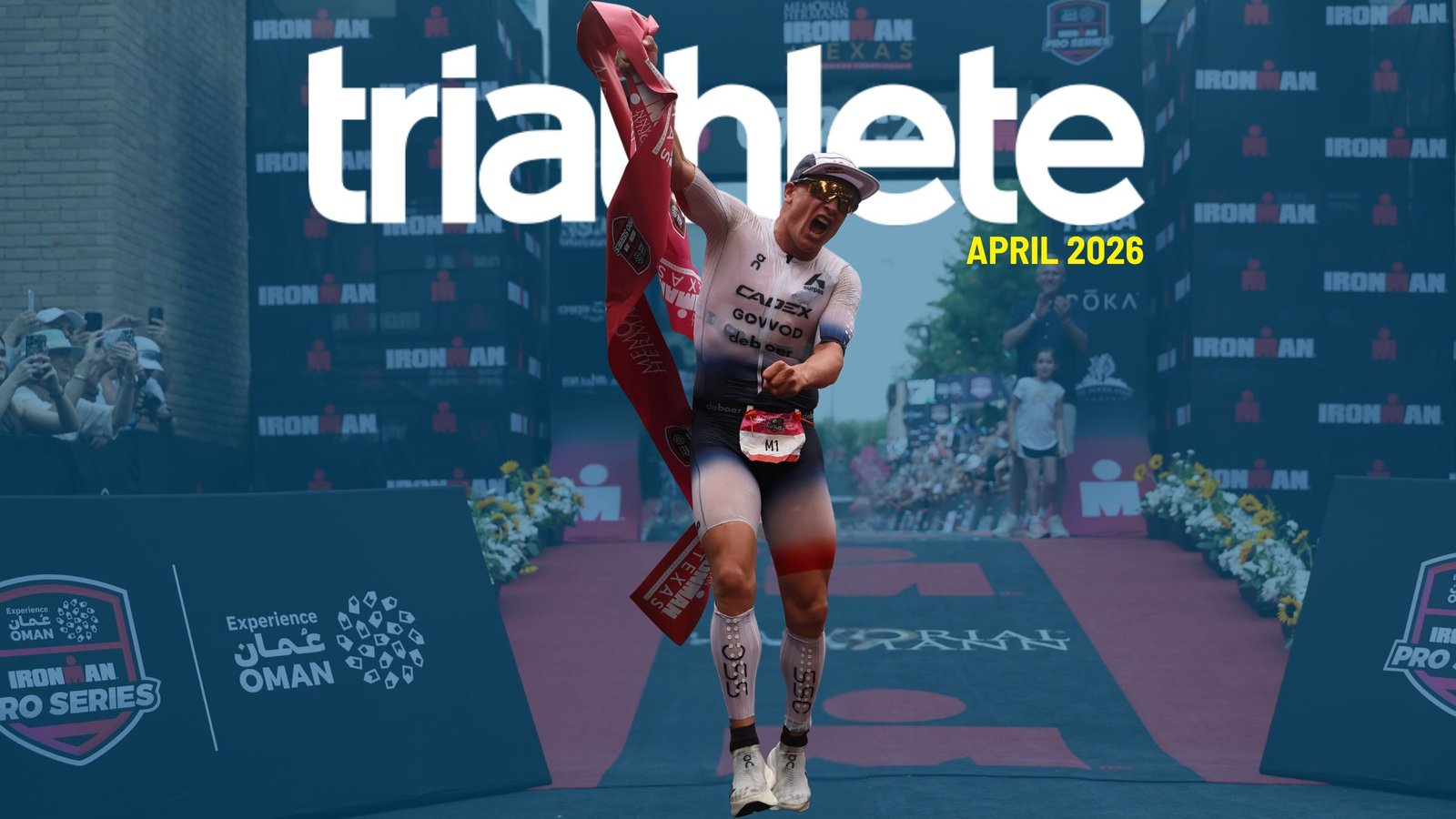
Are Europeans faster? Is triathlon too expensive? What really saves you on race day? Columnist Tim Heming dives into the tri topics we were all talking about in April 2026.
April 2026 brought quite a bit of interesting triathlon news. Tim Heming breaks it down. (Photo: Tim Warner/Ironman)
Updated April 30, 2026 11:26AM
April was a whirlwind of triathlon news, showcasing both the incredible speed of elite endurance athletes and the gritty, often-overlooked details of our sport. We saw exceptionally fast times at Ironman Texas and the kickoff of the 2026 World Triathlon Championship Series (finally!), delivering two inspiring tales of perseverance in a far-flung corner of Uzbekistan.
And just to keep us on our toes, a local mayor decided to throw the 70.3 World Championship into chaos. From the debate over the world’s fastest Ironman courses to the simple, cheap gear hacks that can save your race, columnist Tim Heming dives into all the news and essential takeaways from the month of April.
Jonny Brownlee to Take on Epic Triathlon Challenge

Three-time Olympic medalist Jonny Brownlee is going to take on the Weekend Warrior challenge at Supertri’s Blenheim Palace triathlon on the first weekend of June this year.
It consists of six continuous sprint distance triathlons on Saturday, followed by four on Sunday to give a total distance covered of 8,200 yards (7,500m) swimming, 123 miles (198km) cycling, and 33.6 miles (54km) of running.
The younger of the Brownlee brothers hasn’t yet been able to transfer his short-course palmares to the longer stuff, and is taking a novel approach to build the diesel engine required. If he completes all 10 sprint triathlons within the time allowed, he’ll set a new record for the Weekend Warrior discipline.
He’s already said it might be the “hardest thing” he’ll ever do, and it’ll be interesting to see the approach he takes.
Transitions could be the toughest part, especially if the kit is limited to just one wetsuit, trisuit, and a pair of run shoes.
The location is fitting, as Blenheim Palace is the birthplace and ancestral home of Britain’s wartime prime minister, Winston Churchill. If the going gets tough, Jonny can be reminded of Churchill’s maxim: “If you’re going through hell, keep going.”
2026 World Triathlon Championship Season Kicks Off in Samarkand

World Triathlon’s World Triathlon Championship Series – a mouthful that looks likely to be reduced dramatically to just three letters, T50, by next year – is the premier short-course series in the sport.
WTCS is most influential in Olympic qualification, which, for LA28, starts imminently. It also belatedly got underway last weekend (after the Middle East conflict forced the postponement of the Abu Dhabi curtain raiser) in Samarkand, which is in southwest Uzbekistan, and surrounded by almost all the other ‘Stans.
There were two tales of perseverance in the elite races.
First, despite Olympic champion Cassandre Beaugrand (FRA) not starting due to illness, the women’s race was stuffed with leading contenders, but Britain’s Beth Potter, who had diligently been rehabbing from injury, including a stress fracture, and subsequently said her support team had more faith in her than she did, won out.
In contrast, the men’s race had no Hayden Wilde, Alex Yee, or reigning champion Matt Hauser, but the stage was instead set for Portugal’s Vasco Vilaca to finally, after nine podiums, break his series duck. Vilaca moved to Sweden with his family at age 13, and has been building year on year, including a fifth-place finish at the Paris Olympics in 2024, to become one of the best all-round triathletes in the world.
70.3 Worlds in Jeopardy?

Eric Ciotti, the newly elected mayor of Nice, France, looked to put the skids on the 2026 Ironman 70.3 World Championship by saying the city would pull the budget on the two-day event.
Ciotti won the mayoral vote on a manifesto of spending cuts and tax reductions for residents to bring an end to what he lambasted as a “pharaonic” approach to spending.
Ironman’s response was to try to pacify any discontent by confirming that this edition will go ahead as planned.
The 2028 race looks more uncertain, however, as does Ironman’s Côte d’Azur future in general, with both Ironman France and Ironman 70.3 Nice also taking place there.
Sub-2 Marathon, Sub-7:22 Ironman Bring Awe, Cynicism

The big story in endurance sport this month and (perhaps year) will be Sabastian Sawe becoming the first human to run under 2 hours for the marathon (in a real race).
How times change. The best endurance athletes now appear to be consuming more carbs every hour than their shoes weigh.
Plenty are agog. Some of us are disbelieving that such rapid footspeed could be produced for 26.2 miles when us mere mortals couldn’t deliver it for one lap of the track. Others disbelieve because they know the history of endurance sport (see the disgraced Ruth Chepngetich for a recent example).
I was fortunate enough to be roadside at mile six on a historic day in London to see the front men’s pack, including Ethiopia’s Yomif Kejelcha – who became the Buzz Aldrin to Sawe’s Neil Armstrong, or John Landy to Sawe’s Roger Bannister (look it up) – fly past, and surrounded by pacers, looking mighty comfortable.
On a sunny morning and a course that isn’t considered a main contender for world records, there was no indication of the seismic feat that was to follow.
But even at this early part of the race, it was notable how much farther the group, paced by Olympic triathlon champion Alex Yee, who went through the halfway point in 62 minutes, was behind. We think of Yee as the Rolls-Royce of triathlon running. He is. He is also the second fastest British marathoner of all-time, thanks to a 2:06:38 in Valencia last fall. Yet the context is that this time leaves him a mile-and-a-half down the road from Sawe.
I was still on course when I received a text signifying the feat: “Wow! Have you seen the result?” I say we can be wowed by the result, but retain some cynicism.
Yes, Sawe underwent 25 out-of-competition drug tests in the two months before winning last year’s Berlin Marathon. Chepngetich also passed multiple tests before setting a world record in Chicago in 2024. Sawe’s coach is Italian Claudio Berardelli, who has coached now-banned athletes, including three-time Boston Marathon winner Rita Jeptoo.
But while digesting the facts and taking your own view, I encourage you to remember that the London race day on Sunday was a heady cocktail for fast times. Kejelcha finished in 1:59:41, but Ugandan Jacob Kiplimo ran 2:00:28, Kenya’s Amos Kipruto 2:01:39, and Ethiopia’s Tamirat Tola 02:02:50.
Plus, on the women’s side, Tigst Assefa of Ethiopia (2:15:41) broke the women-only race world record, and both Kenyan’s Hellen Obiri (2:15:53) and Joyciline Jepkosgei (2:15:55) finished within a few seconds of the winner.
It’s a parallel to be drawn with the previous week’s entertainment at Ironman Texas, where we also had times that seem ludicrously fast. Comparing winner Kristian Blummenfelt’s 2:30:47 marathon against Sawe’s after the Norwegian swam 2.4 miles and cycled 112 miles is a fool’s errand, but the constant was a highly competitive elite field on what proved to be an exceptionally fast day. Blummenfelt just missed the Ironman best-ever time with his 7:21:24, but six men clocked under 7:30, 15 men under 7:40, and 25 men under 8 hours.
On the women’s side, reigning Ironman World Champion Solveig Lovseth and Taylor Knibb were the standouts, but another six women also broke nine hours.
We can be cynical, but unless we’re going to be the über cynic and believe everyone is a cheat, then we should acknowledge that weekends like the previous two, with competitive fields, ideal conditions, and a race well and truly breaking out, can happen and are worth celebrating.
The 5 Fastest Ironman Courses in the World Unveiled

Want to know the fastest Ironman course for a PR? Don’t just use last year’s data – Mother Nature has a notorious influence. Instead, tri statistician Russell Cox uses a decade of race data in his piece on the 5 Fastest Ironman Races in the World. I won’t spoil it for you before you click, but a top tip for new PR might be to plan a European vacation this summer.
That said, at risk of alienating most of the readership (or undermining Cox’s fine work), there’s one variable that sticks out.
I’ll put this bluntly: Perhaps the Europeans are just faster.
The Tri Gear That Actually Matters

Triathletes naturally focus on all the big (expensive) things, like buying a new bike, while neglecting the smallest (inexpensive) things that can ruin race day: a worn and broken cleat, an undetected thorn working its way through the tire, chafing after forgetting to lube up, or (as a pal did recently) popping caffeine pills in a panic prior to the start and spending half the day in the porta-potty.
Added to that list should be leaky or foggy goggles. Jon Dorn’s gear testing piece on anti-fog sprays does the work to break down the most effective products. Yes, practice your sighting – crocodile eyes above the water and all that good stuff – but keep the focus on the focus, so it’s not a frustratingly long start to your day.
Want a few more easy (and cheap) hacks for race-day? Emma-Kate Lidbury is on hand with 7 time-saving gems.
Is the Expensive Triathlon Model Broken? One Promoter Says Yes

Perhaps tri doesn’t have to be that expensive. In April, I caught up with Thom Richmond of Cal Tri events, who is on a mission to promote the low-cost, short-course option across the USA.
Richmond is a critic of the current USAT-permitted model, which he sees as unnecessarily inflating costs for athletes, and our profile explains what he does differently, including late-in-the-day refunds, rewarding loyalty, and a unique view on applying the rules.
As usual with tri matters, there’s a lot of nuance – while Richmond is recording record growth in his events, low-cost, longer course options appear to be failing, as Brittany Vermeer found out in her report.
The Value of Beginner Tri Communities

“Create space where it’s OK to be a beginner” is a subheader in Alison Feeman’s report on triathlete communities. Amen to that.
I won’t reel off the full list of what triathlon communities bring to the sport, but I will take this chance to underline that clubs should mandate a sense of fun.
As hosts, what kind of introduction are we giving the newbie to triathlon? Is the communication, sessions, and support all on point, and are they having a good time?
It’s a puzzle to unpick, particularly in multisport.
I think of my local club: We have a former national-level swimmer who finds running daunting because of repeated lower-leg injuries, and a close to four-minute miler who is learning to swim. The diversity of clubs serves as a powerful reminder that confidence and competency in one area do not automatically transfer everywhere else. At some point, we’re all beginners. Let’s not forget that.
The Most-Read Triathlete Articles of April 2026
- The World’s 12 Most Beautiful Swimming Pools (That Make You Actually Want to Swim)
- Our Data Expert Crunched 10 Years of Age-Group Finish Times. Here’s What He Learned.
- 13 Bucket-List Triathlons That’ll Change Your Life
- The Best Triathlon Goggles of 2026, Tested and Reviewed
- FTP is Setting You Up for Race Day Failure. Here’s the Metric That Matters.
- The 6 Best Triathlon Wetsuits of 2026
- The Best Ironman and 70.3 Races for Your Swim, Bike, and Run Strengths
- Why 20 Minutes of Focused Intervals Beats a 2-Hour Junk Ride Every Time
- This “Power Meter for the Pool” Improved My Stroke Efficiency 10%
- Swim, Bike, or Run: Which Sport Determines Who Will Win a Triathlon?



