
Published April 28, 2026 06:00AM
When I started training for triathlons 15 years ago, I’d never participated in an organized swim practice, worn fins, or witnessed any of the culture’s, er … eclectic habits. So imagine my surprise when the guy in a teeny-weenie Speedo started spitting into his goggles. Not polite little ptooeys, but great big throat-clearing loogies. Hmm, I thought, this is going to be interesting.
I soon learned that goggle expectoration is far from unusual – just one of the tactics desperate swimmers employ to keep their lenses clear. Some swear by baby shampoo, others by toothpaste, shaving cream, dish soap, and even hand sanitizer. At my pool, most of the athletes buy anti-fog sprays or wipes. But when I asked for advice on top brands and best practices, they all shrugged their shoulders. No one really had a confident opinion.
Which is why Triathlete assigned me the important task of testing anti-fog treatments. There’s a dearth of reliable performance data out there to guide shopping decisions. In fact, we scoured the interweb for signs of actual comparative testing – and couldn’t find anything legit.
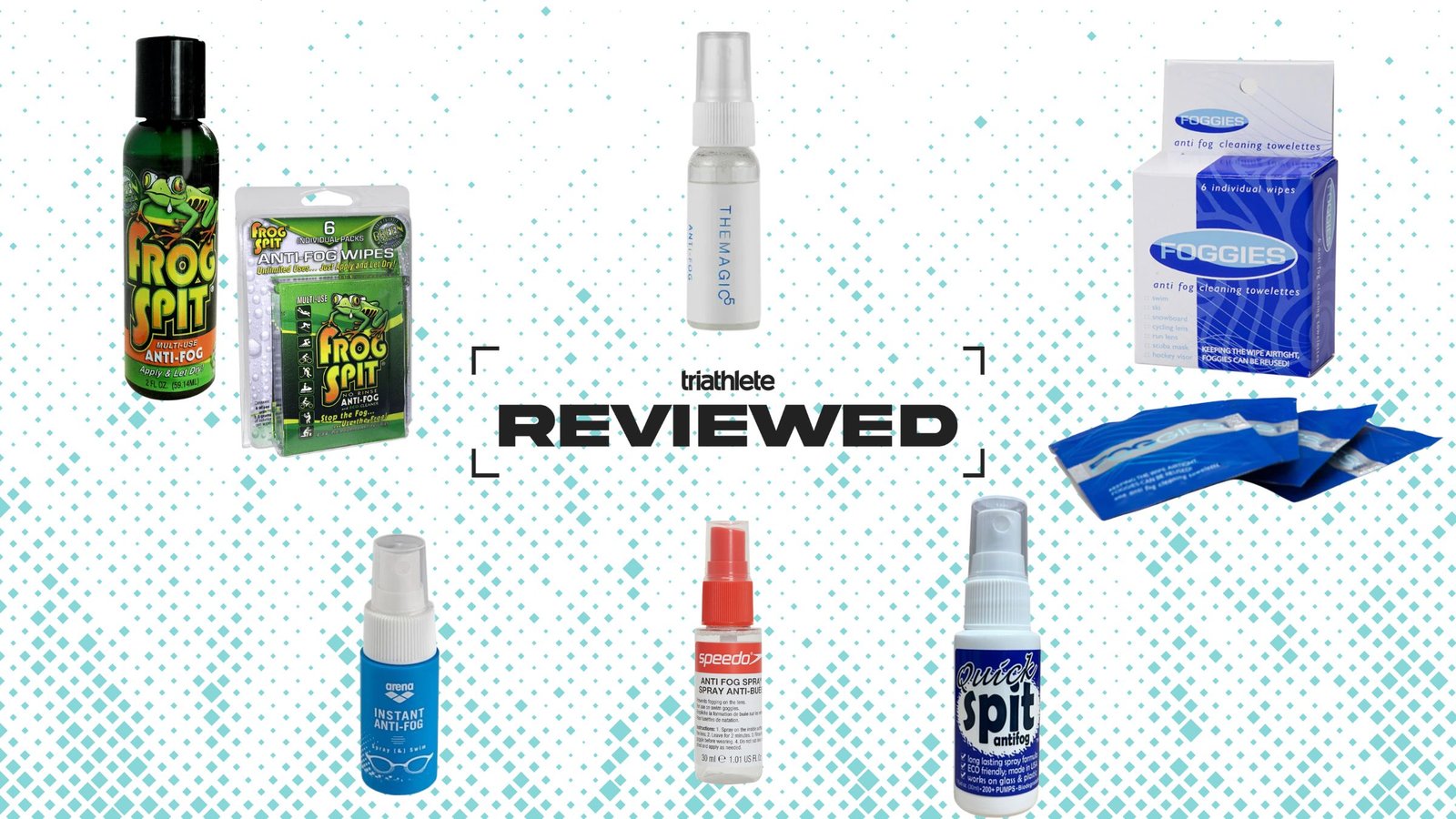
With this weighty task on my plate, I secured samples of seven leading anti-fog products regularly marketed to swimmers and triathletes (and bought one bottle of baby shampoo). Then, as detailed below, I put each treatment through five cycles of condensation testing.
Anti-fog products at a glance
Why your swim goggles get foggy
For those of you who fell asleep in 10th-grade physics, here’s a remedial lesson in goggle thermodynamics, simplified to four steps. (Want to go deeper? Check out this interview.)
Step one: You put on goggles while standing on a deck or shoreline where the ambient temperature is probably 70 degrees F or warmer. The lenses and gaskets trap a small volume of 98.6℉ air, as well as the perspiration vapor that naturally emanates from your eyes and skin.
Step two: You jump into water that may be as cold as 50 degrees F. Even in warmer water, there’s still a sizable gap between the temperature and humidity of the air inside your goggles versus the conditions outside.
Step three: The differential between the cooler outside temperatures and the warmer inside temperatures causes the perspiration vapor to begin condensing.
Step four: The tiny drops of condensation cluster in groups, creating the foggy conditions. Blurriness is then made worse by the diffraction of light through the drops, which distorts vision and can lead to glare in bright ocean settings.
Swimmers often make things worse by rubbing the lenses with a finger, using soap to clean them, and wiping them with a cloth. These actions will all accelerate the breakdown of the hydrophilic coating that comes on all new goggles. This reduces their effectiveness, potentially leading to fogging after a few weeks of steady swimming instead of the usual several months.
Best practice: Rinse and dry your goggles in tap water after a swim, try not to touch the lenses with your fingers, and store them in their original case or bag to keep them free from dust and oils.
Best Triathlon Goggles of 2026: Testers swam nearly 100,000 yards to evaluate leading models in our recent roundup, including a pair with outstanding integrated anti-fog properties.
How anti-fog goggle treatments work
The factory-applied and after-market coatings that we rely on for crystal-clear vision underwater are chemicals known as surfactants. Their active ingredients may include exotic-sounding compounds such as propylene glycol butyl ether, fluorocaliphatic oxyethylene, magnesium lauryl sulfate, cocamidopropyl betaine, decyl glucoside, sodium cocoyl isethionate that are derived from organic sources (such as coconut) or inorganic emulsions (such as silicon). While these chemicals are widely used in shampoos, detergents, and other household products, they can cause irritation for people with sensitive skin, so it’s wise to review the ingredients if you have a condition such as contact dermatitis. And it should go without saying, but never spray them in your eyes.
To prevent fog, these compounds form a hydrophilic (water-loving) film on your lenses that prompts those tiny beads of condensation to merge and spread out in a clear layer rather than developing into separate clusters of droplets.
When it’s time to apply an after-market treatment
Even with careful maintenance, goggles might develop condensation problems after only a few dozen swims. But the first sign of fog is not necessarily an indication that you need to buy an anti-fog spray or wipe. In our experience, all goggles – even brand-new ones – are susceptible to fogging in the first few minutes of a swim, especially when you’re jumping into cold water on a warm day. The initial temperature differential causes this early fogginess and will often dissipate as the microclimate around your eyes reaches a better balance.
Instead, you’ll know it’s time to start treating your goggles when the lenses stay cloudy throughout a swim. This indicates that the factory coating has worn off and needs help.
How we tested anti-fog goggle products
Scoring goggle treatments in a pool would involve too many variables to produce fair and objective results. Outside air temperatures and humidity might change during the course of a swim, and the same thing is going to happen inside a pair of goggles. It would also be virtually impossible to repeat the exact amount of time the goggles spent under or above water from one lap and round of anti-fog treatment to the next.
To minimize these variables and create a more controlled testing environment, I set up a mini-laboratory in my kitchen. My goal was to follow an evaluation protocol that simulated the conditions that cause fogging (temperature differentials and humidity) and could be consistently and repeatedly applied to each product. The key components:
- Ambient temperature: Because condensation happens more readily when the water outside your lenses is cooler than the air inside, I set my house thermostat down to 70 degrees F, where it remained throughout testing.
- Heat and humidity: To mimic the thermal and moisture conditions inside your goggles, I needed to create a source of heat and humidity that could be kept at a steady temperature. To do this, I heated a pan of water on my stovetop until it was producing light steam (but not boiling), then monitored it continuously with a liquid thermometer.
- Goggle interface: To channel the heat and moisture directly into the lenses, I cut a goggle-shaped section out of a stiff plastic sheet that went on top of the pan like a lid. My test goggles fit snugly into the cutout, eye-side down, which trapped the warm, moist air and minimized leakage through the gaskets.
- Test goggles: Fog plagues lenses whose hydrophilic coatings have worn off, so I selected an old pair of goggles whose clear lenses would make condensation easier to spot.
With these pieces in place, I put each product through five testing cycles, completing a full round before moving to the next product. The process:
- Clean: To strip oils, dust, and any residual anti-fog treatment, I washed the lenses of my old goggles with dish soap.
- Apply: After the lenses dried, I applied the product according to the manufacturer’s instructions. That usually meant 1-2 squirts per lens for a spray, and one thorough wipe per lens for a towelette, followed by several minutes for the treatment to dry and cure.
- Test and observe: Placing the goggles in the lid, I used a stopwatch to time how long it took for condensation to appear.
- Repeat: Once condensation was visible, I removed the goggles from the lid, then rinsed and let them dry. Without cleaning the lenses or applying more anti-fog treatment, I then repeated the test four more times, recording the time-to-first-mist each time.
My goal was to evaluate two critical performance characteristics: the initial effectiveness of a treatment and its durability across multiple rinse cycles. Why did I stop at five cycles of testing per product? Because we know that many swimmers reapply anti-fog treatments every few swims once their goggles get old, and because manufacturers typically recommend reapplying them on a similar frequency. But more to the point, none of the products prevented fog for more than three cycles, making more cycles unnecessary.
The results of our anti-fog testing
Every treatment in the test succeeded at its most critical task: preventing fog from forming in the first cycle of testing after application. Each time, my lenses were completely clear after 10 minutes, a threshold that made me confident you could complete a workout or race without blurriness.
But performance varied after the first cycle, once I’d rinsed and air-dried the goggles. Most of the products were unable to prevent fog in their second cycle, which means you would need to reapply them every time you swim. The exception, and clear winner, was the Frog Spit Spray, which kept fog at bay through three full cycles. Its sibling, the Frog Spit Wipes, were nearly as effective, staying clear for two cycles and part of a third.
The best of the rest was the Foggies Towelettes, which stayed clear the longest in its second cycle. The remaining products – JAWS, Arena, Speedo, and TheMagic5 – followed in close order. Interestingly, baby shampoo (in a 5-to-1 shampoo-to-water solution) was neck-and-neck with these four.
In real-world conditions, the small time gaps between the runners-up are inconsequential enough that I’d recommend choosing between them based on price and availability. But that’s only after you try Frog Spit, my top pick and the best value (apart from baby shampoo) from a price-per-application perspective.
What makes our reviews different? Our testers actually use the thing. A lot. Learn more about Triathlete’s gear review process.



