
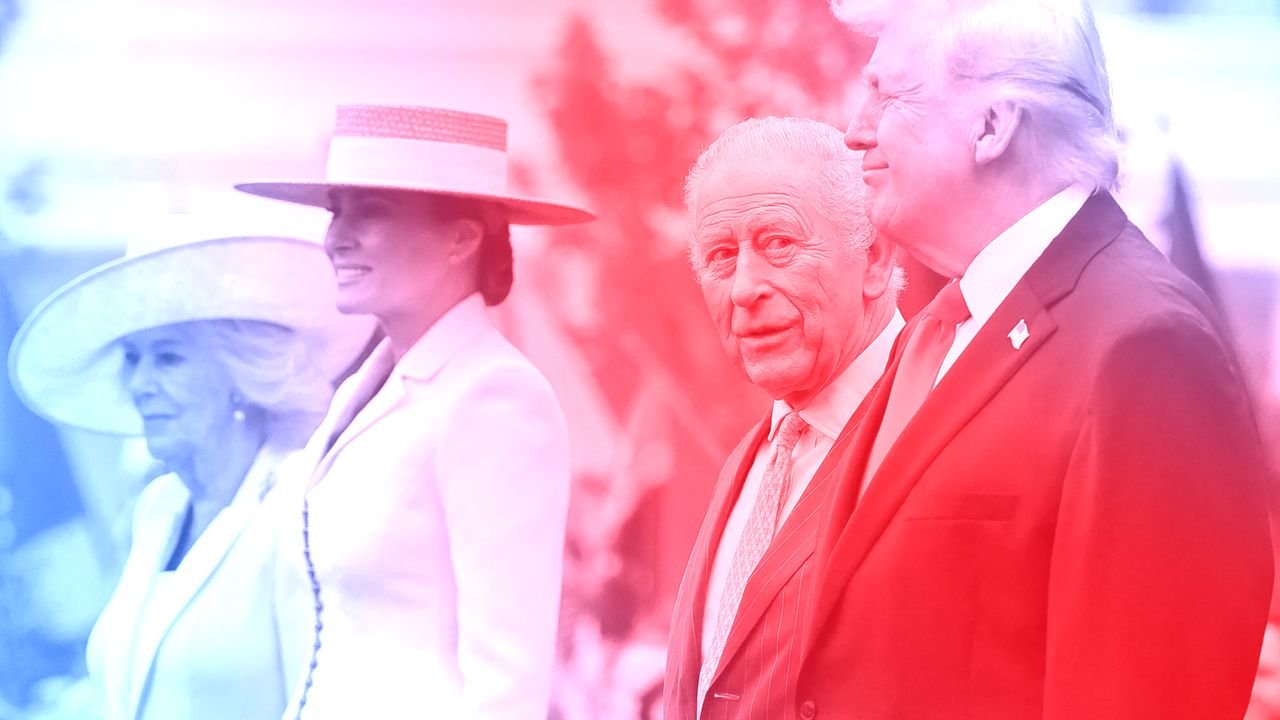
Trump spent the rest of the week proving Charles’s point about unchecked powers, with his Justice Department indicting the former F.B.I. director James Comey, for a social-media post of seashells—which prosecutors improbably claim constituted a threat on the President’s life—and his Federal Communications Commission ordering a review of the broadcast licenses for ABC stations just days after the comedian Jimmy Kimmel had used the network’s airwaves to make a joke that the First Lady did not like.
So here we are, two and a half centuries later, with a King who venerates the American Bill of Rights and a President who, increasingly, rejects it. It hardly seemed a coincidence that, on the same day as the King’s speech, reports emerged about the Trump State Department’s plans to honor America’s two-hundred-and-fiftieth anniversary with a commemorative passport whose distinguishing feature will be a large likeness of the President. Watching Trump and Charles together this week, I could not help but think of the bizarre contrast between the public modesty of the crowned monarch and the pomposity of the self-styled populist President; of these two, it’s not George III’s heir who is the one planning to erect golden statues of himself in his palaces.
The contrast between Charles and Trump was nowhere clearer than when it came to the King’s vision for America’s continued leadership in the world. In his speech, Charles, like every American President of my lifetime except Trump, hailed NATO as the foundation of our common defense. Then he exhorted Congress to defend “Ukraine and her most courageous people” with the “same unyielding resolve” that the United States has shown in fighting two world wars and other international threats to democracy over the past century. The times, he insisted, demand that America “ignore the clarion calls to become ever more inward-looking.”
Charles’s rousing case for U.S. support of Ukraine should hardly be necessary, given that majorities of Americans, four years after Russia’s unprovoked invasion, continue to sympathize with Ukraine, back military assistance to aid Kyiv in its fight, and blame Vladimir Putin for starting the war.
But, in recent weeks, Trump and senior Administration officials have made explicit what has long been clear from their actions—they are not on Ukraine’s side. Amid a new war of Trump’s choosing in Iran, the President, the Vice-President, and the Secretary of State have all made comments essentially walking away from the conflict in Europe. “Ukraine’s not our war,” Trump said in March, at a Cabinet meeting, when asked if weapons originally intended to help Kyiv would be redirected to the conflict in the Middle East. “We helped, but Ukraine is not our war.” A couple of weeks later, Marco Rubio, channelling Trump, said, “It’s not our war.” J. D. Vance, meanwhile, called cutting off U.S. funding for weapons going to Ukraine “one of the things I’m proudest that we’ve done in this Administration.”
These comments, as striking as they were in confirming a major international pivot by the United States, got little attention. They did, however, seem to prompt Ukraine’s President, Volodymyr Zelensky, to shift his own tactics. During an interview this week with the conservative American network Newsmax, rather than trying to paper over differences with the White House, as Zelensky tried to do when ambushed in the Oval Office by Trump and Vance a year ago, he publicly replied to the Vice-President: “If the Vice-President is proud that he’s not helping us, it means he’s helping Russians, and I’m not sure that it’s strengthening the United States.”
On Wednesday, Trump spoke on the phone with Putin about the wars in the Middle East and Europe. Although Russia has, according to intelligence officials, been aiding the Iranians with targeting information in their war with the U.S., Trump claimed that Putin would “like to be of help” in resolving the conflict. As for Ukraine, he told reporters that Putin “was ready to make a deal a while ago,” all but publicly blaming Zelensky, once again, for the continuation of the Russian invasion. A Russian readout of the call by Putin’s foreign-policy adviser, Yuri Ushakov, claimed that, in private, “Both President Putin and President Trump expressed essentially similar assessments of the behavior of the Kiev regime led by Zelensky, who—encouraged and supported by Europeans—is pursuing a policy of prolonging the conflict.”



