
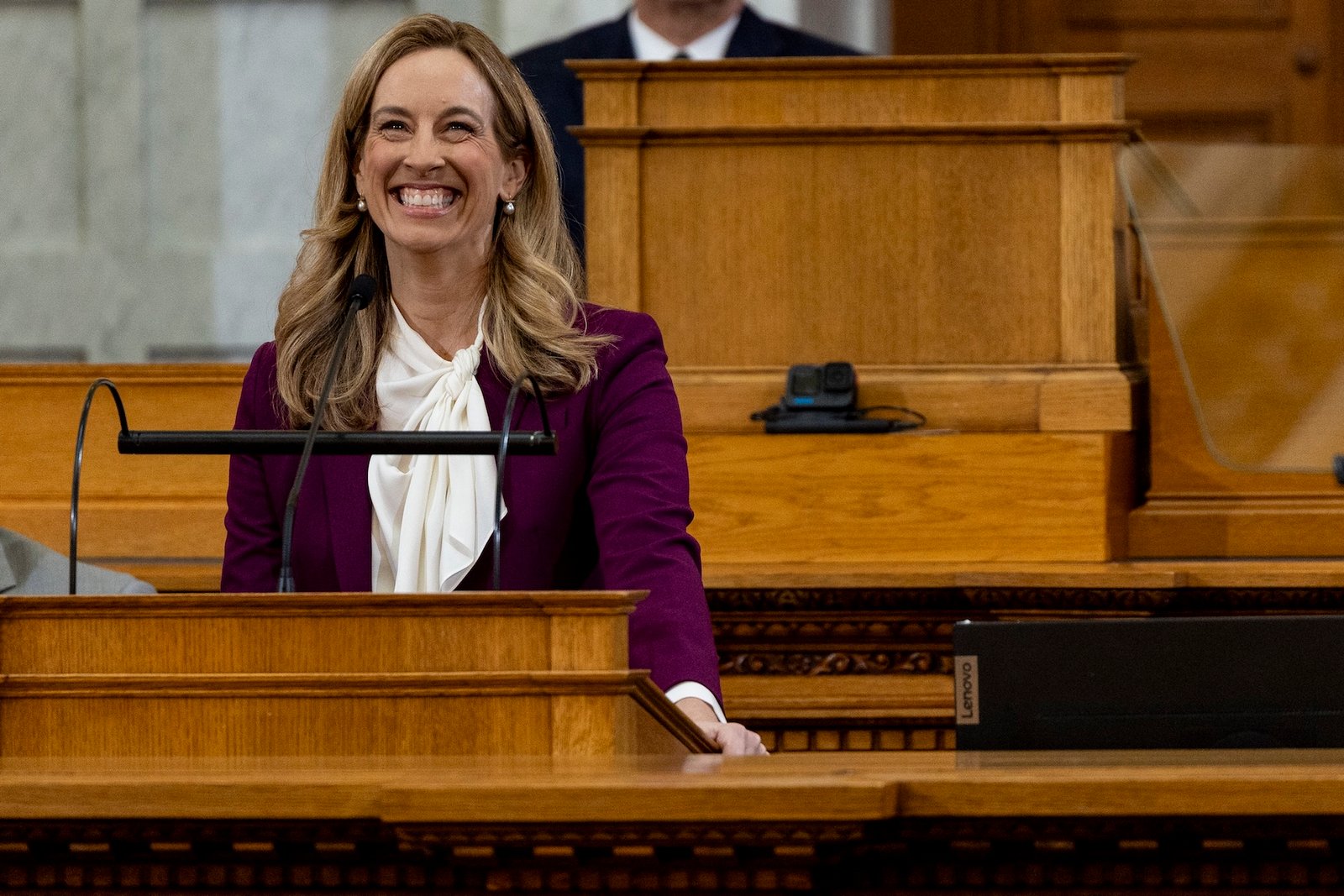
When a major snowstorm headed New Jersey’s way just days after Gov. Mikie Sherrill took office in January, she posted a video to social media urging residents to stay off the roads.
She then posted the same warning, this time speaking Spanish.
“Horas después de asumir el cargo de gobernadora, ya estaba aconsejando y hablando con líderes, agencias, y oficiales locales de todo el estado para asegurar que tengamos un plan,” she said, explaining that hours after becoming governor she began discussing storm response plans with local officials and agencies.
The Spanish-language outreach is part of a new effort by Sherrill to communicate more directly to members of the Latino and Hispanic community, which makes up the largest minority group in the state.
“This is a large part of our population, and I want to make sure that they both have the information and have the ability to engage with the administration on all the issues they want to bring forward,” Sherrill, a Democrat, told the New Jersey Monitor.
Sherrill started this kind of outreach when she campaigned for governor last year, and continued it after her inauguration. In addition to the videos she’s posted of herself speaking Spanish or offering Spanish translations of English-language announcements— about inclement weather, ICE raids, or the World Cup — Sherrill appointed a director of Hispanic media outreach, a first for the state.
Sherrill will also debut an “Ask the Governor” segment Friday on Spanish radio station WXNY 96.3 FM, and next week on Univision (she’ll continue the existing English-language segments on WNYC and News 12).
Sherrill, who graduated with a minor in Spanish from the U.S. Naval Academy, admits her Spanish is a bit rusty after not practicing for many years. But she says the Latino community appreciates her efforts, even when she asks them to speak “muy despacio, por favor” — “very slowly, please.”
“There’s something really nice about being able to communicate with people who are concerned, who need help from the government, even if they’re speaking to me and somebody’s next to me translating some of it. To actually be able to understand a lot of it in their own words is powerful,” she said.
New Jersey is home to one of the largest Latino populations in the country, and the demographic makes up nearly a quarter of the state’s 9 million residents. Roughly 18% of the state’s population speaks Spanish at home, according to census data.
Sherrill noted her Latino outreach comes at a time when the community is largely at odds with the White House over President Donald Trump’s mass deportation effort. Since taking office in January, Sherrill has sued the Trump administration over its plan to open an immigration detention center in Roxbury, launched a website for people to report harmful conduct by immigration agents, and signed a trio of laws aimed at protecting immigrants from deportation.
“It sent a really big signal to the Latino community in New Jersey, and that was a huge signal that she cares about this community. We understand that immigration affects much more than Latinos, but we are almost the face of immigration, so that she did that, it was very forceful,” said Assemblywoman Alixon Collazos-Gill (D-Essex).
Collazos-Gill, who was born in Colombia and moved to the United States at age 14, said she tries to speak Spanish as often as she can with her constituents because it can build trust and connection.
She said it allows Latinos to feel comfortable communicating with lawmakers about how what happens in Trenton affects them differently, whether it’s housing, healthcare, or public transit.
“It’s a good first step, because you open the door and say, ‘Hey, I am here, I’m trying to listen. I am listening and I am making the effort.’ And now we can have a much more open conversation in terms of policy,” she said.
Rep. Analilia Mejia, a Democrat who just won the special House election in the 11th District, often spoke Spanish on the campaign trail. Mejia, who is Colombian and Dominican, said Latinos take notice when lawmakers try to connect in their native tongue.
She recalled her dad, who understood English but was more comfortable speaking Spanish, and who was able to absorb more information when it was shared in his native language.
Mejia said speaking Spanish to voters helped her connect culturally with constituents in the 11th District, where about 1 in 5 people identify as Latino or Hispanic.
“It shows a level of respect and interest that I think will translate to greater support,” she said. “It’s not only the right thing to do in terms of connecting with your constituents, it’s politically smart.”
Mejia thinks expanding the “Ask the Governor” segment to Spanish media will translate into greater civic engagement.
“That benefits not only the individual candidate, but also our democracy,” she said. “People are receiving information in a way that they feel the most comfortable.”
Sherrill said her Spanish-language video updating people ahead of January’s storm outperformed the English version. Her team scripts the videos to ensure her grammar is correct, and sometimes she calls her Colombian brother-in-law Carlos for practice. She said it’s been refreshing to practice her Spanish.
“I’m pretty clear with people that my Spanish is a work in progress, if you will. So I think the community understands that and is just appreciative that we’re trying,” she added.
Marques Zarate is a political scientist at Brown University who has studied how candidates’ use of Spanish reaches Hispanic voters. He noted that Sherrill’s approach is historically unusual among non-Latino politicians, but it’s also effective and a “pleasant surprise.”
“Even if they have bad Spanish, that’s still something,” Zarate said. “They didn’t have to do that, and yet, they still made that effort.”
He pointed to another precedent, former New York City Mayor Michael Bloomberg, who delivered speeches in broken Spanish and sometimes faced public mockery, including a parody social media account called El Bloombito.
Zarate cautioned against the belief that English-speaking politicians are pandering to voters when they speak Spanish. What registers is the attempts to try, he said.
“Latinos don’t have a strong expectation that white candidates are going to be proficient, so I think amongst Latinos, it’s kind of signaling an ability and a willingness to represent them,” he said.
Previous governors have communicated with Spanish speakers largely through translated press releases and social media posts. Sherrill’s predecessor, Phil Murphy, rarely spoke Spanish publicly, and Chris Christie, a Republican, did not launch a Spanish-language campaign website until his second run for governor.
Sherrill said the shift was obvious after seeing the reception to her rusty Spanish in places like Perth Amboy and Hudson County. She said she wants to take more formal lessons eventually, and joked she’s behind on her Duolingo lessons.
“When and if things ever calm down for a minute, maybe I’ll start,” she said.
GET THE MORNING HEADLINES.



