
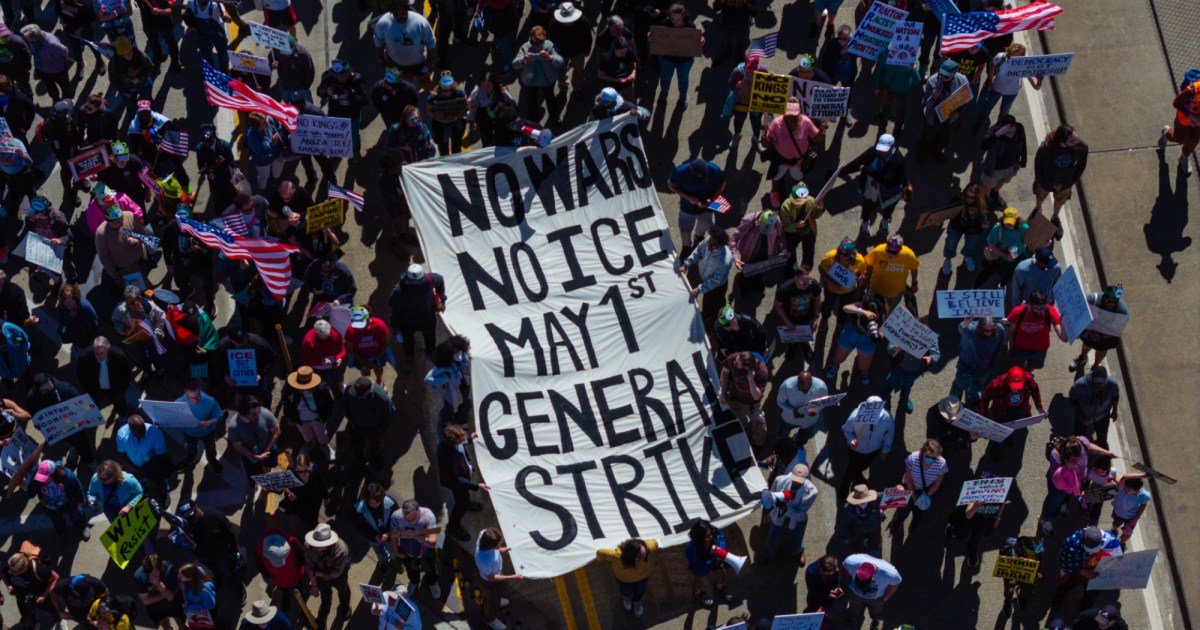
People hold a banner reading “No war, no ICE, May 1st general strike” as they march near the Georgia state Capitol building during the “No Kings” national day of protest in Atlanta, Georgia, on March 28, 2026.Elijah Nouvelage/AFP/Getty Images
After last month’s No Kings protest, Indivisible, the group that describes itself as a pro-democracy, anti-authoritarian people-powered movement, joined May Day Strong’s actions to take a page out of Minnesota’s one-day strike playbook from this past January.
On its surface, Indivisible’s participation appears to be a slight pivot, engaging in more disruptive labor-directed actions. But for Ezra Levin, the co-founder and co-executive director of Indivisible, May Day Strong is part of their movement—one that can’t succeed without growing its broad coalition. “Society cannot function without workers, and our political system won’t function unless more non-billionaires and non-mega corporations get involved in how politics works,” Levin told me when we spoke by phone on Thursday.
Politics feel brutal for most workers these days. It’s equally hard to measure the impact of protest groups like Indivisible. That’s especially true in a week where the Supreme Court dismantled voting rights and the Trump administration doubled down on its war in Iran despite rising costs and thousands of people killed. But Levin was, at times, evasive about looking too far in the future. For him, it’s impossible to measure the success of a pro-democracy movement on whether authoritarians are doing damage. It’s more useful to measure impact by how much a movement grows and tries new tactics.
This strategic alignment with May Day is an example. Levin was focused on building a coalition now—including opening the door for people who are not advocates or organizers. He also seemed clear-eyed about his group’s role: “Indivisible isn’t the right movement organization to organize the entire country. We are a piece of it.”
This interview has been lightly condensed and edited for clarity.
Where do you think Indivisible’s work stands within the larger US ecosystem of organizing?
I don’t think there’s a pathway to getting a real democracy that reflects the world of people that doesn’t depend on coalition. There’s not going to be any one organization or any one individual movement that succeeds in significantly changing our political system and bends it to the will of the people—you need to build across coalition.
For us, that’s core to just about everything Indivisible does. That shows up in the Hands Off coalition that came out a year ago. The Good Trouble Lives On [protests] on the John Lewis Day of Remembrance, and the No Kings coalition itself, which is made up of hundreds members.
May Day is not by Indivisible and it’s not led by the No Kings coalition. It’s being led by the May Day strong coalition with an emphasis on union participation. You’re not going to build a pro-democracy movement that’s successful without having heavy involvement from union leaders. You can’t succeed in what we’re trying to do without welcoming new members to your coalition and without showing up for them when they’re leading a day of action like tomorrow.
How are you measuring the impact of your work with No Kings, considering we’re in a week where the Supreme Court has fully gutted voting rights?
How you judge the success of a pro-democracy movement is with a couple of criteria: One, are you bigger than you were before? Two is, are you more aligned than you were before? Three is, is the authoritarian regime less popular than it was before? And four is, are your tactics proliferating? Are you trying new things? Are you developing new muscles?
We had three million people at the 1300 Hands Off protests last April. Then for the first No Kings, we had five million people at 2100 protests at the second No Kings. We had 7 million people at 2700, protests at the third No Kings. We had 3300 protests and more than 8 million people, which is to say three of the largest protests in all of American history are in ascending order.
The growth is pretty evident, and I don’t think it’s just us saying that. Some of the experts like Erica Chenoweth who are looking quantitatively at the scale of protests over the course of 2025 and into 2026. It dwarfs what we saw in 2017. The scale of mass mobilization and organizing is historic.
What are the challenges of growing No Kings?
The challenges in growing No Kings are the president repeatedly systematically using the powers of the presidency to go after his opponents. There are challenges of convincing people to care about politics. A lot of people believe that politics is bullshit, that both sides are corrupt, and that the whole system is broken and it’s not worth their time to get involved. That cynicism and nihilism and fatalism about the state of the country and our politics is the primary enemy that we have and the one that we have to slay. Indivisible isn’t the right movement organization to organize the entire country.
We are a piece of it. And if we’re doing our work to build a truly representative and powerful movement, we’ve got to be helping and showing up for other organizations, other movements, went into their time to lead, and I would be May Day tomorrow as an example that, like I said, it’s not an Indivisible action. This is being led by May Day Strong.
What do you think of larger disruption actions formed by coalitions over longer periods of time like the general strikes in India, Panama, and Italy? Do you think that is possible in the US?
In 2025, the regime was targeting the organization of America, which is straight out of [the playbook of] Hungary. One of the lessons of Orbán’s downfall is that the best way to remove an authoritarian is electorally, so it depends on building a mass movement.
When it comes to disruption, you don’t have to look abroad. You can look at the Twin Cities. The Day of Truth and Freedom was a mass disruption event and intended to bring society to a halt. And I think it was very successful. The federal government had to retreat because of the PR disaster as a direct result of the incredible organizing on the ground. If Trump tries to sabotage the midterm elections, you’re going to need something that looks like the Twin Cities but at the scale of something that looks like No Kings.
Going off what you brought up about disruption actions in the US, what do you think about tactics that try to get around restrictive US labor laws such as the proposed UAW strike in 2028?
I’m one battle at a time right now. There are a lot of questions about what happens in the Democratic primary, how we position ourselves in that race, and what happens if Trump runs again. These are all interesting questions that I look forward to digging into after we crush the regime in the midterms and elect some Democrats who are interested in using the powers of the Senate and the House to prevent the regime from doing more damage and bringing accountability to people who violated the Constitution. That is the single best thing we can do to set up democracy for a successful 2028.



