
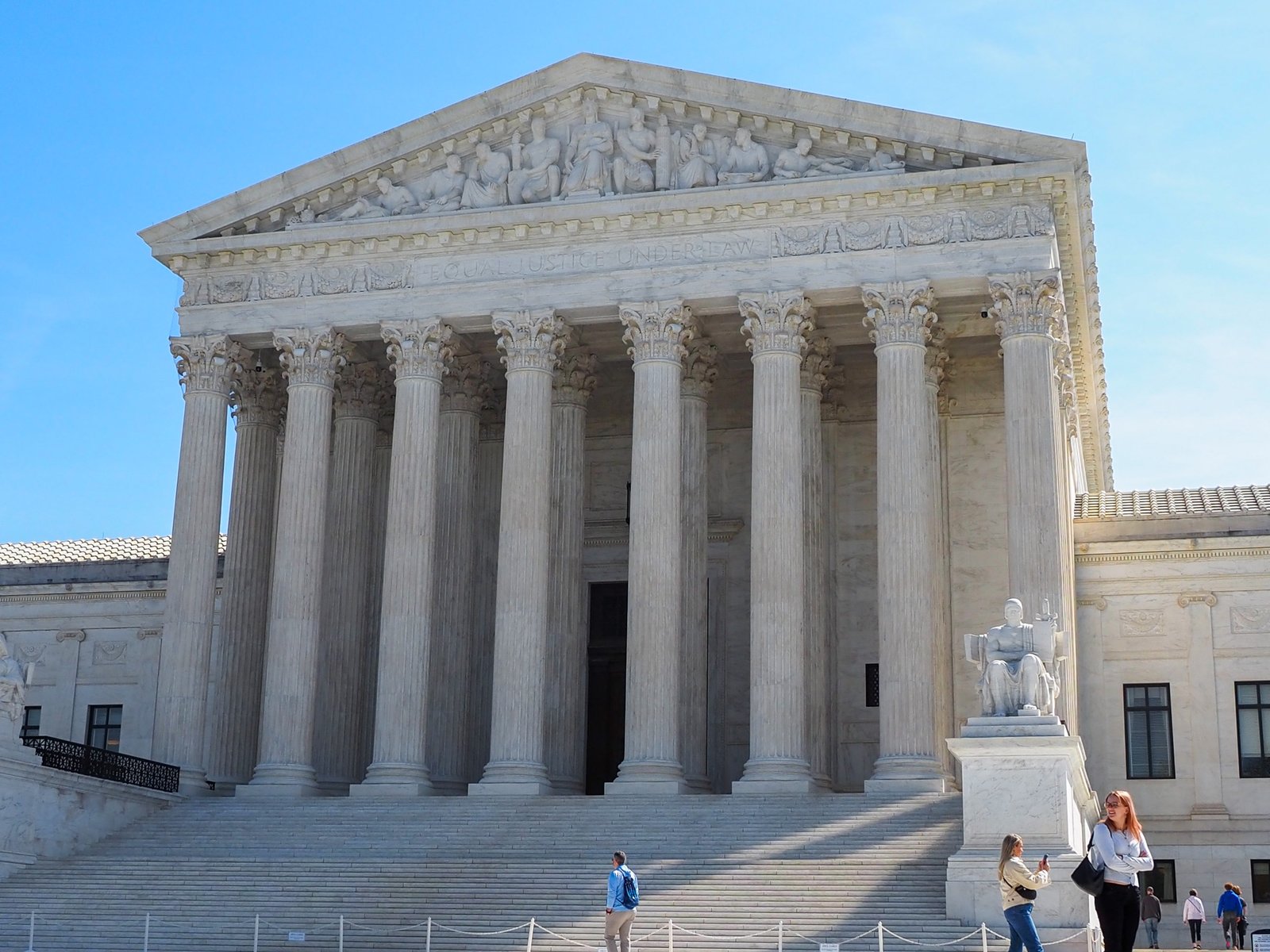
After the U.S. Supreme Court severely weakened the federal Voting Rights Act in an April 29 decision, a furious U.S. House Minority Leader Hakeem Jeffries condemned what he called an “illegitimate” conservative majority on the court.
“This isn’t even the Roberts Court,” Jeffries said, referring to Chief Justice John Roberts. “It’s the Trump Court.”
Democrats are renewing their calls to overhaul the Supreme Court in the wake of the court’s decision, which empowers states to gerrymander congressional maps in ways that will break apart districts where a majority of residents are Black, Hispanic or belong to other minority groups.
The momentous opinion overturned the reasoning behind decades of court cases that relied on the 1965 Voting Rights Act, a law born of efforts to stamp out Jim Crow voting laws in the South, to protect these majority-minority districts.
For years, critics of the court, where conservatives enjoy a 6-3 majority, have pushed for changes. Those efforts often center on expanding the size of the court to dilute the influence of the majority or imposing term limits on the justices, though other ideas, like narrowing the kinds of cases the court can consider, have also been discussed.
But the April 29 decision seems to be the last straw for some Democrats and progressives, though they are unlikely to be able to force any of the changes on their wishlist — at least for a long time.
After rulings in recent years that ended the federal right to an abortion and handed President Donald Trump sweeping immunity from criminal prosecution while in office, they are fed up with a court they view as unmoored from the law and ruling based on politics.
“We cannot protect voting rights, civil rights or the environment as long as we have a Supreme Court majority that is captured by MAGA authoritarians,” Doug Lindner, senior director of judiciary and democracy at the League of Conservation Voters, an environmental advocacy group, told reporters on Thursday. “We need to take back our Supreme Court.”
Any effort to impose significant changes at the court will encounter stiff Republican opposition. GOP lawmakers have praised the court’s latest decision and some see long-serving Justices Clarence Thomas and Samuel Alito as conservative icons. Unless Democrats win 60 seats in the Senate or eliminate the filibuster, Congress is highly unlikely to pass a major overhaul.
Republicans have denounced past proposals to change the court. After President Joe Biden proposed 18-year terms for justices and other changes in July 2024, U.S. House Speaker Mike Johnson said the plan “would tilt the balance of power and erode not only the rule of law, but the American people’s faith in our system of justice.”
No action under Biden
Supreme Court reform has long percolated as an issue among Democrats and progressives, but picked up steam during the 2020 presidential primary campaign.
The court’s ideological makeup had already moved toward conservatives after Justice Anthony Kennedy, often a swing vote on key decisions, retired in 2018 and was replaced by Justice Brett Kavanaugh, a conservative. Republicans then cemented a firm 6-3 majority on the court in the fall of 2020 after Justice Ruth Bader Ginsburg, a liberal, died and was replaced by conservative Justice Amy Coney Barrett.
Campaigning for president, then-candidate Biden voiced support for a presidential commission that would study court reform. After winning election, Biden named a blue ribbon panel of law professors, former judges and other lawyers, which issued a final report in December 2021.
The commission’s report stopped short of endorsing structural changes. It took no position on expanding the size of the court from nine members, citing “profound disagreement” among commission members over the idea. The commission also adopted no stance on term limits for justices.
The report was essentially put on a shelf — Biden made no serious effort to advance a court overhaul, though he later proposed some reforms after ending his campaign for reelection.
Public opinion dropping
Americans’ view of the Supreme Court has been falling. An August 2025 Pew Research Center survey found 48% of Americans hold a favorable view of the court, a 22-percentage point drop from August 2020.
A survey released in September 2025 by the Annenberg Public Policy Center at the University of Pennsylvania found 69% support for term limits but only 31% support for expanding the size of the court.
Eric J. Segall, a law professor at Georgia State University and the executive director of the Emmet J. Bondurant Center for Constitutional Law, Practice and Democracy, said past courts would have been responsive to the prospect of legislation, but the current court isn’t swayed by public opinion.
In some cases the court tries to preserve its legitimacy by giving the other side a win, Segall said, but in general the court’s decisions since 2018, when Kennedy retired, can be explained by viewing the court as a subset of the Republican Party.
“This court is defined by the Republican Party,” he said.
Segall has called for dividing the court evenly between conservative and liberal appointees. An evenly-split court would encourage greater compromise among the justices, he contends. He also supports expanding the court and term limits if possible. But he bluntly predicted court reform wouldn’t happen in his lifetime.
“If Democrats have the power to do it, they won’t do it,” Segall said.
Action unlikely, at least in short term
Jeffries, who will likely become U.S. House speaker if Democrats retake the chamber in the November midterm elections, said this week that “everything was on the table” in terms of the Supreme Court.
“In the new Congress, we’re going to have to do something about this Supreme Court,” Jeffries told the MeidasTouch Network.
Rep. John Rose, a Tennessee Republican, said on social media that Jeffries’ comments show that Democrats are preparing to “nuke the filibuster and pack the Supreme Court the second they’re back in power.”
Trump and some Republicans in Congress, convinced Democrats will end the filibuster to pass priorities like Supreme Court reform, want Republicans to end the filibuster first and enact a host of conservative priorities before the party potentially loses control of the Senate following the November elections.
But even if Democrats end the filibuster, the party faces a steep climb to changing the court unless it retakes control of Congress and the White House. That means any major overhaul almost certainly wouldn’t become law until at least 2029.
Trump’s response
Trump has had a turbulent relationship with the court but would be virtually certain to veto legislation remaking it while he remains in office.
While the justices have protected Trump and future presidents from criminal prosecution for actions taken as part of their presidential duties, they struck down his sweeping worldwide tariffs as illegal, dealing a major blow to one of his signature policies. They also refused to hear legal challenges that sought to overturn Trump’s 2020 election loss.
Still, Trump scoffed on Thursday at Democratic hopes to remake the court in the future. He accused the party of wanting 21 justices on the court (Democratic-sponsored plans in recent years have called for 13 or 15 justices). He also called Jeffries’ comments a “dangerous statement.”
“Hakeem Jeffries said the Supreme Court is illegitimate,” Trump said Thursday. “That’s a rough statement.”



