
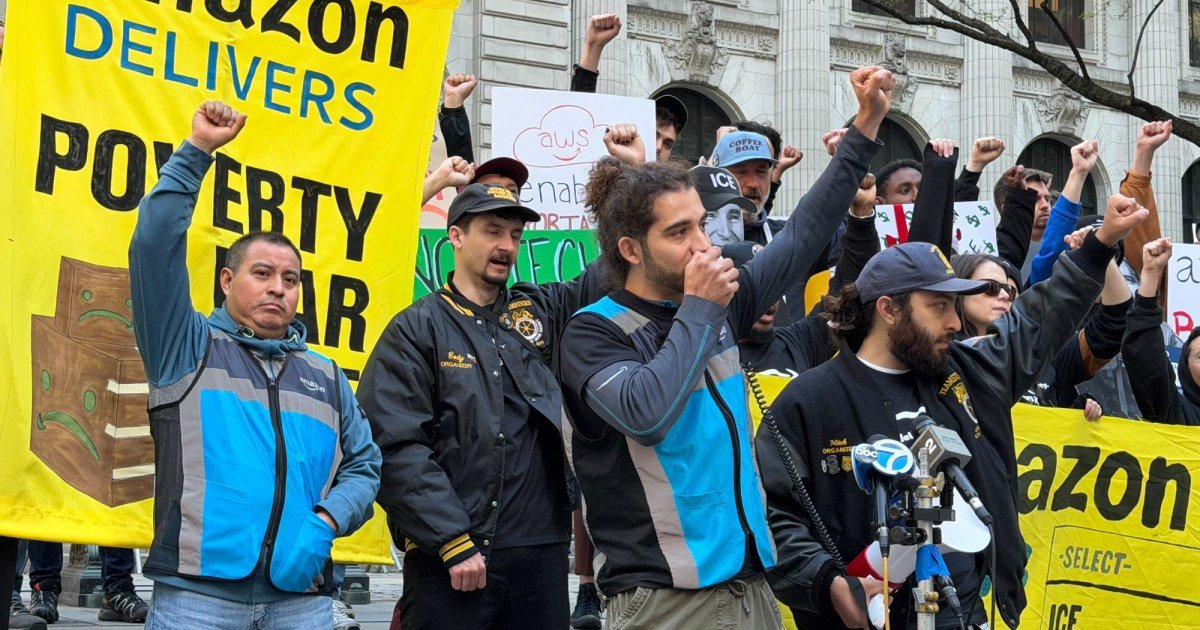
Matt Multari, an Amazon driver who works in Queens, spoke against Amazon’s collaboration with ICE at a May Day rally.Sophie Hurwitz
Matt Multari has been driving for Amazon—and organizing with the Teamsters—for about a year and a half. His days are mostly spent delivering packages. But he thinks of his role as a worker-organizer as something much more historically significant than just maximizing delivery efficiency.
“After the Assyrians lost their state, they survived in their homeland of Iraq for thousands of years. After facing a genocide that forced them to flee that homeland, they went to Russia, and then to Iran, and then some of them went to New York. Now I’m here,” he said. “And I’d like to tell Amazon: fuck you!”
Early on the morning of May 1, Multari took the megaphone in front of a hundred or so sign-toting Amazon warehouse workers, delivery drivers, and software engineers, who had traveled in from Queens and Staten Island to march on an Amazon office building for International Workers’ Day.
“Each of us here has a story of generational struggle,” Multari, 25, said. But to him, working for Amazon means the obliteration of identity. “Amazon is trying to erase that.” Every day, as he puts on his blue vest and delivers packages from Amazon’s DBK-1 warehouse in Queens, the company surveills him: “You have an app that tells you the exact stop order you’re supposed to go in. You’re under a time quota, basically.”
If you take too long, or take too many stops, Multari said, the app tells you to go faster. “You get a scorecard every week that says how you’re performing.” Five months ago, Multari and his DBK-1 coworkers unionized with the Teamsters, joining thousands of unionized Amazon workers nationwide. They’ve been able to extract some concessions from the e-commerce giant, though Amazon has refused to bargain with their unionized workers. Nonetheless, during this year’s record-breaking winter storms, they were paid for days they weren’t able to work; and when they needed new hand-trucks, Amazon paid up.

Nonetheless, Multari and his coworkers are aware that they’ll have to do much more to win real job security in an age of automation. “Amazon, at its core, is a tech company,” Multari said. “Our main asset to them is our data from our routes, so that it can train its algorithm, so it can make us more and more replaceable.”
Amazon’s Web Services cloud-computing platform is more profitable than all the company’s retail operations combined. And AWS sells cloud-computing services to clients throughout the American government, including Immigration and Customs Enforcement: According to Forbes reporting, ICE spent at least $25 million on AWS during the second Trump administration. Amazon Web Services also holds contracts with Palantir, the surveillance-tech company behind much of ICE’s deportation operation. (And Amazon has served as an inspiration for ICE, too: acting ICE director Todd Lyons has said he wants deportations in the US to run “like Amazon Prime for human beings.”)
That’s part of why, at Monday’s rally, non-union tech workers stood alongside unionized warehouse workers.
Zelda Montes, a former software engineer at Google who was fired in 2024 for holding a sit-in with their coworkers, said they’ve spent much of the past two years trying to help organize tech workers at places like Amazon. With the group No Tech for Apartheid, Montes works to build power within tech companies against the contracts that Amazon and Google hold with the Israeli government. “For a lot of tech workers, the work that they’re doing is helping to create these systems of surveillance that affect warehouse workers, that affect delivery workers, that create more difficult working conditions for them,” Montes said. “So it’s really important for us to be able to unite with them on the labor front.”

At some Amazon warehouses, more than half of workers are immigrants. But Amazon CEO Jeff Bezos has shown no interest in walking back the company’s contracts with agencies targeting those immigrants. “Amazon’s abuse of workers bankrolls their ability to do this,” said Sultana Hossain, an organizer with Amazon Labor Union. So, workers in New York told Mother Jones, they’re going to keep fighting.
“We will demand the one thing that’s worth fighting for in this life: respect,” Multari said.



