
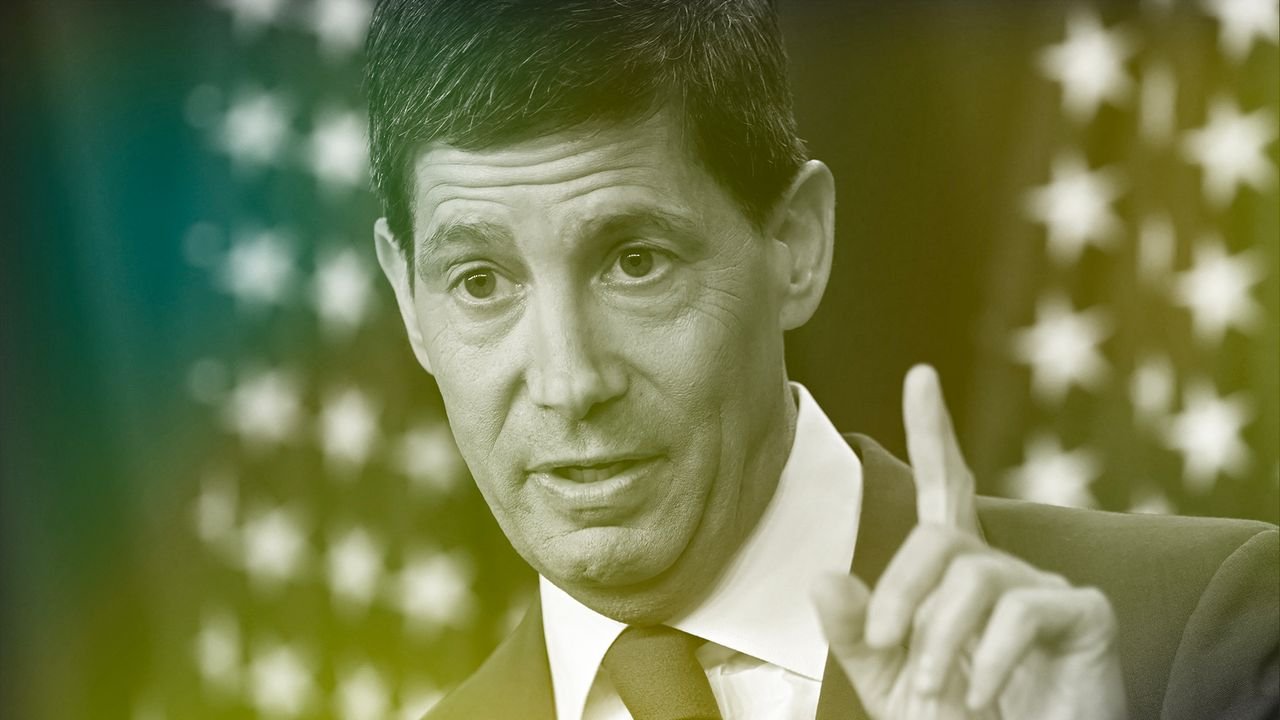
To be sure, the sell-off in long-term bonds doesn’t mean another financial blowup is imminent. It does mean that the Treasury Department will have to pay more interest on the debt it issues—payments that already cost the government a sum comparable to the Pentagon’s budget. Home buyers will face higher mortgage rates, and Warsh will be forced to confront a credibility problem. Last year, when Trump was looking for someone to replace Jerome Powell as Fed chair, Warsh positioned himself as an inflation dove who would deliver lower interest rates. At the time, inflation seemed quiescent. But, a month after Trump nominated Warsh in January, the President launched his ill-conceived war on Iran, which caused oil prices to skyrocket and changed the inflation picture for the worse. Between February and June, the inflation rate rose from 2.4 per cent to 4.2 per cent, well above the Fed’s two-per-cent target, prompting the question of whether it should raise rates.
At Warsh’s first policy meeting, in June, the F.O.M.C. voted to stand pat, keeping the federal funds rate in a range of 3.5 to 3.75 per cent. However, the new chair repeatedly stressed his commitment to meeting the Fed’s inflation target, and many Wall Street observers took him to be an inflation hawk at heart. Many of them pencilled in a rate hike for September, if not sooner. At last week’s meeting, though, Warsh spoke largely in platitudes and generalizations. When he was asked why he hadn’t been persuaded by the arguments of the three F.O.M.C. members who voted for an immediate rate hike, he dodged the question. At another point, he suggested that the financial markets, in bidding up long-term rates, had already done some of the Fed’s inflation-fighting work.
Warsh’s stated motive for saying so little is that he believes the Fed should no longer provide the markets with any “forward guidance” on its intentions, lest it lock itself into an undesirable policy path. He says that this happened in 2021, when inflation shot up and the Fed initially failed to respond. The merits of this argument can be debated—and will be debated by one of the task forces that Warsh has appointed to review how the Fed operates. In the meantime, though, a reluctance to provide forward guidance is surely no justification for not providing any current guidance either, which is where Warsh appears to have landed. As last week demonstrated, this is a recipe for confusion, uncertainty, and higher borrowing costs.
The irony is that Warsh, if he were more open, could have made a strong argument for the Fed’s inaction without compromising his inflation-fighting credentials. Even though inflation has risen this year, higher energy costs account for most of the rise, and there is little sign of a generalized price spiral. Moreover, between mid-May and early July, as the U.S. and Iran reached a ceasefire agreement, oil prices tumbled. The over-all Consumer Price Index for June fell by 0.4 per cent. Since then, the ceasefire has collapsed, and the oil price has rebounded. But nobody can be sure what will happen next, and it seems reasonable for the Fed to wait another couple of months to see how things pan out, while remaining ready to raise rates if inflation doesn’t ease.
Evidently, most of Warsh’s colleagues on the F.O.M.C. hold this position—eight of them voted with him to hold the funds rate steady—and it remains a bit of a mystery why he didn’t articulate the rationale more fully. One conceivable explanation is that he welcomes the higher long-term interest rates that accompany heightened uncertainty about the Fed’s intentions, because it means markets will price risk more cautiously, which could be healthy in the long term. “Granted, injecting uncertainty premia into markets isn’t the sort of thing that any central banker we can think of has tried before,” Toby Nangle, a reporter at the Financial Times, noted. “But it sort of provides some quantum of internal coherence to Warsh’s comments and actions.”
A more cynical view is that Warsh’s primary goal is to avoid incurring Trump’s wrath by raising rates before the midterms, and that explains why he is so unwilling to give any hostages to fortune. If, for instance, he were to say publicly that he and his colleagues would base their decision on the July and August inflation figures, and those figures came in worse than expected, he might have little choice but to support a rate hike in September and avoid Truth Social. Better to say nothing of note and leave himself a little wriggle room.



