
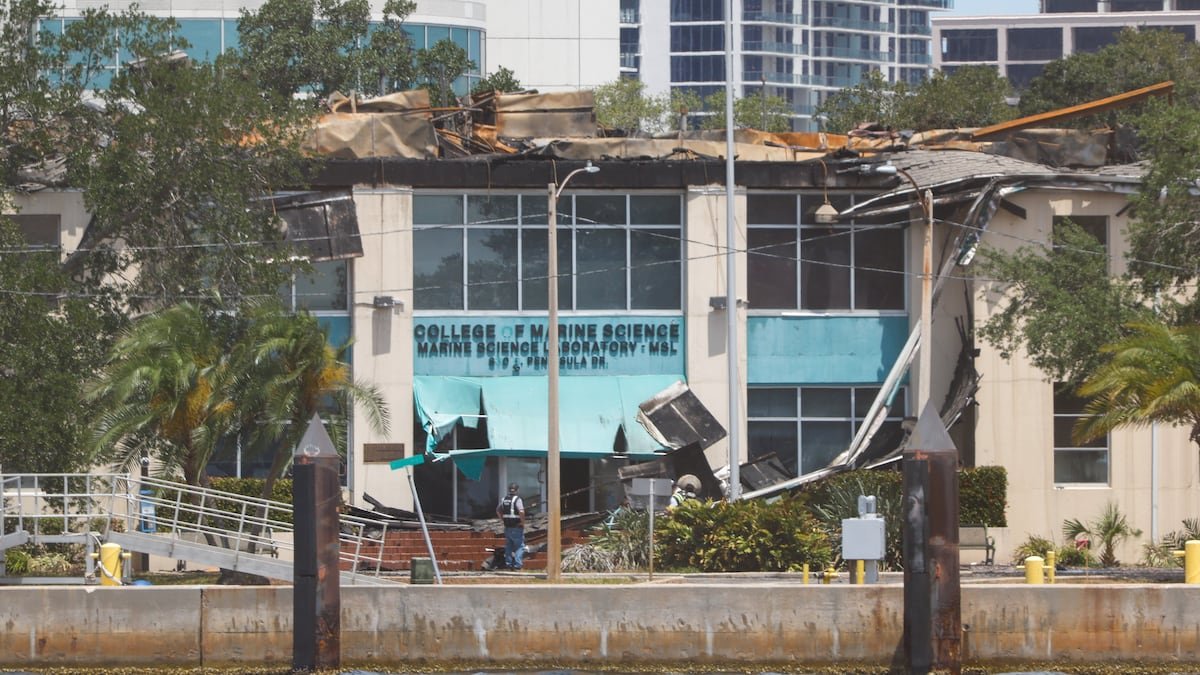
The University of South Florida’s Marine Science Lab in St. Petersburg has 17-inch-thick walls, former dean Peter Betzer said.
They were built in the 1930s, when the building provided barracks for young merchant marines.
“That building is as good as any bank vault and would never be moved by any hurricane,” Betzer said. “You could hit it with multiple hurricanes, that thing is incredible.”
The roof — which former faculty members say has likely not been replaced or renovated since the 1970s — was another story.
After it was set ablaze when lightning struck during a gusty thunderstorm Saturday night, faculty have questioned whether the building’s old infrastructure contributed to the destruction of labs that held vital scientific research.
A university spokesperson could not immediately say whether the roof has ever been renovated. The Tampa Bay Times requested the lab’s code inspection records from the university’s Building Code Administration but did not hear back late Monday afternoon.
The Times also requested annual safety inspections from the State Fire Marshal’s office. A representative was not able to provide the reports Monday.
In 2022, Gov. Ron DeSantis vetoed $75 million that the Legislature had approved to build an upgraded facility. In subsequent budget cycles, the Legislature passed roughly $34.3 million for upgrades, including hurricane recovery, but those efforts had not yet started.
Here’s what to know about the building.
From a training station to a science lab
On the cusp of World War II in 1939, a training station for young merchant marines opened on the peninsula of Bayboro Harbor.
The U.S. Maritime Service Training Station hosted 800 men at a time in barracks out of a two-story concrete building that decades later became the first labs for the USF College of Marine Science.
The wooden barracks were later replaced with classrooms, labs and offices, retired professor Al Hine said. After the State University System designated the program as a Center of Excellence in 1978, student enrollment and faculty positions grew, Betzer said.

The waterfront location forced some early renovations of the building due to flood risk.
Water from a 1985 hurricane came within inches of a supercomputer on the first floor, Betzer said, so the university reinstalled some of the building’s electrical wiring higher off the ground.
“That would have been a billion-dollar loss, and we came within inches of losing it,” he said.
Since then, Betzer said, new electrical wiring was installed in the attic.
The cause of the fire is still under investigation
Gary Jenkins, an independent contractor who inspects safety elements for insurance companies, said the first thing he thought to question was the integrity of the building’s wiring.
Prior to the 1940s, the go-to wiring in buildings and homes was in a style called knob-and-tube. When wire turned a corner from one room to another, a ceramic knob was installed to turn it. Copper cables were used instead of electrical ones.
It was not clear Monday what electrical wiring is currently used in the building.
Copper wiring can pose a safety issue because it is more susceptible to deterioration, Jenkins said. An increased use of electronics — particularly in a lab setting — can overheat the wires.
Because the fire originated on the roof, Jenkins said the lightning likely caused an electrical fire.
“There are too many unanswered questions about what it could be,” he said. “The fire destroys a lot of evidence.”
A spokesperson for the St. Petersburg Fire Department said Monday that the official cause is still being investigated by the State Fire Marshal’s office. The office did not respond to an email seeking comment.
The roof has always had maintenance issues, Hine said, including poor insulation, rats and leaky spots. It’s possible a few shingles have been replaced over the years, Betzer said, but nothing more major than that.
“Apparently, (the roof) burned like crazy (on Saturday), and the water, unfortunately, that was used to put the flames out, it really does a lot of the damage to the building,” Hine said.
State universities are not subject to local government permitting requirements, plan reviews or inspection fees, according to the Florida Building Code. The university itself is responsible for all of its buildings and facilities.
A new building was vetoed
The university had plans to build a new main building for the college on the St. Petersburg campus.
The project was at the top of USF’s wishlist in 2022, and much of the university community was surprised when DeSantis vetoed $75 million in funding for it. The new center could have meant a partially demolished, partially remodeled Marine Science Lab.
The Legislature granted the college $24.3 million in the next budget cycle. In 2024, the university requested $35 million for the college, which was ultimately not included in the final budget bill.
Last year, the Legislature approved $10 million to renovate the Marine Science Lab after hurricane damage. The funding was requested to upgrade the lab facility and construct a storm-hardened research facility closer inland, according to a legislative funding request.
University spokesperson Matthew Cimitile told the Times on Monday that the project had not started yet, and the university has only spent a “minimal amount” on planning for the site.
USF requested $2.5 million from the Legislature this year to fund the Florida Institute of Oceanography — which is housed within the college — to modernize research vessels and equipment.
The Legislature has not decided on a budget and will go back into session in a few weeks.
Times staff writer Nakylah Carter contributed to this story.
The Tampa Bay Times Education Hub reports on Florida’s schools and universities and the students they serve. You can contribute to the hub through our journalism fund by clicking here.



