
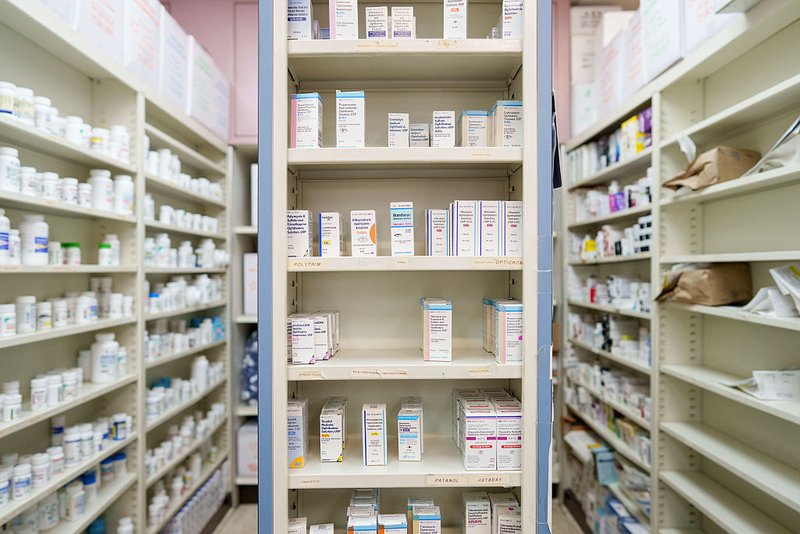
Medications are stored on shelves at a pharmacy in Los Angeles. The U.S. Supreme Court heard a case April 29, 2026, that could have major implications on the price of generic drugs. (Photo by Eric Thayer/Getty Images)
By Zara Norman/Medill News Service
WASHINGTON — John Bailey said he’s saved tens of thousands of dollars over the last decade by relying on a generic prescription to lower his cholesterol.
The 68-year-old from central Texas was able to get a generic because the patent on a brand-name medication expired. He and many other Americans worried that a case the U.S. Supreme Court heard April 29 could restrict access to generic drugs more broadly.
“It’s probably going to make a difference in how much we pay,” Bailey said while sightseeing near the court.
The case, Hikma Pharmaceuticals USA Inc. v. Amarin Pharma, Inc., will decide whether generic drug manufacturer Hikma infringed on a cardiovascular medication patented by Amarin when it marketed an unpatented use.

That practice, known as “skinny labeling,” is a key pathway that brings cheaper generic drugs to market sooner. The Journal of the American Medical Association found skinny labels were used by 43% of generics from 2015 to 2019.
Should justices affirm the U.S. Court of Appeals for the Federal Circuit’s 2024 ruling for Amarin, experts warned it could have a chilling effect on the generic industry writ large, which would seriously hike up drug costs.
“It would mean that the monopoly prices of prescription drugs that are currently being paid right now have no end to them,” Charles Duan, a patent lawyer who wrote a “friend-of-the-court” brief in favor of Hikma, told Medill News Service in an interview ahead of oral arguments.
For consumers, higher prices would be untenable. Six in 10 US adults are already worried about the affordability of their prescription drugs, per a March Kaiser Family Foundation poll. Drug prices fall with an increasing number of generic competitors, according to the Department of Health and Human Services.
Issue is narrow, drugmaker says
The case deals with an issue that policymakers have debated for decades: whether federal policy should encourage drug companies to develop new products by giving them monopoly control for a certain number of years, or seek to make drugs more affordable by shortening the monopoly window.
Amarin argued to the court that the case hinges on a narrow regulatory matter that would have neither a bearing on skinny labels, nor on the 1984 law that established a framework for cheaper drug manufacturing.
Tegan Berry, a spokesperson for Amarin, said in an email drugmakers would lose their business purpose for research if the company loses the case.
“The broad safe harbor Hikma seeks for skinny labels will eviscerate financial incentives for research into new uses for existing drug treatments,” Berry wrote.
Justices Brett Kavanaugh and Ketanji Brown Jackson seemed wary of how a finding for Amarin could impact the industry writ large. Kavanaugh in particular emphasized that the 1984 law balanced innovation with affordability, and ensured the skinny label pathway was codified.
Kavanaugh cited a brief written for Hikma by former U.S. Rep. Henry Waxman, a California Democrat who was one of that statute’s principal authors, saying the Federal Circuit’s decision threatened to “undermine” the generic pharmaceutical industry.
The brief “points out, you know, generics have saved $3.4 trillion over the past 10 years, but the Federal Circuit’s decision leaves generic drug companies in the dark about what might expose them to liability,” Kavanaugh said while questioning Michael Huston, the attorney representing Amarin. “That’s going to have some serious implications market-wide.”
Generics expand access
The concern for generic manufacturers is the threat of infringement lawsuits will force them to wait until patents expire to bring drugs to market, rather than trying sooner with one unpatented use.
“Generic companies won’t choose that pathway if, at best, it means paying millions in legal fees and, at worst, a massive damages award,” Charles Klein, the attorney representing Hikma, said during arguments.
“The risk of liability and what it could do to a generic, I would think, would be pretty significant,” Jackson said while questioning Deputy U.S. Solicitor General Malcolm Stewart.
Some experts were concerned that a decision for Amarin could impact other generic products, not just pharmaceuticals.
“Drugs are obviously sort of the poster child here, because they’re so expensive and people are very concerned about drug prices,” Duan said. “But this is not a case that’s specific about drugs. In that sense, it’s really a case about whether or not generic products can exist.”
Generic products can seriously save consumers. Store-brand foods cost up to 40% less than name brand items at Wegman’s and Stop & Shop, a 2022 CNET study found. Any savings go a long way — food prices rose 2.7% from March 2025 to 2026, according to the Bureau of Labor.
Justices are not expected to issue a decision in the case until near the of their term in early July, either to dismiss Amarin’s complaint or send it back to trial court in Delaware.
Already, Stewart warned the court, generic manufacturers will have a “substantial disincentive” for entering the market and are holding off now pending the court’s decision.
“This is a real test for how we want to balance innovation versus affordability in this country,” John Murphy, CEO of the advocacy group Association for Accessible Medicines, said. “We need to make sure that balance is more appropriately favored for consumers.”



