
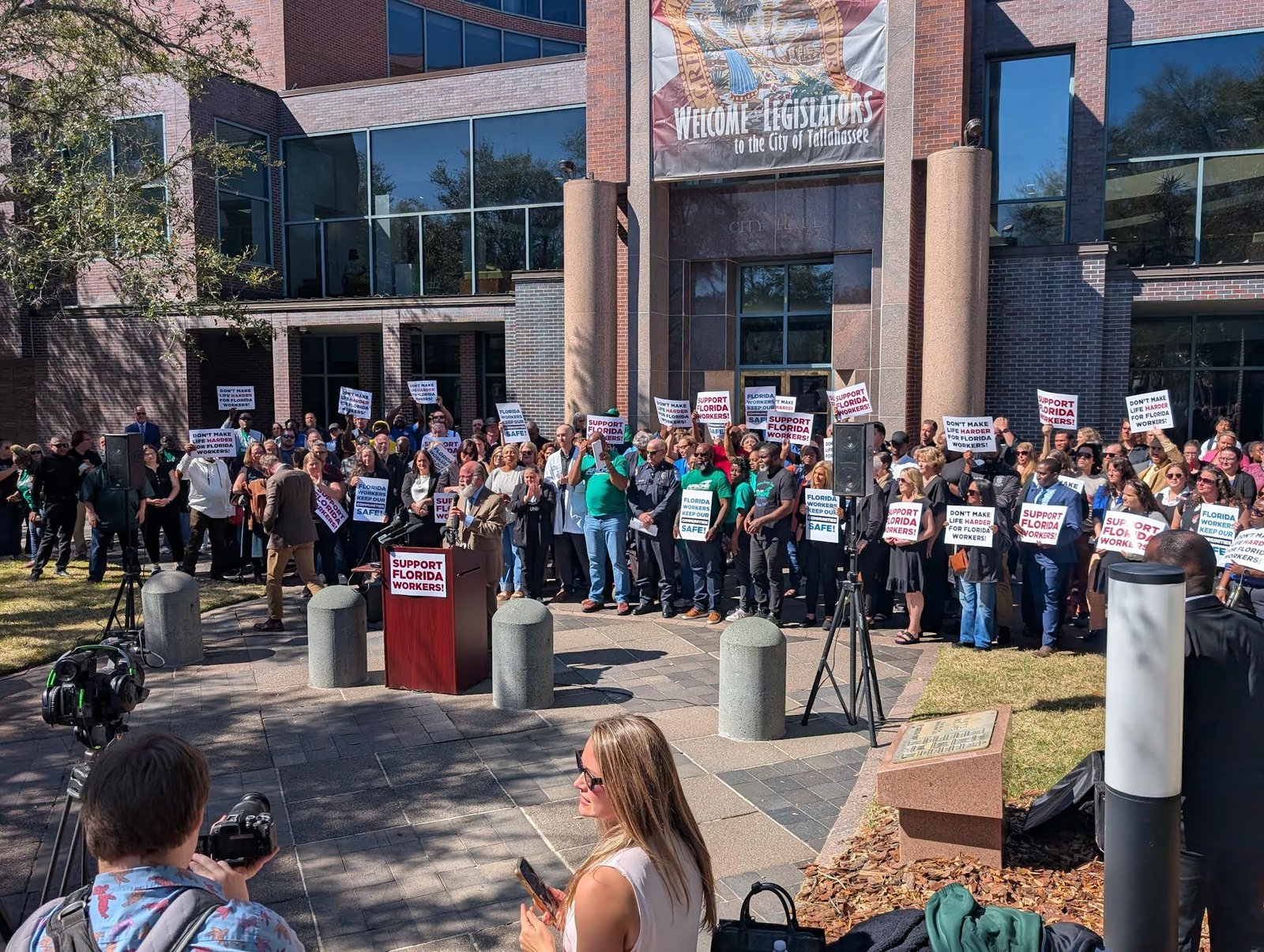
Gov. Ron DeSantis got to put the finishing touches on one of his 2026 legislative priorities Friday, signing a union-restricting bill that had been subject to intense debate in Florida’s Capitol.
DeSantis signed SB 1296 at Fort Myers High School on May Day, a worldwide holiday observing the labor movement.
Although the focus of the news conference was on education and teacher unions, the state teachers’ union, Florida Education Association; and AFL-CIO, said the law will touch an array of sectors.
FEA President Andrew Spar said DeSantis and “anti-union, anti-worker legislators” are “chipping away at the constitutionally enshrined rights of thousands of workers in the state.”
He listed “nurses, sanitation workers, utility workers, line technicians, certified nursing assistants, doctors and medical residents, city bus drivers, teachers, education staff professionals, higher education faculty and graduate assistants, city and municipal workers, communications workers, and countless other public sector workers who help make Florida safe and prosperous.”
The law, effective July 1, requires that, to win certification, public-sector labor unions need at least 50% of all of the employees in the bargaining unit to vote and that the vote itself wins 50%-plus-one support. Currently, those unions only need a majority of those who voted.
Florida Legislature approves restrictions on public sector unions
DeSantis commented that he believes education unions get involved in “a whole host of things” in advocating for causes — contrary to police unions, which have been spared in recent union-busting legislation. Police, firefighter, and correction officer unions tend to support Republican political causes.
Education unions “take the money out of everybody’s check for dues and it’s supposed to be, ‘Oh we’re going to improve your working conditions or benefits.’ But what they use it for is basically partisan political activism. Massive amounts of money going into the political system, basically, through commandeering of peoples’ paychecks, part of their paychecks,” DeSantis said.
During the legislative process, unions and some Republicans advocated against the legislation.
“Talking about SB 1296, I’m still flabbergasted by how hard the teacher unions pushed back against this legislation,” Republican Rep. Jenna Persons-Mulicka of Fort Myers said during the news conference. She sponsored a similar House bill.
“What it does is very simple — it gives teachers the tool to hold accountable those unions that aren’t doing their job. If you’re doing your job, this bill doesn’t impact you. This bill won’t end unions. The unions will end themselves when they lose their way and focus more on politics than on representing the employees at the bargaining table,” Persons-Mulicka said.
During the legislative session, U.S. Secretary of Education Linda McMahon advocated for the new law.
I commend @GovRonDeSantis and the Florida leaders working to ensure unions truly have the support of the educators they represent.
This commonsense reform, SB 1296, reins in fringe political activism from teacher unions and refocuses them on accountability to teachers.
— Secretary Linda McMahon (@EDSecMcMahon) March 5, 2026
“She did not have to do it, but she proved the backbone she has by weighing in on something that is so important to the education system nationally,” Florida Education Commissioner Anastasios Kamoutsas said of McMahon.
“The governor actually reminds us that May Day exists because workers across the nation fought for safer workplaces, fair hours, and stronger protections,” Spar said.
“Floridians have made it clear that they expect an economic future that benefits us all, and that begins with a public education system that is strengthened by state leaders, not abandoned, weakened, or destroyed. The future we want for ourselves, for our children, and for our communities is possible if we come together and fight for a stronger Florida,” Spar said.
The Florida AFL-CIO, which represents more than 500 local labor unions, denied that unions are strictly partisan.
“The facts remain clear: Over 30% of Florida’s union members are registered Republicans, with close to another third being independent or nonparty-affiliated,” the organization said in a written response to the signing of the bill.
“Florida’s labor movement is non-partisan, and its unions push for better lives for their members independent of partisan or ideological preference, because working class issues cross all party lines,” they continued.
Florida AFL-CIO President Kimberly Holdridge said DeSantis “gave another win to billionaire-funded out-of-state think tanks at the expense of Florida’s working people.
“Make no mistake, however: This is a temporary win. While wealthy special interests might believe they have the power in the halls of the Florida Capitol, Florida’s public sector workers have the power and support in our communities statewide to show them otherwise. We will organize and come back stronger than ever,” Holdridge continued.
In 2023, the Legislature passed and DeSantis signed SB 256 into law. That measure requires teacher and other public sector unions (but not those representing police or firefighters) to stop automatically deducting dues from members’ paychecks, and that union membership has to constitute 60% of a bargaining unit, an increase from the old threshold of 50%.
The measure DeSantis signed Friday passed the Senate 20-14 and the House 73-37.
GET THE MORNING HEADLINES.
Another one
DeSantis also signed HB 1279 at the news conference, which in part looks to address a concern in Lee County.
The legislation expands the criteria for a district to declare an education emergency, allowing for “salary incentives” “not subject to collective bargaining requirements.”
Education priorities either dropped or added to last-second mega-bill
Emergencies also allow for school boards “to assign high-quality teachers more equitably across schools in the district to low-performing schools as a management right.”
Existing law reserves emergencies for schools with a D or F grade, but now, with DeSantis’ signature, being a persistently low-performing school is cause for that status, too.
Last year, lawmakers expanded the definition of persistently low-performing schools beyond just receiving a grade lower than a C for three consecutive years. Now, worse than a C for three of the last five years (without also scoring a B) or dropping in the bottom 10% of schools in math and reading for two of the past three years, will land a school on that list.
During floor debate, Persons-Mulicka pointed to Lee County, which experienced a teacher shortage and declared an educational emergency last year and gave teachers bonuses. The union there was not happy with the processes the district used.
Among other tweaks, the new law qualifies dance to satisfy the physical education graduation requirement or a performing arts credit.
The legislation directs the State Board of Education to create “a statewide uniform weighted grading system for honors courses and articulated acceleration mechanisms.”
The measure removes mention of the American Bar Association in statute governing law schools at Florida International University and Florida A&M University, instead allowing for “a nationally recognized association.”
That follows a ruling from the Florida Supreme Court in January determining the state need not rely solely on the ABA for accreditation.
Independent Journalism for All
As a nonprofit newsroom, our articles are free for everyone to access. Readers like you make that possible. Can you help sustain our watchdog reporting today?



