
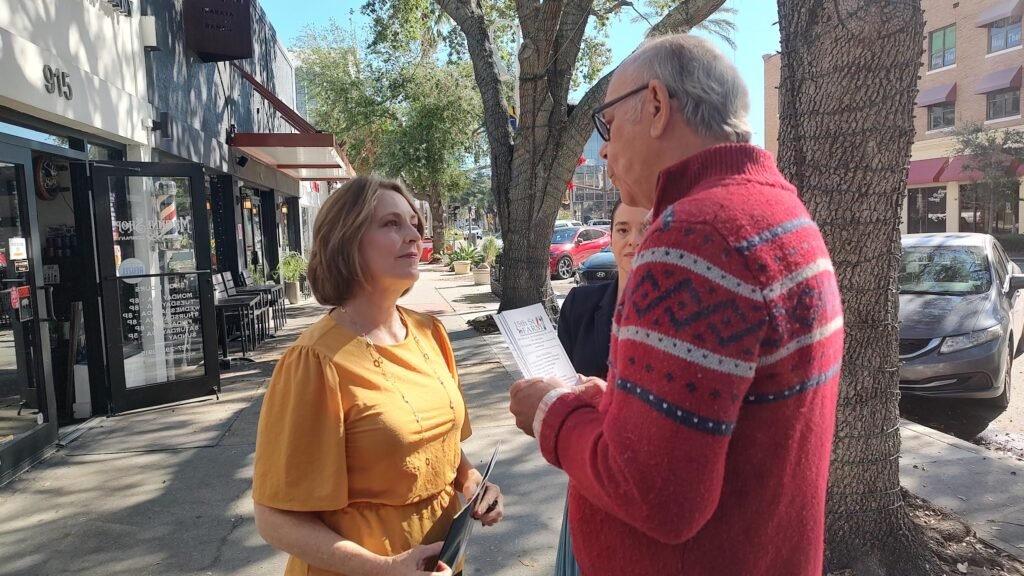
Tampa Bay Area Democratic U.S. Rep. Kathy Castor in downtown St. Petersburg on Nov. 26, 2024. (Photo by Mitch Perry/Florida Phoenix)
Two Florida Democratic members of Congress who have seen their districts radically altered by the newly approved congressional redistricting map this week said Friday that they intend to run again this fall.
Tampa Bay’s Kathy Castor and South Florida’s Debbie Wasserman Schultz are among the most vulnerable Democratic incumbents following legislative passage of Gov. Ron DeSantis’ redistricting map, which polls show the majority of Floridians oppose.
They, along with Central Florida Rep. Darren Soto, all confirmed on Friday that they intend to run for office in November.
“This is my home. No matter how they draw lines on the map, I’m Tampa Bay’s congresswoman and I’m going to fight to lower costs,” Castor told this reporter in an interview on WMNF 88.5 FM Radio in Tampa.

“The easiest decision for me to make is that I’m running,” Wasserman Schultz told the South Florida Sun-Sentinel following an event this morning, although she added that she has not yet determined whether she’ll run again in Florida’s 25th district or another South Florida seat.
She’s represented parts of Broward and Miami-Dade counties since 2004. Her newly drawn district moves from much of southern Broward County to stretch along the Atlantic Coast from Palm Beach County to Miami Beach.
Castor is from Tampa and has represented parts of Hillsborough and Pinellas counties since 2006. Her district was radically reconfigured in the map drafted by staffers in DeSantis’ office that was introduced to the public on Monday and approved Wednesday by Florida’s GOP-controlled Legislature — although five Republicans (four in the Senate and one in the House) voted along with every Democrat to oppose it.
DeSantis’ map cuts the city of Tampa into three congressional districts (12, 14, and 15) that all contain more Republicans than Democrats, even though a Democrat has represented the city for decades. “The outrage has been pretty palpable since the map was rammed through the Florida Legislature,” Castor said.
“If you live in Ybor City, you’re going to have to try to stay up with a representative who is serving Citrus County,” she said. “Or if you’re a St. Petersburg resident, you are in a district with folks in Hardee and DeSoto counties. That’s such a disservice. It’s so disrespectful to those communities and it’s blatantly wrong.”
Her District 14 seat has gone from one that was won by Kamala Harris by 7.6% in 2024 to a district that would have gone for Trump by 10.5%, according to data analyst and Democratic consultant Matt Isbell.
Radical shift
No change is more drastic than in Soto’s Ninth District in Central Florida. According to Isbell, Soto’s old district went for Kamala Harris in 2024 by more than three points but would have gone for Donald Trump by 18 points — a 22-point shift.
A spokesman for his office confirmed to the Phoenix Friday that Soto will run again in District 9, pointing to a comment he made to a reporter earlier this week.
The two other Florida Democratic representatives whose districts became more Republican-leaning this both reside in South Florida.
In District 23, Jared Moskowitz’ seat has been split between three districts and, as now drawn, would have voted for Trump in 2024 by more than 13 percentage points. In 2024, Kamala Harris won his district by 1.9%. Moskowitz told an Axios reporter earlier this week that he will run for re-election but, like Wasserman Schultz, isn’t sure where yet.
“I’m running for reelection,” he said. “I’ll figure out what district I’m going to run in; I think there’s three districts I could choose.”
The fifth vulnerable Democratic incumbent is Palm Beach County’s Lois Frankel in District 22. Her district has now flipped from one that supported Kamala Harris by 5.5% to one that is now plus-10.5% for Trump.
Frankel’s office did not respond to a request for comment.



