
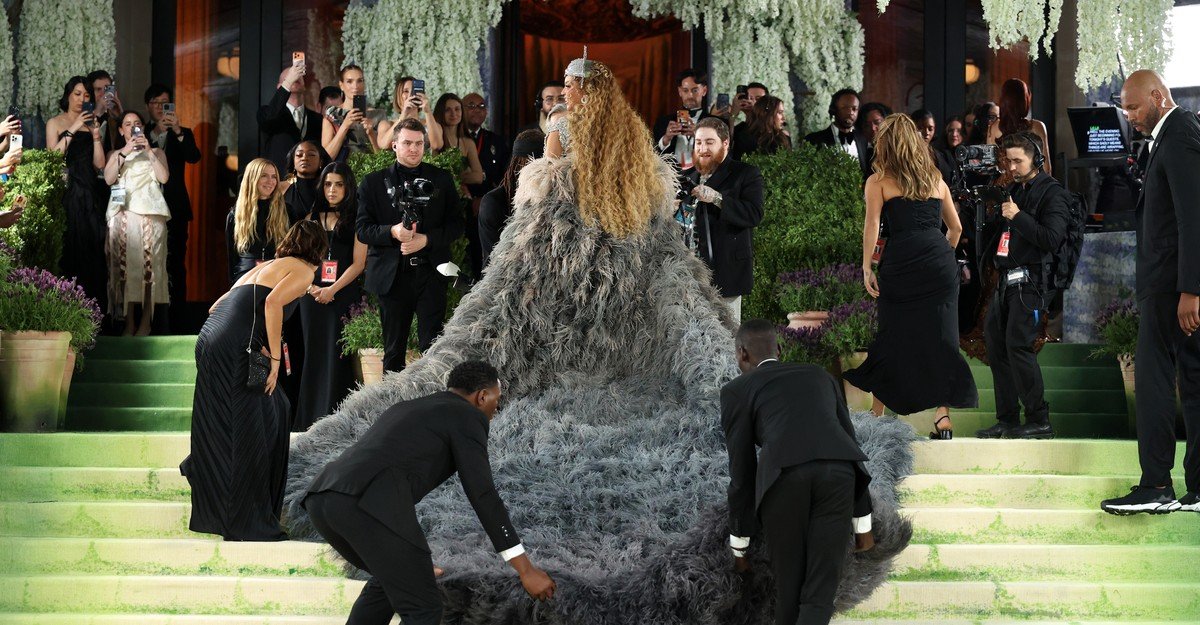
Every year, the Met Gala—the opulent celebration of the Metropolitan Museum of Art’s Costume Institute—unveils a theme with a dress code that its famous attendees then attempt to interpret. And every year, many of the guests fail the assignment: They arrive in a superficial take on “punk” or an awkward rendition of “dandyism,” if they don’t veer off course completely. (See: various questionable efforts to capture the 2019 theme, “camp.”) It’s a treat, then, when someone gets it just right.
Someone like the actor Tessa Thompson at this year’s event, for instance. The theme of the 2026 exhibit, “Costume Art,” considered how fashion and fine art intersect; the gala’s corresponding dress code was “fashion is art.” Thompson’s Valentino garment, inspired by the French painter Yves Klein, couldn’t have been more appropriate” Klein was known for exploring a particular shade of ultramarine blue, now known as International Klein Blue, throughout his career; in one project, he drenched models in blue paint and used them as human paintbrushes. Thompson’s dress, in said hue, involved sculptural pattern cuttings (fashion) and evoked the shape of paint splatter (fine art). She even coated her fingers in blue makeup, referencing Klein’s MO down to the last detail.
If you tuned in to the official livestream of the Met Gala red carpet last night, however, you would have learned none of this. Indeed, you wouldn’t have learned much at all. Perhaps unsurprisingly, the spotlight stayed largely on the spectacle. One ostentatiously dressed invitee after another paraded across the screen; occasionally they were stopped for a trivia-laden interview. Did you know Amanda Seyfried has a donkey whose milk she does not drink, because the donkey is male? Or that Hailey Bieber loves listening to Rihanna when she’s getting ready?
Shallow chitchat is the lingua franca of red-carpet Q&As—but the Met Gala is the rare venue where the question “Who are you wearing?” can yield actual substance beyond just a name, and more so this year than in the recent past. The Costume Institute exhibit heralded last night features nine new mannequins modeling body types that aren’t typically included in the fashion industry, including those that are in wheelchairs, pregnant, or missing limbs. “Fashion is art,” was meant to encourage attendees to think about how every human body is a canvas, and about how making an item of clothing—the precision that goes into selecting textiles, creating shapes, and combining colors—requires the same kind of artistry deployed by the painters and sculptors featured throughout the museum. In a speech before the evening began, Anna Wintour, the Vogue editorial director and Met Gala co-chair credited with transforming the event into the A-list pageant it is today, emphasized that the evening was an opportunity to showcase the work that goes into fashion—work, she said, that included the efforts of hairdressers, drivers, and caterers, who make the Met Gala itself possible. Once she hit the carpet, Wintour noted that the livestream also encourages tourists to visit the Met in person.
Yet what the Met puts on display for such visitors to view seemed beside the point last night. Some celebrities, such as Lena Dunham and Gwendoline Christie, mentioned some of the artworks and artists they were referencing, such as Artemisia Gentileschi’s Judith Slaying Holofernes and John Singer Sargent, respectively. A handful of times, an image of a concept sketch or the cited inspiration appeared on-screen. But mostly, for every minute an interview devoted to exploring the thinking behind an outfit, another was spent on empty blather. The designer Michael Kors, for example, who made Anne Hathaway’s gown, had just finished describing the dress as an ode to the Grecian urns in the Met when the conversation turned to Hathaway’s sleep schedule.
The superficiality, perhaps unintentionally, highlighted the noise surrounding this year’s Met Gala—particularly the fact that the billionaires Jeff Bezos and Lauren Sánchez Bezos were the lead sponsors and honorary co-chairs of the evening. But anyone watching the livestream would not have heard the hosts discuss the protests that had cropped up against the Amazon founder’s involvement, or that one protester was detained after attempting to enter the event. (This is not the first time that the Met Gala has met in-person pushback; pro-Palestine demonstrators similarly stood out front, and off camera, last year.) They wouldn’t have noticed that the gala was attended by several tech CEOs, some of whom skipped the photo op and slipped inside; Sánchez Bezos posed for the cameras but didn’t participate in interviews. Other reporters whose exchanges weren’t caught on the livestream did ask celebrities about Jeff Bezos’s participation: Venus Williams, one of this year’s celebrity co-chairs alongside Beyonce, sidestepped a question, while Cher mentioned she was “not a fan.”
The emphasis on glamour did nonetheless offer some excitement—and financial payoff. This year’s Met Gala brought Beyoncé back to the event for the first time in 10 years, saw the debut of Stevie Nicks as an attendee, and raised a record-breaking $42 million, putting the Costume Institute on track to become self-sustaining. But the gala’s masterminds—including Wintour and Andrew Bolton, the Costume Institute’s curator—should go beyond showing off bespoke gowns and suits. The event is a pop-culture institution with the cachet to really elevate the artistry of fashion. Beyond letting the public ogle nice suits and gowns, it could emphasize the handiwork that goes into such clothing—and help us understand what makes the spectacle possible.



