
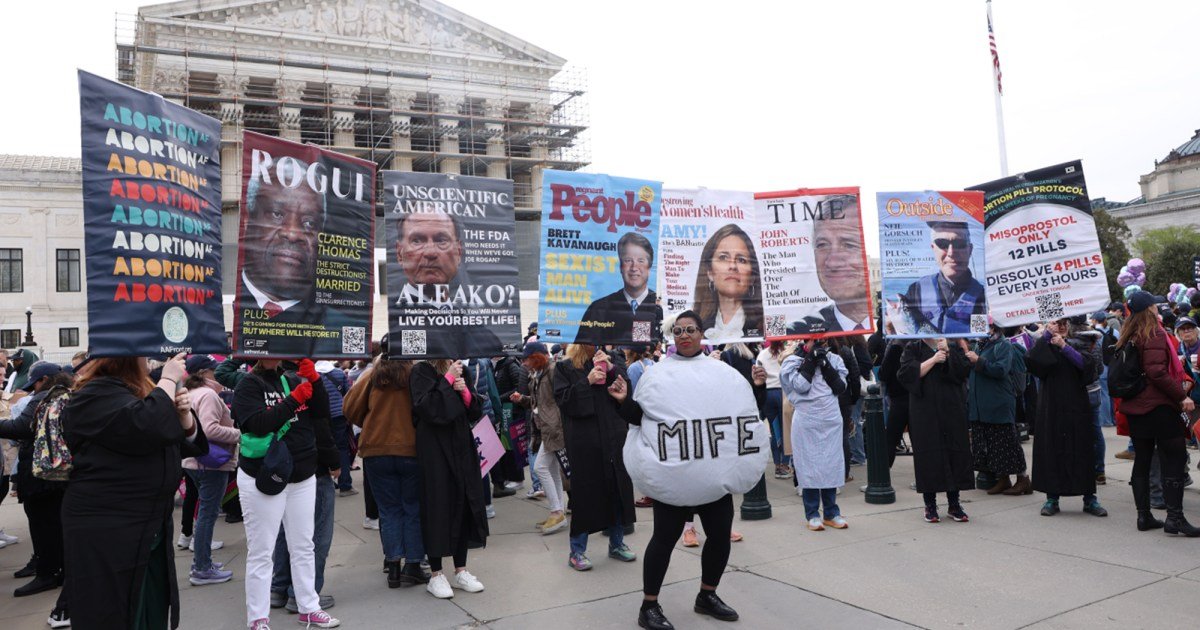
Supporters of Planned Parenthood and reproductive health advocates rally outside the US Supreme Court.Gent Shkullaku/ZUMA
The Supreme Court on Monday temporarily reinstated a Food and Drug Administration rule allowing the abortion pill mifepristone to be prescribed via telemedicine and dispensed through the mail.
The order, by Justice Samuel Alito Jr., paused a ruling by the federal Fifth Circuit Court of Appeals that sought to block nationwide access to mifepristone by cutting off online providers. The Fifth Circuit ruling, issued Friday, caused providers, advocates, and patients to scramble all weekend to put in place contingency plans to keep abortion medication available. Almost two-thirds of abortions in the US now occur with pills, and nearly 30 percent take place via telemedicine.
Louisiana filed suit against the FDA last fall, claiming that a 2023 rule change by the Biden administration allowing mifepristone to be prescribed by telemedicine was “arbitrary,” “capricious,” and politically motivated. The drug, part of a two-pill regimen that also includes the medication misoprostol, was approved by the FDA in 2000.
Louisiana had asked lower courts to issue a nationwide injunction on the telemedicine rule and reinstate a requirement that abortion pills be prescribed and dispensed in person. The trial court judge declined to do so, but the Fifth Circuit, packed with anti-abortion ideologues, complied. The telemedicine rule “injures Louisiana by undermining its laws protecting unborn human life and also by causing it to spend Medicaid funds on emergency care for women harmed by mifepristone,” the Fifth Circuit said in a 3-0 ruling. “Both injuries are irreparable.”
In Monday’s order, Alito granted temporary relief to mifepristone’s manufacturer, Danco Laboratories, and a generic manufacturer, GenBioPro, which had filed emergency appeals of the Fifth Circuit ruling over the weekend. Alito paused the case until at least May 11.
Alito, of course, is the ultraconservative author of the Dobbs v. Jackson Women’s Health Organization decision that overturned Roe v. Wade in 2022 and ended the national right to abortion. Monday’s order comes almost exactly four years after the Dobbs opinion was leaked, throwing abortion access into a state of turmoil from which it has never recovered.
As I have written, the Louisiana lawsuit “reflects widespread anger within the anti-abortion movement over the continued availability of abortion pills in the post-Roe era, even in states with near-total bans.” Louisiana, for example, prohibits abortions in almost all cases, classifies the abortion medications mifepristone and misoprostol as “controlled substances,” and equates abortion providers with “drug dealers.” Yet every month, nearly 1,000 patients there are getting abortion pills from telemedicine providers.
The case is similar in key ways to 2024’s FDA v. Alliance for Hippocratic Medicine, also from the Fifth Circuit, in which a coalition of anti-abortion medical groups and doctors sought to overturn the FDA’s initial approval of mifepristone as well as the more recent rules’ changes. In that case, the Supreme Court ruled 9-0 that the doctors lacked standing to bring the lawsuit because they could not show that the FDA regulations caused them any direct harm. But the ruling left open the possibility that states might have standing to sue the FDA on their own. Last fall, Louisiana brought its own case in federal court, as did Texas and Florida in a separate lawsuit. A third suit, involving three states, is pending in Missouri.
As I noted last week, the Louisiana case puts abortion on the SCOTUS docket at a critical political moment.
[T]he Fifth Circuit ruling suddenly makes abortion a huge issue in the midterm elections—something Donald Trump has been hoping to avoid, says abortion historian Mary Ziegler, a law professor at the University of California, Davis. Telemedicine “has been why people in abortion-ban states have been able to get access to abortion,” she says. “It’s been the centerpiece of absolutely everything.” Voters who have been showing signs of complacency over the abortion issue, thanks in large part to telemedicine, won’t be complacent any longer, she says. “It’s going to be a major political pressure point.”



