
This is an edition of The Atlantic Daily, a newsletter that guides you through the biggest stories of the day, helps you discover new ideas, and recommends the best in culture. Sign up for it here.
By the United States military’s estimation, about 1,550 marine vessels—oil tankers, bulk carriers, container ships, and more—are idling in the Persian Gulf right now. With the Strait of Hormuz effectively blockaded, their crews, many of them uninvolved in the ongoing war with Iran, are slowly using up supplies as they await safe passage through the mine-filled waterway. Donald Trump announced on Sunday that the U.S. would rescue these “victims of circumstance” by guiding them out of the war zone in an as-yet-unspecified way. On Monday, though, Iran’s military rejected the plan, warning that American military forces would be attacked if they approached the strait.
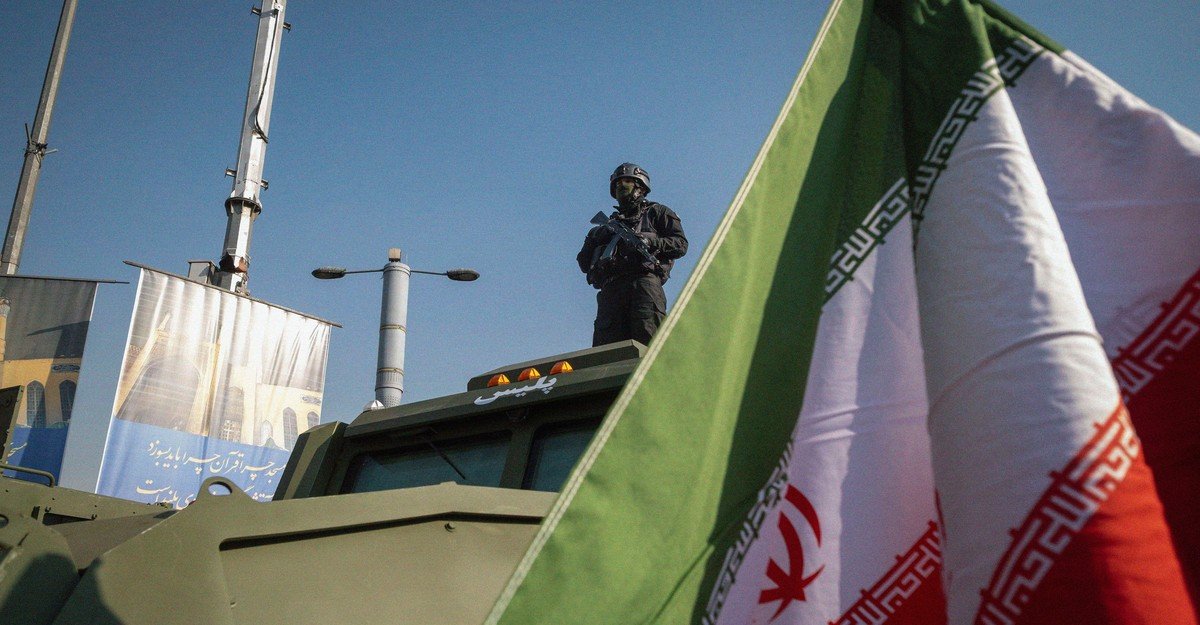
Both sides fired shots yesterday, although the U.S. claims that the cease-fire remains in place. The fact that Iran’s leaders are apparently willing to risk violating the delicate monthlong truce emphasizes just how fiercely they want to protect their hold over the strait. The past 65 days of war have badly punished Iran: Its leaders are dead, its navy and air force have been depleted, and its economy and infrastructure have been decimated. “If we leave right now,” Trump said last week, “it would take them 20 years to rebuild.” But amid the destruction, the country has also found new forms of leverage. Iran had not previously exercised this degree of control over the Strait of Hormuz, and before the war, the country could not have been confident that it would be able to do so. Even in its diminished state, the Iranian military has managed to deter enemy ships and outmaneuver anti-air systems, maintaining that grip on the strait while costing the U.S. billions.
After the U.S. and Israel began their military action, the Iranian government said it would attack any ship that tried to sail through the strait, and began deploying mines as deterrents. Before the war, more than 130 ships passed through each day; yesterday, that number was down to three. The ships that do cross now mostly do so under the strict supervision of Iran’s Islamic Revolutionary Guard Corps, which reportedly has been demanding tolls in cryptocurrency and Chinese yuan, and rerouting traffic away from Oman, toward Iran-controlled waters.
Iranian dominance over the strait may well be the new norm. On Sunday, Iran’s Deputy Speaker of Parliament Ali Nikzad was emphatic that the country “will not back down” from its position on the strait, “and it will not return to its prewar conditions.” That’s because the country’s restrictions on the strait have succeeded on a strategic level, creating a global energy shock and unleashing economic devastation around the world—putting massive pressure on the U.S. and Israel to come to the bargaining table. Trump has demanded that Iran “Open the Fuckin’ Strait,” but as Iran’s threats yesterday made clear, we’re a long way off from the pre-February status quo. Even when Iranian leadership has offered to reopen the strait as part of potential peace deals, as it has over the past month, it has done so with the knowledge that Iran could always reassert control. That’s exactly what happened on April 17, when the country declared the strait open to all; the next day, Iran reimposed its restrictions on passing ships, effectively closing the waterway once again.
The strait is not the only tool available to Iran. As recently as this weekend, Trump said that the country has “no navy” and “no air force.” But U.S. officials told CBS in late April that they believe 60 percent of its navy is still “in existence”and two-thirds of its air force is “operational.” Although the Iranian military is indeed far weaker than the U.S. military, it has also reportedly proved scrappier and more capable than expected. Last week, the Pentagon offered its first estimate of the total cost of the war in Iran thus far: $25 billion. A single high-tech American weapon might cost millions; Iran’s signature drone—known as the Shahed-136—costs only tens of thousands, and has been threatening U.S. partners, such as Kuwait, Bahrain, and Azerbaijan, throughout the region. The anti-air munitions required to shoot them down can cost more than the Shaheds themselves. And when Shaheds do penetrate air defenses, they can be deadly.
Meanwhile, the country’s “mosquito fleet” of nimble, surveillance-dodging boats has been intimidating military and commercial vessels alike, projecting Iranian power in the strait. Admiral Brad Cooper, who leads U.S. Central Command, told reporters yesterday that the U.S. “blew up” six small Iranian boats in the area—a possible example of the IRGC’s reduced capacity. More typically, Cooper explained, the Iranian military deploys “between 20 and 40 small boats” when it intends to harass vessels. But a reduction in capacity is not the same as defeat. As my colleagues Nancy A. Youssef and Jonathan Lemire reported last week, officials inside the Trump administration have admitted to being surprised at Iran’s resilience.
Although Trump insists that Iran has been completely destroyed and that the war is over, reality suggests otherwise. After two months of war with a superpower, Iran is in some respects outmatched: The U.S. said it bombed more than 13,000 targets during Operation Epic Fury. Yet Iran has refused to concede, even as hundreds of its own civilians have died and the rest have suffered from an economic crisis. U.S. efforts to fully degrade Iran’s defensive capacities may ultimately end up succeeding. But the longer Iran is able to inflict economic pain across the world, and the longer its depleted defensive capabilities hold, the more evidence its leaders have that it can continue to stand firm.
Related:
Here are three new stories from The Atlantic:
Today’s News
- Secretary of Defense Pete Hegseth said that the U.S.-led mission to reopen the Strait of Hormuz is “separate and distinct” from the broader war with Iran and described it as defensive and temporary.
- The World Health Organization said close-contact transmission among humans is suspected in a cruise ship’s hantavirus outbreak that has killed three people and infected at least seven; the virus is typically spread to humans through contact with infected rodents. About 150 passengers remain stranded off Cabo Verde while two patients are being evacuated, but officials say the public risk is low.
- In an interview yesterday, President Trump accused Pope Leo XIV of endangering Catholics by opposing the U.S. war with Iran. Secretary of State Marco Rubio is set to visit Rome and meet with the pope on Thursday.
Evening Read
What Adding Race to BMI Can Do
By Katherine J. Wu
In recent years, the perils of body mass index, or BMI, have become a hobbyhorse for professionals in several fields of medicine and research. For decades, doctors have used BMI to help diagnose and treat obesity, diabetes, and other chronic conditions, even as evidence has accumulated that the metric is a poor proxy for excess fat. BMI factors in height and weight but not actual body composition; many people with high BMIs are the picture of health, and many with “healthy” BMIs are at serious risk of metabolic disease. The case against BMI is strong enough that many in medicine would like to be free of it.
Gripes have been raised, too, about medical guidance that relies on race. Although race can track with some factors that influence health, such as lifestyle and socioeconomic status, its relationship to genetic differences is tenuous: Designations such as “Black” and “Asian” cover so many people, with such varied backgrounds, that they’re essentially meaningless as biological categories. When doctors have used race to assess well-being, they’ve missed diagnoses and discriminated against patients. Experts now widely consider many race-based tools in medicine to be harmful and outdated, and are eager to leave them behind.
But researchers and clinicians still rely deeply on both BMI and race, in some cases at the same time.
Read the full article.
More From The Atlantic
Culture Break

Explore. The Met Gala wasted an opportunity to really make the case for fashion as art, Shirley Li argues.
Read. Adam Begley on the secret of Elizabeth Strout’s appeal: She writes best sellers that are also critical darlings.
Play our daily crossword.
Explore all of our newsletters here.
Rafaela Jinich contributed to this newsletter.
When you buy a book using a link in this newsletter, we receive a commission. Thank you for supporting The Atlantic.



