
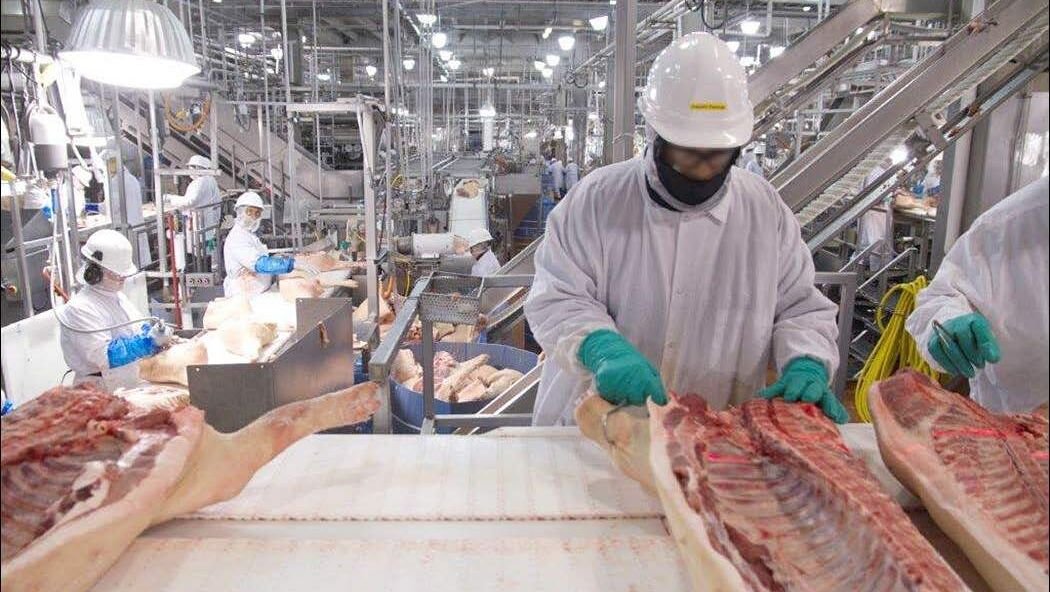
 WASHINGTON — The lives of slaughterhouse workers, who hold some of the most dangerous jobs in the U.S., would be at greater risk if the Trump administration puts into effect proposals backed by the poultry and pork industries.
Two proposed regulations, pending at the Department of Agriculture, would allow meatpacking companies to increase their assembly line speed.
“Even with existing line speed limits, severe injuries are frequent,” Senate Democrats, including New Jersey Sen. Cory Booker, who is leading a push against the rule changes, wrote in a letter on Thursday. “Amputations in poultry facilities are almost five times the average for all industries, while meatpacking workers overall suffer 14 times as many.” Booker sits on the Senate Agriculture, Nutrition, and Forestry Committee, which has jurisdiction over the national food supply.
For chickens, the USDA proposed raising the slaughter-per-minute maximum to 175 birds from 140. For turkeys, the department supported lifting the limit to 60 from 55 to 60 birds permit, and it endorsed lifting all limits on pigs.
Raising or eliminating line speed limits would mark a victory for meat industries and trade groups, such as the National Chicken Council and the National Turkey Federation.

The USDA is finalizing the two rules as Congress writes a multiyear agriculture bill. At the same time, the federal unit in charge of slaughterhouse inspections, the Food Safety and Inspection Service, is reeling from staff cuts.
In 2025, the safety service, which is a USDA division, lost 8% of its staff, according to Food & Water Watch, an environmental and legal advocacy group that opposes the faster line speeds. “To protect workers, consumers, and animals, these dangerous facilities need more oversight — not less,” Dani Replogle, an attorney with the group, said in a statement.
‘Gold standard’
Senator John Boozman of Arkansas and Pennsylvania congressman Glenn Thompson, the two committee chairmen who dominated the writing process of that legislation, known as the farm bill, applauded the line speed proposals in February, when they were proposed.
“We are pleased to see USDA take this next step to modernize and provide much-needed certainty to our pork and poultry supply chains,” Boozman and Thompson said at the time. “America’s meat and poultry companies continue to set the gold standard worldwide for food and worker safety.”
“Increasing line speeds will allow the U.S. poultry industry to thrive through greater global competitiveness and benefit consumers through greater operating efficiencies all without sacrificing food or worker safety,” Ashley Peterson, an executive with the National Chicken Council, wrote to the food safety service head on April 20.
In their comments to the leader of the food safety service, Lindy Froebel, an executive with the National Turkey Federation, said the trade group “would prefer that establishments be permitted to establish their own line speed limits,” though it supports the increased speed proposal.
During President Donald Trump’s first term, USDA issued a rule to permit pork companies to run their lines as fast as they wanted. A federal judge in Minnesota blocked that rule in 2021 after unions challenged it.
Labor unions and external worker-safety groups have long said that increasing line speeds in an environment with blood and animal carcasses would place workers at physical risk and could spread disease.
Pain after three months
“Meatpacking workers know the potential impact of this proposed rule better than any elected official, bureaucrat or industry talking head,” said Mark Lauritsen, director of food processing, packing and manufacturing division at United Food and Commercial Workers, a national union. “Workers will find themselves in more dangerous workplaces, consumers will be at risk of buying unsafe meat and communities will face the possibility of plants closing if this rule is finalized.”
Seventy percent of poultry workers experienced “moderate to severe work-related pain” within three months of hire, and 81% of all workers were at increased risk of“musculoskeletal disorders, according to a USDA-backed study published last year. To complete the study, the food safety service funded a team from the University of California, San Francisco.
Another safety service-funded study of pork plants found 46% of workers were at high risk for ailments such as carpal tunnel syndrome.
In their letter last week, Booker and his colleagues said raising line speeds could be a national health problem. “It is unacceptable to create a work environment that will increase the harm to workers and to subject them to more life-changing injury and the public to more foodborne illness,” the members of Congress wrote.



