
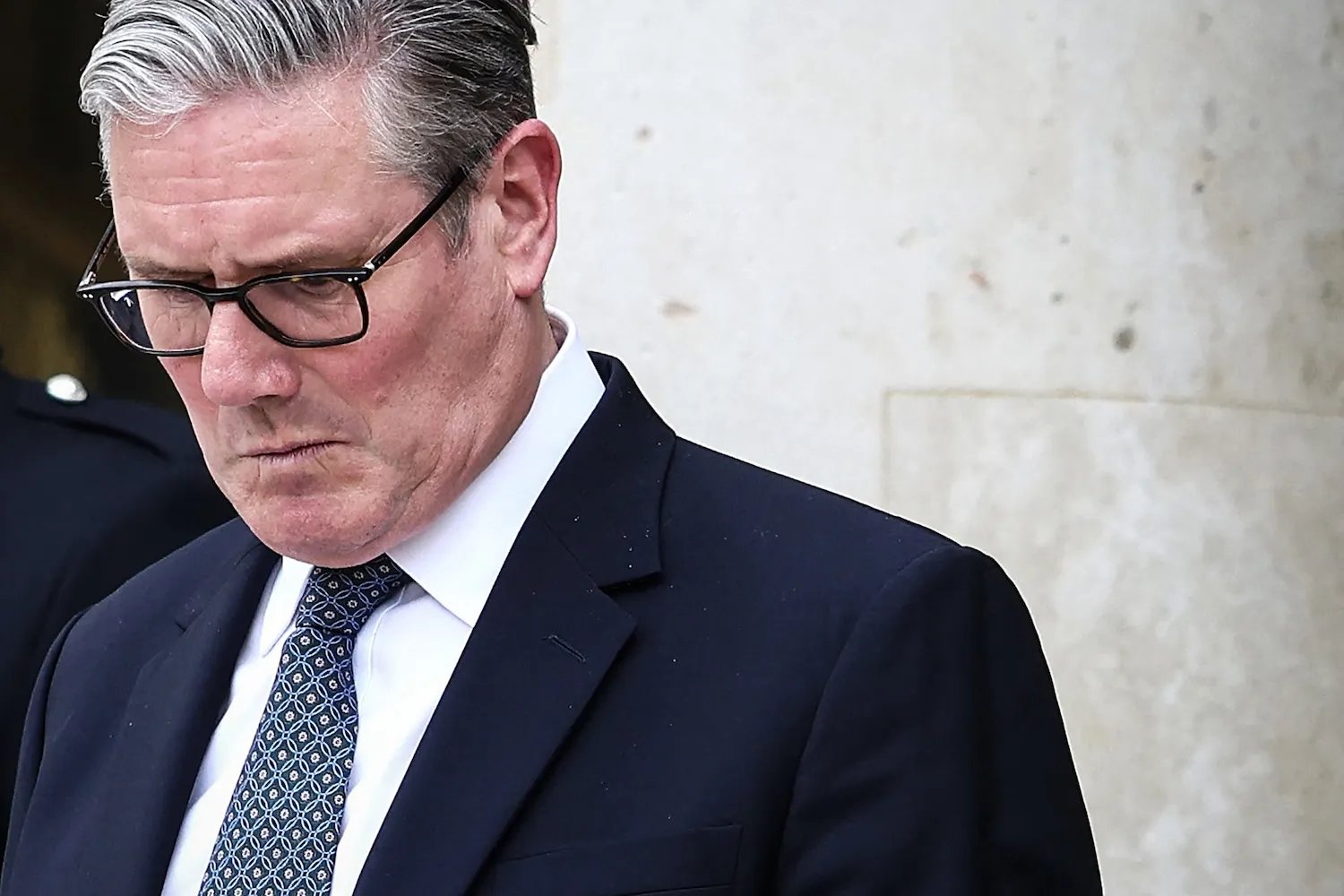
Keir Starmer was always a curious choice for Labour Party leader; he never got the hang of politics and often gave the impression he didn’t want to. Britain’s former chief prosecutor rose imperceptibly up the party ranks at a time when Labour was desperate for someone with the basic commodity of competence—nothing more, nothing less.
The Britain of 2020 was in the throes of post-European referendum chaos. It had just transpired to elect Boris Johnson as prime minister, despite his buffoonery, based on his vague promise to “get Brexit done.” The main opposition party was in the grasp of the far-left Jeremy Corbyn. It decided on a change of course and settled on a man with no history: Starmer.
Keir Starmer was always a curious choice for Labour Party leader; he never got the hang of politics and often gave the impression he didn’t want to. Britain’s former chief prosecutor rose imperceptibly up the party ranks at a time when Labour was desperate for someone with the basic commodity of competence—nothing more, nothing less.
The Britain of 2020 was in the throes of post-European referendum chaos. It had just transpired to elect Boris Johnson as prime minister, despite his buffoonery, based on his vague promise to “get Brexit done.” The main opposition party was in the grasp of the far-left Jeremy Corbyn. It decided on a change of course and settled on a man with no history: Starmer.
His promise was to make Labour electable again, and that he did emphatically. In July 2024, Labour won a general election for the first time in 14 years and with a thumping majority of 174. It was the third-best showing in the party’s history. The Conservatives had collapsed. The two insurgent parties that are now the talk of the town—the far-fight Reform UK and leftist Greens—were nowhere to be seen.
Starmer inherited an economy in the doldrums, overleveraged on the bond markets, and a moribund public infrastructure. There was little of the exuberance and optimism that marked Tony Blair’s famous victory in 1997. But there was relief and an assumption that the dour new prime minister would roll up his sleeves and make things work again.
Less than two years later, the mood is sourer, and living standards for most have continued to stagnate or have fallen further back. Starmer is on his last legs, assailed by all factions within his party and suffering possibly the worst opinion poll ratings of any prime minister in recent times. In recent elections for local councils in England and for parliaments in Scotland and Wales, Labour was humiliated.
As members of his own party have called on him to resign, or to set a timetable for a more gradual and dignified departure, Starmer has dug in his heels. He has promised to learn the lessons: A big speech was advertised as relaunching his leadership with added passion and vision. Instead, it was a damp squib. He couldn’t do it because he can’t do it.
How did it all come to this?
In his biography of Starmer, published shortly before Starmer entered No. 10 Downing St., Tom Baldwin called him the “unpolitician”—“because he doesn’t fit the template of political leaders,” Baldwin wrote in the Guardian in February 2024. Baldwin intended the phrase as a compliment, adding: “His backstory is messy and flawed, and he has neither a grandiose vision that can be summed up in a three-word slogan nor the kind of charisma that for so long made so many think Boris Johnson was unbeatable. However, even if ‘unpolitician’ had been a real word, it still wouldn’t have been a fair description of Starmer who, for all his misgivings about this profession, has learned how to become pretty good at it.”
Though still personally loyal, Baldwin has joined the mass ranks of those who see how much he has disappointed.
Almost from the first day he took office, Starmer set a gloomy tone and embarked on a timid approach to policymaking. On the odd occasion when he allowed his ministers to show some determination, the government ended up doing a U-turn to tone down or abandon a particular proposal.
He abandoned plans for welfare reform after a rebellion among his ranks. He angered older Britons by announcing cuts to support for heating payments, only to back down. Among the many fiscal changes that were then reversed or pared back, the plan to increase inheritance tax on large plots brought farmers onto the streets. He botched the introduction of digital ID cards, turning a proposal that had been popular into one that was deeply unpopular. The longer the list (and there were many more failures), the more he became the butt of jokes.
Starmer could never make up his mind. He feared upsetting anyone and ended up infuriating pretty much everyone. So determined was he not to leave himself open to attack, Labour went into the 2024 election campaign pledging not to increase income or sales tax. That left the Treasury with no headroom. Starmer’s government then briefed that it might have to break the pledge—which raised hackles but was praised by some for showing candor—only to end up not doing so and trying to cobble other tax revenues on the sly.
Timidity, U-turns, countless relaunches that went nowhere, the communication skills of a funeral director, and endless unnecessary mistakes. But the problem was more fundamental than that. Starmer never knew where he stood on the big issues of the day. He allowed himself to be swayed by a single advisor, his chief of staff Morgan McSweeney, who became possessed of the view that Labour had lost the working-class vote and needed to tack rightward to win it back from Reform.
The worst of several faux-populist speeches led Starmer to echo the views of the archconservative MP Enoch Powell of the 1960s, warning that immigration was turning Britain into an “island of strangers.” Amid the opprobrium that followed, Starmer tried the excuse that he didn’t realize the racist toxicity of the connection.
Then came the single-worst decision—the one that has taken him to the brink. A man who would walk across the street to avoid taking a risk, Starmer decided to throw caution to the wind in his choice of Peter Mandelson as Britain’s ambassador to the United States.
It would later transpire that Mandelson—a former cabinet minister and European commissioner, a man synonymous with the creation of the Blair era, a man who had been close friends with Jeffrey Epstein and had strong business ties to Russia and China—had been deemed a risk in his security vetting report. Somewhere between the Foreign Office and Downing Street, this seemingly wasn’t relayed, as everyone knew Starmer wanted to appoint Mandelson and they didn’t want to upset the prime minister. The paradox is that Starmer didn’t particularly like him but was persuaded that he would be the right person to get into U.S. President Donald Trump’s good books. It backfired—spectacularly.
Starmer immediately sacked the head of the Foreign Office. The body count now includes one cabinet secretary (a post that includes the head of the Civil Service), and from within Downing Street, two chiefs of staff, at least three heads of the policy unit, four communications directors, and many more senior ministers, advisors, and officials have “moved on.”
Starmer can rightly claim that he has been a steadying hand on the international front, working well with European partners on Ukraine. Relations with Trump have gone into freefall, but that doesn’t necessarily reflect badly on him—it is the fate of anyone who has not given the U.S. president uncritical support. His dogged negotiating skills might have made him more suitable as foreign secretary. Yet he cannot hide the diminution of British influence, in the Middle East, with China, and even in the Commonwealth. As for the European Union, it has become increasingly frustrated by Britain promising to “reset” relations and then avoiding serious discussion about the mechanism to achieve that, such as restoring links with the customs union and single market.
Deep disappointment he may have been, but the anger that has been directed toward Starmer appears out of proportion to facts. He hasn’t been given credit for any of the (small) improvements during his tenure, such as the lessening of waiting lists in the National Health Service, or for various reforms in education and elsewhere. The King’s Speech, delivered to Parliament on May 13—just as rivals were preparing to stand against the prime minister—included several legislative measures worthy of merit.
Yet voters have tuned out. Labour candidates during the recent council elections reported that very mention of his name at the doorstep often led to fury. Sociologists as well as political scientists and historians will point to a mix of factors—social media-driven bifurcated politics seen everywhere and a country that has long been ill at ease and struggling to find its place in the world.
Whatever transpires next, Britain’s reputation has taken a further hit. A change at the top would mean a seventh prime minister in 10 years (though it must be said the previous five were during the Conservative era). Whoever eventually takes over will need to show far more imagination and courage than Starmer has. And whenever it ends, Starmer’s term will serve as a how-not-to guide in the exercise of power.



