
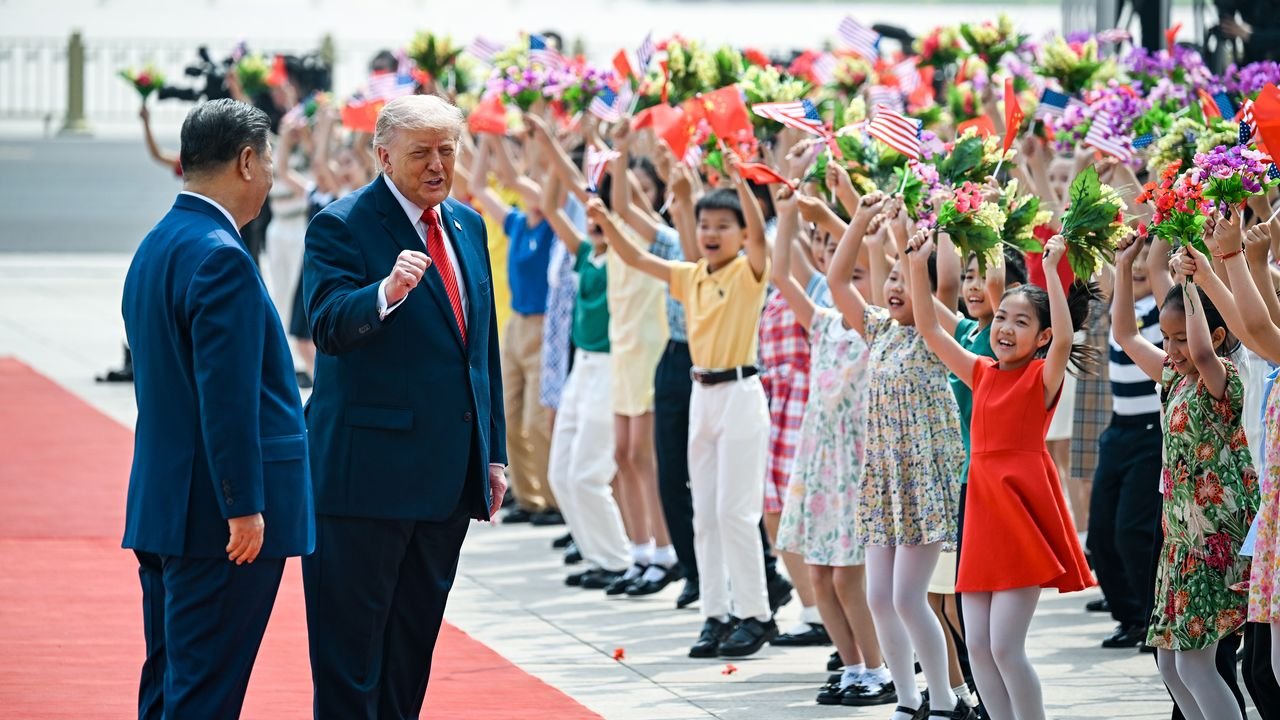
When it was Trump’s turn, he touted the C.E.O.s he had brought with him and praised the pageantry as “an honor like few have ever seen before.” After another handful of sentences, the press was ushered out.
In fairness, most of the press was never there. Other than the Chinese state press, and a small pool of reporters who traditionally accompany American Presidents, many journalists rarely came closer to the action than a conference room several miles away. Most of the news emerged through Sean Hannity, the Fox News personality, who had flown to China aboard Air Force One. Fox broadcast Hannity as he interviewed Rubio and spoke to a succession of others close to the Administration. The coverage seemed fitting in Beijing, where the leaders of an authoritarian government operate at a remove from the public, delivering slogans through the state broadcaster.
By the time Trump and Xi had arrived at their next event, a stroll through the tranquil environs of the Temple of Heaven, where emperors once prayed for good harvests, state media was putting out its first words about the meeting. It reported that Xi’s “most important” message to Trump concerned Taiwan: a warning to use the “utmost caution” so as to avoid “clashes and even conflicts, putting the entire relationship in great jeopardy.” The White House’s own statement about the meeting made no mention of Taiwan. Instead, it led with a sunnier interpretation: “The two sides discussed ways to enhance economic cooperation between our two countries.”
In Washington, Trump rarely passes reporters without pausing to hold forth. In Beijing, he was less inclined to take questions. He did sit down with Hannity to announce that China had agreed to buy two hundred airplanes. (Attentive observers recalled that the original projection was five hundred; Boeing shares dropped more than four per cent.) Trump also told Hannity that he had pushed China to buy more American agricultural products. “Talked about soybeans for our farmers,” he said, adding, “When you have that many people, they need it.” When asked about discussions of China’s program of industrial espionage, Trump complained that a “60 Minutes” reporter had posed a similar question before he left. He said that he’d responded, “They spy on us, I said, we spy on them, too,” and dismissed the reporter as a “stupid person.”
The festivities were not without moments of cultural friction. The two sides’ security teams fell into at least one dispute, when an American Secret Service officer wanted to bring a weapon into a restricted area. But the incidents paled beside the prospect of transactions. In the evening, Trump returned to the Great Hall of the People for a lavish state banquet, featuring roast duck. (The C.I.A. study of Chinese negotiation cited Henry Kissinger once telling his hosts, “After a dinner of Peking duck I will agree to anything.”) Over dinner, the leaders toasted each other, and Trump invited Xi to the White House later this year. Xi seemed a half step removed; he is not a man prone to displays of clubby kinship, though he has described Russia’s President, Vladimir Putin, as his “best friend.”
When Trump left the hotel on the morning of his departure, the pool reporter on duty confessed to colleagues that, in the argot of White House coverage, “Pool did not lay eyes on POTUS.” The motorcade crossed town to Zhongnanhai, a former imperial garden that is now the secretive headquarters of the Chinese Communist Party. Trump was there somewhere, but the pool reporter could convey little more than a message from the White House: “President Trump will be met by His Excellency Xi Jinping,” and the two “will participate in a Friendship photo.”
Eventually, Xi and Trump walked into view of the assembled press, taking in the walled gardens and ornamented roofs. Xi mentioned that he “very rarely” brought other heads of state there, then added, with a chuckle, “For example, Putin has been here.” Trump marvelled at the size of Chinese roses, and Xi promised to give him seeds to plant in the White House garden. “I like this place,” Trump said. “I could get used to this.”
They settled once more in an opulent meeting room, with a vast gold carpet. With Xi beside him, Trump said, “This has been an incredible visit. I think a lot of good has come of it. We’ve made some fantastic trade deals, great for both countries.” On the most pressing issue—the war in Iran—Trump suggested, vaguely, that the two leaders “feel very similar” about it. “We want that to end,” he said. “We don’t want them to have a nuclear weapon. We want the straits open.” But neither he nor Xi gave any indication that China had committed to pressuring Iran. Instead, Trump lingered on praise for his host. He called Xi “a man I respect greatly” and said he’d “become really a friend.”



