
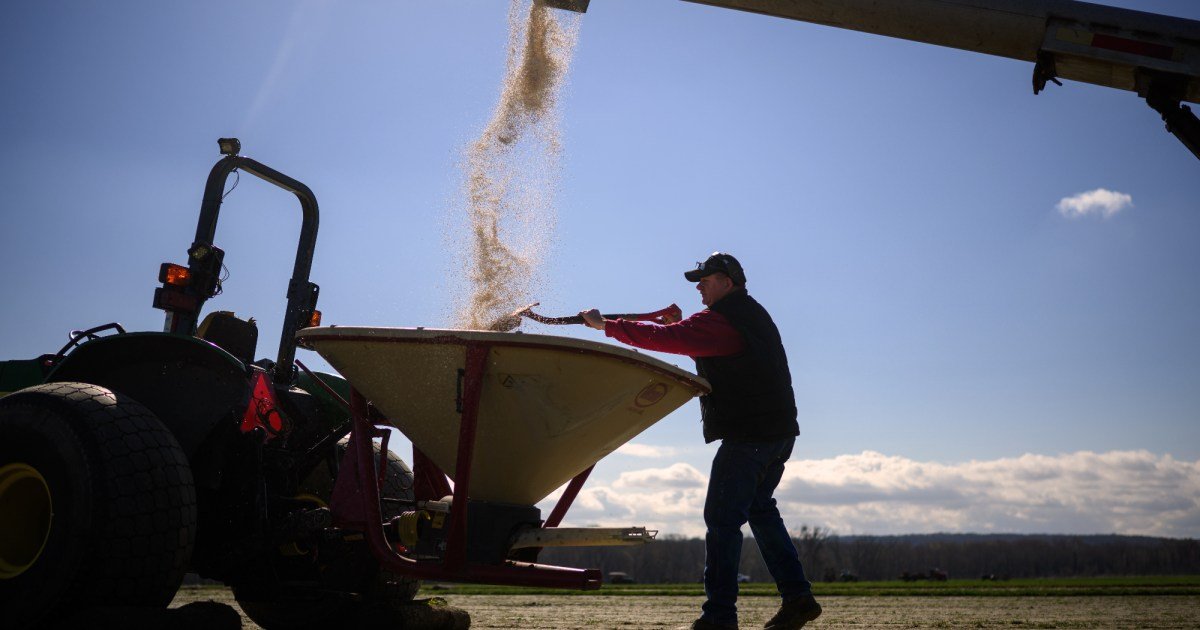
Bill Collins, a farmer in Connecticut, prepared to spread fertilizer across his crop in April. Collins has already decided to cut production by 20% this year thanks to soaring fertilizer prices. Mark Mirko/Connecticut Public via Getty Images
It’s planting season, and 70 percent of American farmers can’t afford enough fertilizer to plant all their crops. About a third of the planet’s nitrogen fertilizer, the most widely used in global agriculture, must pass through the Strait of Hormuz. Thanks to Donald Trump and Benjamin Netanyahu’s war on Iran, that waterway is essentially still closed to most ships.
It’s been described as a “slow-moving food crisis”: when farmers can’t buy fertilizer, they don’t plant as much, and months on, that shows up in scarcer, pricier food. United Nations estimates that 45 million people worldwide could go hungry thanks to the closure of the Strait of Hormuz. Though the situation is not quite as dire in the US, American farmers are feeling the squeeze, too: fertilizer prices are changing by the minute, soybean farmers are still facing export tariffs, and diesel costs are up, too.
In an Agriculture, Nutrition, and Forestry Committee hearing Tuesday, Arkansas Republican Sen. John Boozman proclaimed that “food security is national security.” But the hearing offered few governmental solutions to the fertilizer shortage—particularly not ending the war.
Trent Kubik, president of the South Dakota Corn Grower’s Association, told the committee he’s had a hard season on his farm. “We expected our costs were going to be higher than normal, as we’d be purchasing [fertilizer] closer to peak demand season,” he said, but with the war on Iran, they’re “nearly doubling.”
He’s not the only one. In the first quarter of 2026, 86 American farms have already filed for Chapter 12 bankruptcy. And while farmers suffer under the Hormuz blockade, fertilizer producers’ revenues continue to increase.
“The fertilizer industry is one of the most heavily consolidated industries,” Omanjana Goswami of the Union of Concerned Scientists, who studies agricultural policy, told Mother Jones. “At the same time that these companies are making billions of dollars in profits over the years, farmers have seen profit margins go down drastically because of the higher cost of fertilizer.”
Four major manufacturers control nearly the entire US fertilizer market—and they’ve increased nitrogen fertilizer prices 28 percent since the war on Iran began in February, according to recent University of Illinois data.
Meanwhile, farmers are scrambling, planting less food, and switching to less fertilizer-thirsty crops. “About 4 million acres of corn [in the US] have been switched over to soybean, just to make up for the fact that fertilizer availability was much less this spring,” Goswami said.
“That’s the thing that we feel the worst about,” Kubik, the corn farmer, said. “During the last 75 days, a lot of money was being made–but it wasn’t by farmers.”
“Farmers get thrown head first into a crisis every time global supply chains are hit,” Goswami said. That reoccurring crisis—which also happened when Russia invaded Ukraine in 2022, and during the early months of the COVID-19 pandemic in 2020—is the product of an unsustainable agricultural model that requires massive amounts of fertilizer to be shipped from overseas. Some experts suggest that even if the war on Iran ends tomorrow, high fertilizer prices will persist through at least 2027.
The Iran war fertilizer shock, Goswami added, will likely impact wheat in particular.
Combined with some bad weather earlier this spring and an unrelenting drought in the plains states, the war is making this the worst year for wheat yields in decades. Most wheat grown in the US (unlike, say, corn or soy) is destined for consumption by humans, which means there’s a good chance we’ll see that price shock in the bread aisle later this year.
Meanwhile, beyond some efforts at mandating greater price transparency from fertilizer manufacturers, farmers haven’t been offered any real relief.
Sen. Raphael Warnock (D-Ga.), at Tuesday’s hearing, was indignant. “Between the war in Iran, spiking fuel and fertilizer prices, and illegal trade wars, increasing the cost of equipment, and limiting market access, it’s no wonder that farmers in Georgia I talked to say that they can’t take much more,” he said at this week’s hearing. “Fertilizer prices are increasing. Diesel costs have increased by over $2 a gallon compared to this time last year and there’s no end in sight. At this point, the best-case scenario for farmers is the reopening of the Strait of Hormuz.”
It was open, he pointed out, before the war started.



