
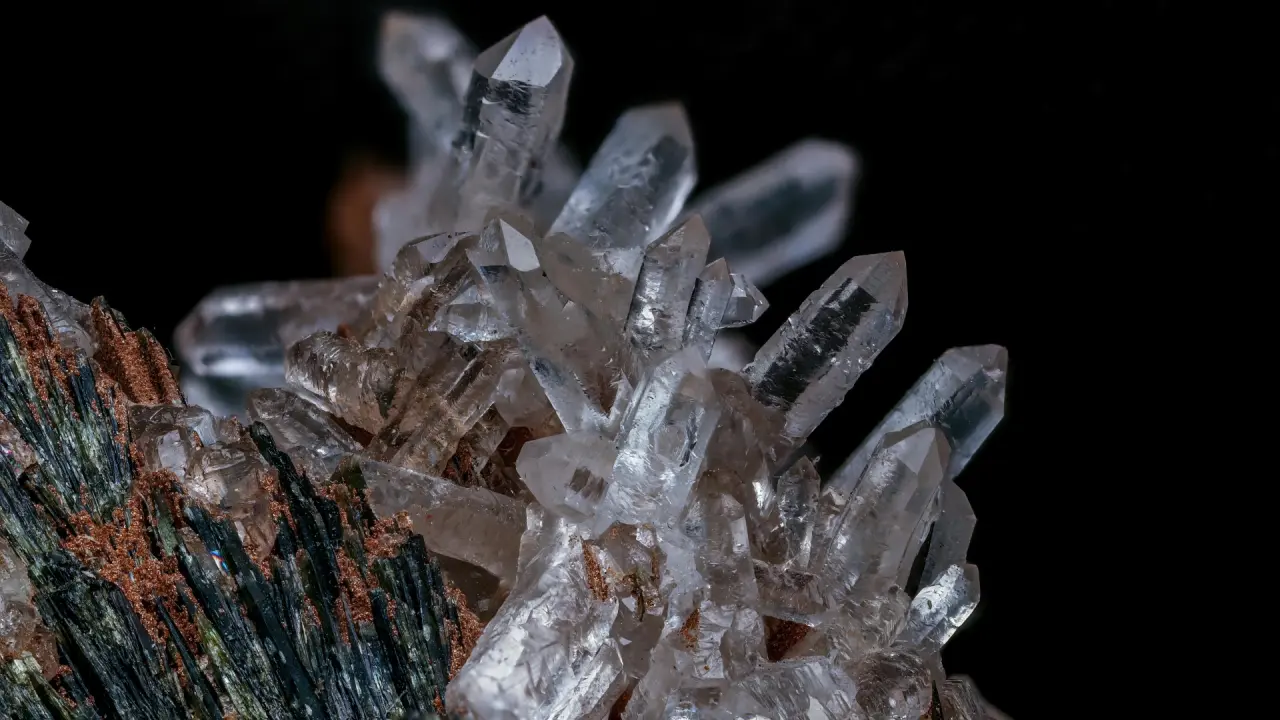
Crystals are often admired for their beauty, but their inner structure is far from simple. At the atomic level, most crystals are not perfect. They contain small irregularities, such as missing atoms or extra bonds, which can change how the material behaves. These defects can weaken a crystal by starting fractures, but they can also make it stronger in certain cases.
A recent study published in The Royal Society Open Science by researchers at Osaka University takes a fresh look at these imperfections. The team used differential geometry, a branch of mathematics that studies curved and twisted spaces, on Riemann–Cartan manifolds to build a unified mathematical model explaining how different crystal defects behave.
A Riemann–Cartan manifold is a type of geometric space used in advanced physics and mathematics to describe shapes that can both curve and twist. Ordinary curved spaces in Einstein’s relativity only bend, but Riemann–Cartan spaces also include torsion, which measures twisting within the geometry itself.
“Defects come in many forms,” said Shunsuke Kobayashi, lead author of the study. “For example, there are so-called dislocations, which are tiny mistakes where rows of atoms become misaligned, associated with the breaking of translational symmetry, meaning the crystal no longer repeats perfectly when shifted in space. There are also disclinations, which are rotational defects where the atomic arrangement twists out of alignment, associated with the breaking of rotational symmetry, where the crystal no longer looks the same after being rotated. Capturing all these defects within one mathematical theory is not straightforward.”
The researchers focused on Volterra defects, a classical mathematical way of describing cracks, twists, and distortions in solids. They followed the Volterra process to derive the Cartan moving frame, a geometric tool that tracks how directions change in curved or twisted spaces, and the related Riemannian metric, the mathematical rule used to measure distances and angles in curved geometry, using exterior algebra, a branch of mathematics designed to simplify calculations involving directions, surfaces, and higher-dimensional spaces.
This approach helped them define the geometry of three types of dislocations and the wedge disclination. However, they found that twist disclinations, defects caused mainly by twisting distortions, could not be fully classified because of a persistent torsion component. This suggested that the traditional Volterra process may require modification.
To connect different defect types, the team used the interchangeability of the Weitzenböck and Levi-Civita connections, two mathematical methods for describing how objects change inside curved spaces — one emphasizing torsion and the other curvature. They also applied an analytical solution for plasticity, the permanent deformation of materials under stress, based on the Biot–Savart law, a physics law originally used to describe how electric currents create magnetic fields.
This allowed the researchers to mathematically prove the long-suspected relationship between edge dislocations, defects created by an extra row of atoms inside a crystal, and wedge disclinations.
“Differential geometry provides a very elegant framework for describing these rich phenomena,” explained senior author Ryuichi Tarumi. “Simple mathematical operations can capture these effects, allowing us to focus on similarities between seemingly different defects.”
The study also introduced additional mathematical tools. Riemannian holonomy, which studies how directions change after traveling around loops in curved space, was used to analyze the Frank vector, a quantity measuring the strength and direction of rotational crystal defects. Meanwhile, complex potentials, mathematical functions that simplify difficult physical calculations, were used to describe the topological properties of wedge disclinations — features that remain unchanged even when shapes are stretched or bent — as jump discontinuities, meaning sudden rather than smooth changes.
The researchers further derived analytical expressions for the linearized stress fields of wedge disclinations, simplified mathematical descriptions of internal forces within crystals assuming the distortions remain small, and confirmed that these matched previous results.
By extending and generalizing the classical theory of Volterra defects, the Osaka team has provided a stronger foundation for understanding how imperfections shape the mechanics of crystals. Their work demonstrates how advanced mathematics can reveal hidden order within structures that initially appear irregular.
The researchers hope this geometric approach may eventually help scientists and engineers design materials with carefully controlled properties by making strategic use of defects. For now, the study stands as an example of how mathematical beauty can help explain the beauty found in nature.
Source: University of Osaka, Royal Society Publishing
This article was generated with some help from AI and reviewed by an editor. Under Section 107 of the Copyright Act 1976, this material is used for the purpose of news reporting. Fair use is a use permitted by copyright statute that might otherwise be infringing



