
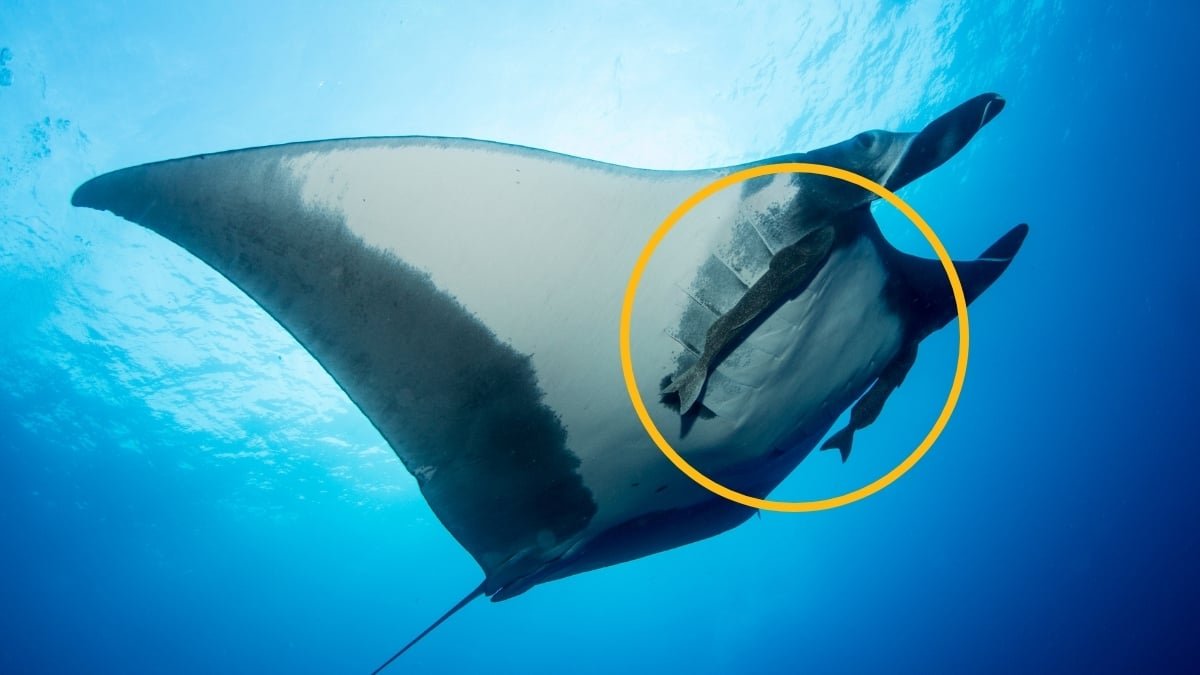
Remoras are pretty weird fish, but a new study shows they really have no boundaries when it comes to mooching off their manta ray hosts.
These tropical suckerfish are best known for hitching a ride on sharks, whales, and even turtles.
They grab on to their host with a sucker on the back of their head, which is actually a modified dorsal fin.
This allows them to travel much further than they ever would otherwise, while getting a nice flow of oxygenated water across their gills, and food scraps from their hosts’ meals.
Ecologists believe these hitchhikers are pretty much taking a free ride.
Dolphins and green turtles can get weighed down by too many of these fishy passengers, but most of the time, remoras don’t seem to bother their hosts much at all.
That is, until they get a bit too comfortable.
While reviewing photos and videos of manta rays (Mobula yarae, Mobula birostris, and Mobula alfredi) collected from manta ‘hubs’ across the world, a team of marine biologists noticed, on a few occasions, something weird going on with the remoras.
In just seven instances, across thousands of surveys conducted between 2010 and 2025, they observed remoras hiding out inside the cloaca of their manta ray hosts.
A cloaca, in case you’re not familiar, is a multi-purpose, rear-end hole that many animals use to release their body’s waste products and for reproduction.
It is not, presumably, meant to be a shelter for a fish, and yet some sneaky remoras seem to have decided it’s a perfect hiding place.
One astonishing video, captured by a freediver in Florida, USA, even captured a remora diving straight on in.
The video shows an adult Atlantic manta ray (M. yarae) with a medium-sized remora (Remora remora) hanging out near its pelvic fins.
“Once the diver passed into the ventral plane of the manta ray, the remora appeared to startle and quickly inserted itself into the manta ray’s cloacal opening,” marine biologist Emily Yeager and her colleagues report.
“In response to this intrusion, the manta ray briefly shuddered before continuing to swim away with the remora still inside of its cloacal opening.”
They call this fishy behavior ‘cloacal diving’. See it for yourself:
 frameborder=”0″ allow=”accelerometer; autoplay; clipboard-write; encrypted-media; gyroscope; picture-in-picture; web-share” referrerpolicy=”strict-origin-when-cross-origin” allowfullscreen>
“While this video clip was brief and does not show the remora reemerging from the cloacal opening, it is possible the unexpected presence of the freediver prompted the cloacal diving behavior, indicating the possibility that this behavior could be a response to perceived predation risk or other threat by the remora,” the team writes.
More disturbingly, the scientists believe the manta rays may not actually welcome the behavior.

Remoras have been spotted diving into the nether-regions of whale sharks before, but whale sharks (and their cloacas) are rather vast compared to their intrusive stowaways.
Manta rays are much closer in size to their hitch-hikers, and the medium-sized remora in that video could potentially cause its host some grief.
“While this behavior was documented through short interactions and the amount of time a remora may spend inside a cloacal opening is unknown, the presence of a moderately-sized remora in a manta ray’s cloacal opening could impede mating behavior, live birth, or defecation if the cloacal diving behavior occurs for extensive periods of time,” the team warns.
Related: Expired Cans of Salmon From Decades Ago Contained a Big Surprise
If there are remora hanging out in the cloacas of fish for longer periods, it would be difficult to know from a photo. While a few observations captured the remora’s tail poking out of the manta rays, it does appear they can become concealed entirely.
This behavior casts a shadow on the ray/remora relationship, once thought to be mutually beneficial.
“Evidence of cryptic harmful behaviors in new species indicates that these symbioses may be more parasitic, at least in some contexts, than previously understood,” the authors conclude.
The research was published in Ecology and Evolution.



