
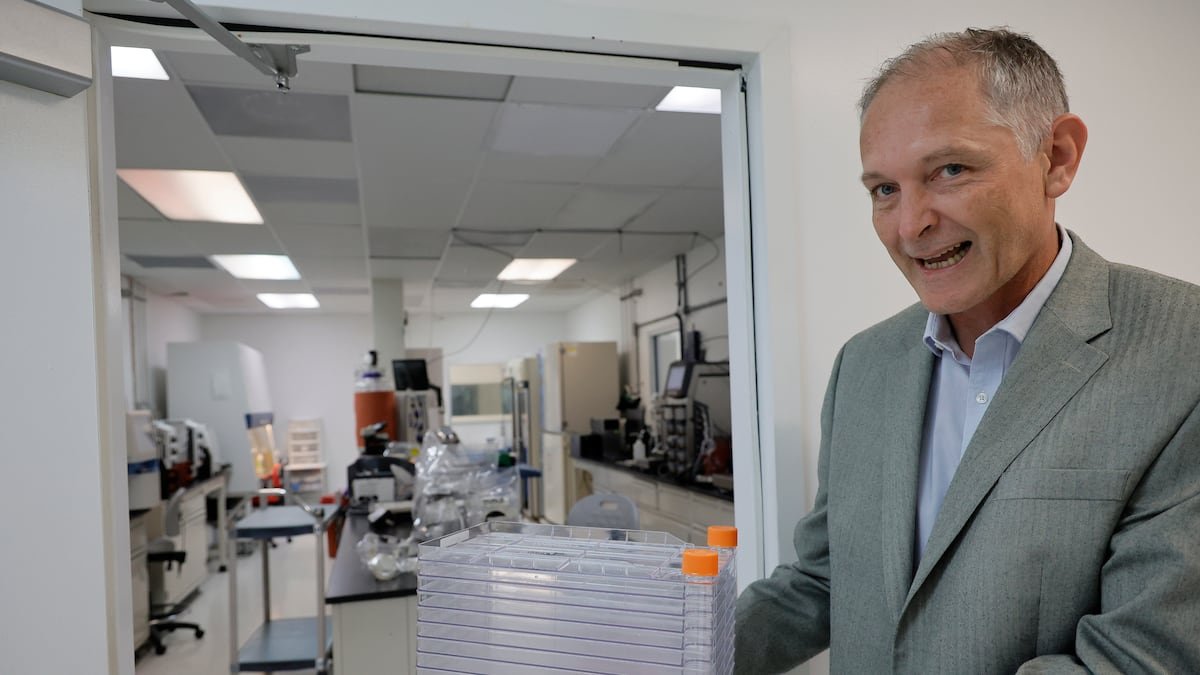
Inside a pristine laboratory at GBI Biomanufacturing in Plantation, stem-cell production ramps up, producing regenerative medicine with the potential to repair a torn rotator cuff, deep skin tear or an arthritic knee.
The escalation comes as the outlook for stem-cell therapies in Florida grows, driven by a new law that widens the path for doctors to use them to manage pain or treat orthopedic injuries and wounds.
For years, GBI Bio has manufactured therapeutic proteins and antibodies at its 40,000-square-foot Plantation facility, and while that work continues, the company has repurposed an additional 20,000 square feet, doubling its stem-cell manufacturing capacity.
“It’s a new line of business growth for us,” GBI President Jesse McCool said.
GBI employs 60 people, and expects to bring on 30 more, including biotech engineers and lab technicians as new orders come in.
Stem cells often are touted as a cure-all for everything from joint pain to Alzheimer’s, but the FDA has approved them only for a narrow set of disorders affecting blood production. Now, some states are making their own rules. Florida is one of five states that has green-lighted stem-cell use for conditions not yet approved by the U.S. Food and Drug Administration. That new law sparked GBI to increase its stem-cell manufacturing.
“Right now, we can manufacture enough stem cells for about 10,000 patients per year,” McCool said. “But demand is growing, and the process that we use today is pretty well tested, but not a very scalable process. We would like to go towards a much more scalable process.
“If our team can begin to use 3D production techniques, we can scale up to 1 million patients a year here,” he said.
McCool said his company has invested $26 million in private capital from Signet Health, and it’s likely his company will receive some state funding recently secured by state Rep. James Buchanan, R-Sarasota, who sponsored Florida’s stem-cell therapy legislation, known as Right to Try. Those funds would help the company complete the installation of bioreactors and clean rooms to increase capacity. GBI Biomanufacturing is one of a handful of companies in Florida involved in stem-cell production.
The 2025 Florida law explicitly prohibits the use of embryonic stem cells and instead focuses on sources such as donated umbilical cord blood and placental tissue. GBI gets much of its stem cells from bone marrow. Each commercial stem cell order is unique and created for a specific purpose, such as wound care or arthritis treatment.
“The trick is really how do you scale and keep your stem-cell products safe from microbial contamination and how do you keep them consistent? At the foundation, you have to have quality manufacturing,” McCool said.
In Plantation, lab workers in scrubs, hairnets, shoe covers, and gloves prepare solutions and buffers, while a microbiologist assesses the air quality in the engineering room.
Guiding visitors through a maze of machinery, Andrew Majdoch, vice president of technical operations, said the GBI’s facility must meet stringent government standards for approval, and quality control is critical. “Everything has to be documented,” he explains.
Dr. Bruce Werber, formerly a lower extremity surgeon, purchases stem cells manufactured by GBI and distributes them through his Pompano Beach company, BioXtek, to about 50 Florida doctors. Werber said the doctors use them for the types of patient care now permitted by Florida law.
“Stem cells are good at reducing inflammation and scarring and getting the body to heal itself,” Werber said. “With orthopedics, it is pretty much the same. With a torn ACL or Achilles tendon or rotator cuff, injecting stem cells around the injured area will help your body rebuild that tissue, and in many cases, reduce the need for surgical intervention.”
Werber said getting a good result requires using the right protocol to stimulate the tissue to receive stem cells and adding controlled, monitored exercise to heal the injury correctly.
Researchers have studied stem-cell therapy for medical purposes for more than two decades and continue to do so. Throughout the U.S., researchers have received a specific type of FDA approval for stem-cell trials, ranging from repairing cardiac muscle to reconstructing cartilage and bone to treating multiple sclerosis. The possibilities even include regenerating organs.
One of those researchers is Dr. Joshua Hare, co-founder of biotechnology company Longeveron and founding director of the Interdisciplinary Stem Cell Institute at the University of Miami Miller School of Medicine. Hare has studied stem cells as a treatment for Alzheimer’s disease, frailty, and heart disease.
“The interest has been there for a long time,” Hare said of stem cells. However, he said the 2025 Florida law and promising data have sparked renewed interest.
He has just published a study that shows a novel infusion of stem cells from young, healthy people into older individuals significantly improved their mobility.
“The big difference between stem cells and the other types of medicines that we use, first and foremost, is safety. They are incredibly safe and don’t have side effects, and the other big thing that’s exciting is that stem-cell therapy has a long-lasting effect,” he said.
Hare predicts that, within the next five to 10 years, doctors in the United States will be able to prescribe stem-cell-based therapies for numerous conditions.
“The future for stem cells, in my view, is they’re going to become a new class of drugs,” he said. “You’ll see more and more approvals, and I would say 10-15 years from now they’ll be in common use by doctors for multiple conditions,” he said.
Experimental stem-cell therapies are not covered by health insurance. And with treatments costing anywhere from a few thousand dollars to tens of thousands of dollars per session, the treatments by Florida doctors could be out of reach for some seeking relief.
But that could change with larger-scale production.
McCool says that if GBI Bio can safely scale production, it could eventually drive down the price of stem-cell therapy for patients.



