
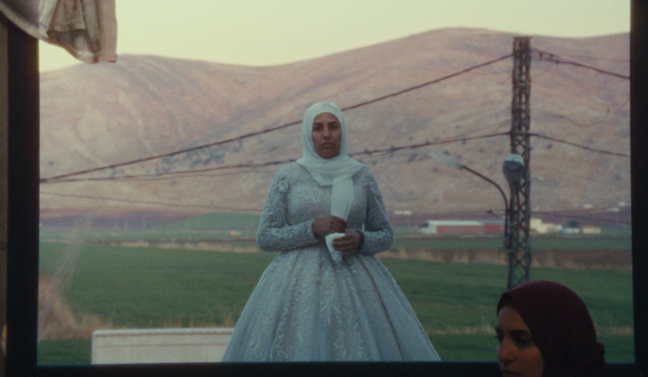
Toward the start of Rakan Mayasi’s stirring debut feature, “Yesterday the Eye Didn’t Sleep” — the only feature in this year’s Cannes official selection by a filmmaker of Palestinian descent — there’s a striking wide shot of women laboring in a fertile field amid the majestic snow-capped Anti-Lebanon mountains. As the still camera zooms in ever so slowly, our attention shifts from one of the film’s leads, Rim (first-time actor Rim Al Mawla), to the constant sound of a war drone in the distance.
Even if you didn’t know that Mayasi’s film — shot in March 2025 in eastern Lebanon’s Beqaa Valley, and an outgrowth of his short “Trumpets in the Sky” — is about a Bedouin family caught up in the country’s age-old intertribal blood feuds and cultural practices of honor and retaliation, you’d appreciate that contemporary Middle East and North African films that turn their eyes inward to their nations’ internal strife can’t avoid acknowledging the past century’s geopolitical cataclysms that have wrecked the region.

Speaking to IndieWire on Zoom ahead of “Yesterday’s” Un Certain Regard premiere, Mayasi said, “I tried to have this turmoil in the background. Israel has been bombing Lebanon whenever it wants. We were filming during a so-called ceasefire, a ceasefire from one side. There were two takes where Israeli jets bombed, obviously not near us, and we had the sound of explosions on the dialogue in the take. We had to remove the frequency in post.”
In the shot of the women working in the field, he also had to add the sound of the drone. “The moment I wanted it, it was not there. So [we] added it in post, just to have a nuance of this daily life. Israel uses psychological warfare to remind you [they] are here. They can silence the drones if they want, but they keep the sound on. I tried not to take a fully political stance, but [give] more like a political stage. The two tribes are in a fight. There’s also the bigger picture, the geopolitics of the area. It’s political, if you like it or not. [Politics are] part of the landscape of the region.”
How landscape intersects with tribal relations is the narrative backdrop for the somber, surprising, darkly poetic “Yesterday the Eye Didn’t Sleep.” When Yasser, the second son of the eight-member Al Mawla family (of the Mawali tribe), accidentally runs over and kills a man from the rival Jabour tribe, his two sisters, nurse Jawaher and fieldworker Rim are sent off to the Sheik of the other tribe as ritual honor offerings. During a fragile truce that is to last three days and a third, the Jabour men debate the sisters’ fate. Will they forcefully marry one to their sons? Will they kill one, or both? This mystery forms the crux of the film’s middle, even as surrealist scenes bring welcome tonal upheaval to the film’s last third.

Mayasi, who belongs to the Palestinian diaspora displaced during the Naqba of 1948, was born in Germany, grew up in Jordan, and is now based between Brussels and Beirut, where his mother and friends “from a previous life” still live. He says this film is truly an ode to his grandmother, who, like the protagonists of “Yesterday,” was forcibly married; in her case, she was 14.
Mayasi felt the deeply patriarchal honor system implicating an entire family would make for a compelling story filled with negotiated, tense situations. “I tried to be loyal to the universe of this occurrence. It doesn’t mean [a forced marriage] happened or has to happen, but that it could happen,” he said. His grandmother’s death three months before filming, while “emotionally really difficult,” gave him the strength to continue, “because there was no other choice.”
Did it get harder from a filmmaking standpoint that “Yesterday” was shot without a script? He doesn’t think so. Similar to recent fiction filmmakers like Kate Beecroft (“East of Wall”), who, like anthropologists and documentarians, spend extended time with their subjects, Mayasi felt compelled to return multiple times over three years to the Beqaa Valley. He wanted to unlock why his grandmother, in very different circumstances, was forcibly married at 14.
Moreover, “Trumpets” and his 2012 short “Roubama” were also made without scripts and dialogue. “I had to learn how to make visual sequences without needing to speak. But no script doesn’t mean no dialog only. It means you don’t really block the scene, and you don’t fully imagine the scene on paper. The way they teach us at film school, fuck that. These things make me feel I’m not free to explore, that I’m not open enough to let life interfere. ‘Yesterday’ was researched and written collectively with the family, but also the village. It was written on and for them.”
Which is one of the most remarkable discoveries in “Yesterday.” You suspect it, but you don’t fully know it until the end credits that the family in the film, who must make the terrible decision of giving up their daughters, is real. Even most of their names are the same.
How did he find the family? Mayasi said that once he decided on the story, he panicked over casting. He and his fixer would knock on doors and meet people. No luck.
Until his fixer said, “I want to show you this one house, just as a location.” And Mayasi said he finally chanced upon the Al Mawla family. He saw the older sister, Jawaher, and “just saw a spark in her eyes [with] a strong personality… she’s a nurse. I asked her whether she would like to act. And she said, ‘Yes, why not?’”
The father and mother gave their blessings too; they themselves didn’t want to be filmed but eventually agreed because of the trust Mayasi built over successive visits. He dove deep, sampling from and embedding himself in their lives. He followed Jawaher in her work as a nurse, studying how she dealt with babies and gossiped about doctors. Rim, though, wasn’t working. She used to be a fieldworker. At some point, Mayasi decided to switch the sisters’ roles, mainly for performance reasons.
“After getting to know them more, I realized that if I want to end the film more poetically and to release the idea of a classic resolution, I cannot end with Jawaher because Jawaher is more extroverted and I would need her in scenes where dialogue is needed, where she’s an engine in the scene,” he said. “But Rim is more poetic, she’s more introverted, discreet. She’s able to give me emotion and expression rather than the spoken word. So when I was thinking of the writing, I was also thinking of how it [would] affect the performances, knowing these women. I kept rewriting until the script became very loyal to the dynamics of the family, until we arrived at a point where there’s no acting. There’s just you being yourself in this situation.”
At the same time, Mayasi had to take advantage of the uniqueness of his situation. “I like what [avant-garde Russian American filmmaker] Maya Deren said, that the machinery should never be bigger than the artist. This made a lot of sense on this shoot. The community does not know the filmmaking discipline. I didn’t want to scare them with the machinery, like what happens when you put the camera on the left or the right. Because of that, I didn’t let them see the monitor. I didn’t want them to see what they looked like.”
Just as easily as Mayasi drops us into the breathless mystery about the sister’s fate, he switches gears readily from what he calls “narrative, neorealist filmmaking” by employing static shots in two unforgettable scenes of aesthetic and emotional power. What’s more, somehow he found a place in between them for a wedding dance scene of electrifying motion and sinewy slow-mo camerawork, edited with the stealth and danger of a predatory animal. These scenes announce the arrival of a director with indeed a certain regard in marrying political context with surrealist aesthetics, all the while honoring his indigenous subjects’ philosophy of life.
Mayasi shares a fascinating story about how he cast that dance sequence. “We had a group from the Syrian refugee camp next to us whom we invited,” he said. “They arrived, a lot more than expected, which was great. But to mix up their looks and [physicality] and to not have a single community [represented], I invited another village. The fixer drove two buses of 40-50 people from a Lebanese Bedouin village. There were a lot of people, maybe even more women than men at some point. We began filming at sunset into the night. We put up par can lights because why not stage it? It is a wedding [after all].”
The final impact of the scene on Mayasi is that it “felt out of this film completely and it acted like a climax. There’s no real climax in the film in the classic form but it helped because I needed… the film to go wild. Some tribe chooses this girl, she’s OK with it or she’s not okay with it, but she accepts it for the sake of the bigger picture. It’s always individual versus tribe, which is a main theme of the film. She sacrifices herself for the tribe, for her brother, for her family. It’s a very dark choice. So I said, let’s go crazy in this darkness. Let’s even watch a dance that we could enjoy somehow. But then when it finishes, we will feel guilty [and ask] how the fuck did we enjoy this?”
“Yesterday the Eye Didn’t Sleep” premieres at the Cannes Film Festival on May 20. It is currently seeking U.S. distribution.



