
Welcome to Foreign Policy’s Southeast Asia Brief.
The highlights this week: Gunfire erupts in the Philippine Senate, Malaysian authorities weigh a snap election, and scientists unveil the discovery of a massive dinosaur in Thailand.
Gunfire in Philippine Senate
On May 13, shots were heard in the Senate of the Philippines.
At the heart of the drama was fugitive Sen. Ronald “Bato” dela Rosa. Wanted by the International Criminal Court (ICC) on an arrest warrant that was unveiled on May 11, dela Rosa surfaced the same day for a crucial vote. After the melee on May 13, he again disappeared.
This is the latest twist in a struggle between President Ferdinand Marcos Jr. and his erstwhile allies, the Duterte family.
In the days before the firefight, the Philippine legislature had been consumed with an ongoing campaign to impeach Vice President Sara Duterte.
The House of Representatives advanced articles of impeachment on May 11.
Now the Senate must decide her fate. This takes the form of a trial for several alleged offenses, including corruption and threats to assassinate the president and his wife.
The last charge may be hard to deny, as she did so in comments that were streamed on Facebook, though she also said that the hitman she had retained would act only if she was killed first.
Duterte’s impeachment would prevent her from running for president in 2028. An attempt to impeach her was also launched December 2024, but this was blocked by the Supreme Court on procedural grounds.
Meanwhile, her father—former President Rodrigo Duterte—was arrested in March 2025 and sent to the ICC for trial over his so-called war on drugs.
As the impeachment articles advanced, dela Rosa—a staunch Duterte ally who had been hiding from his own ICC warrant concerning his alleged involvement in the drug war—appeared back in the Senate on May 11 for an important vote.
Sprinting into the chamber, the former police chief helped provide a majority to install a more pro-Duterte Senate leadership ahead of the trial. (Dela Rosa later claimed that law enforcement had been hot on his tail as he ran in.)
He then holed up in the Senate to try to avoid arrest. In a teary-eyed livestream the next day, he begged not to be sent to The Hague for trial. He also filed a petition with the Supreme Court in an attempt to block the warrant.
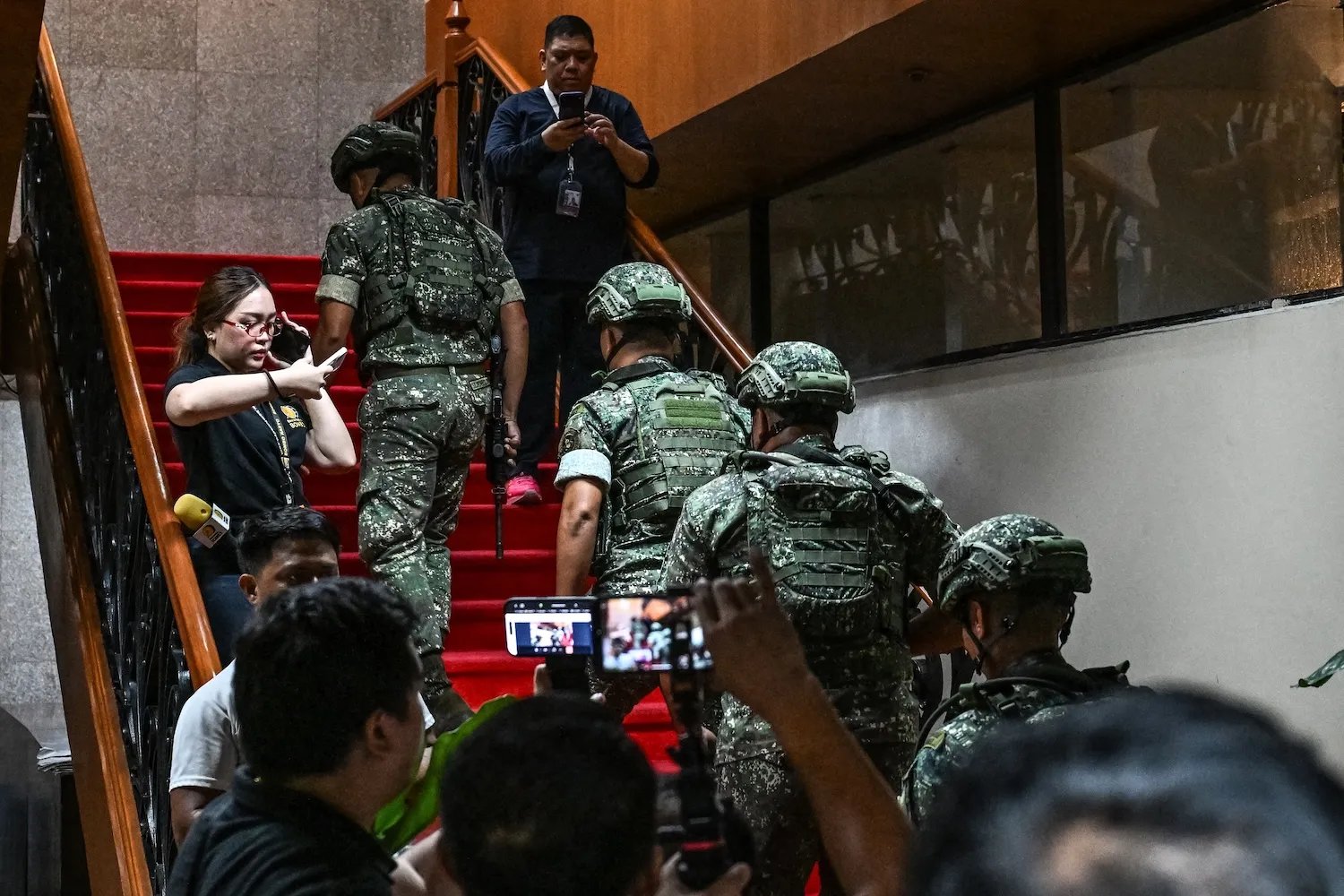
Then, on May 13, gunshots were heard as the Senate building was stormed by security personnel. And Bato disappeared once again.
Exactly what happened is murky.
The shots appeared to be the result of a clash between the National Bureau of Investigation (NBI) and personnel from the Office of the Sergeant-at-Arms (OSAA), which is charged with keeping order in the Senate. The NBI says that it was there to secure an adjacent building. Pro-Duterte senators said the NBI tried to drill through the walls to arrest dela Rosa and that the OSAA interpreted this as an attempt to breach the Senate.
A confrontation between the OSAA and the NBI ensured. No one was hurt, but there’s considerable argument about who was to blame. The NBI has suggested that the incident was deliberately provoked to give dela Rosa cover to escape.
There are now indications that dela Rosa might have left hours before the gunfight. Focus is now on a black van that left the Senate earlier in the day accompanied by a police vehicle. Some journalists claim that they saw him an elevator shortly before the incident.
Meanwhile, Marcos has denied that there was ever an order for the NBI to arrest dela Rosa.
What a mess. So what happens now?
Duterte will still face trial in the Senate, but whether she will be cleared or convicted remains uncertain.
Soon, the pretrial will begin. Duterte herself has been summoned and has 10 days to reply.
Early general election? Malaysian Prime Minister Anwar Ibrahim has said that he is considering a snap general election.
Legally, Anwar need not call an election for another two years, but there are escalating tensions in his coalition government.
Anwar’s musing followed the decision by a key member of the coalition, Barisan Nasional, to contest the Johor state election alone—and not cooperate with Anwar’s electoral bloc.
The prime minister’s base, made up of ethnic minorities plus a slice of the Malay vote that tends to be reformist, is splintering in all directions. Reformers are angry over scandals and lack of reforms, while minority voters feel sidelined.
Even the prime minister’s seat could be at risk in an election, according to leaked party report.
An opposition alliance between a Malay nationalist party and an Islamist party (the Malaysian Islamic Party, or PAS) could capitalize on this.
But after a period of bitter internal struggle, the opposition has appointed a leader from PAS. The specter of an Islamist prime minister could spook some voters into rallying to Anwar.
Barisan Nasional—which governed Malaysia for more than 40 years before its 2018 crash—is hoping for a revival. Yet the taint of old scandals—see the item below on Jho Low—might stick to he party.
A controversial film. A film about Indigenous communities in southern Papua has faced repeated attempts by various Indonesian authorities to block its screening.
Entitled Pesta Babi: Kolonialisme di Zaman Kita, or Pig Party: Colonialism in our Time, the film explores how locals in Papua are affected as the forests they live in are converted into industrial plantations as part of a government policy. It also tracks the ownership of the companies behind this.
Civil society groups have documented 21 occasions on which authorities have tried to block screenings.
On one occasion, the effort was led by a local military commander.
The government has denied ordering authorities to stop the film being screened.
The topic of Papua is extremely sensitive in Indonesia. The country took control of western Papua in 1969, having driven out the Dutch, who retained it as a colony after Indonesian independence.
However, the referendum that approved its entry into Indonesia is widely seen as having been stage-managed by the Indonesian government.
Since then, the region has seen a violent conflict between a long-running separatist movement and the Indonesian military. Over time, this has become bound up with murky—often military-linked—logging and mining businesses in the region.
The vast new food estates program that the film examines, spearheaded under President Prabowo Subianto, has created new land conflicts.
Critics say that the moves to suppress the film are part of wider authoritarian tendencies of the Prabowo government.
FP’s Most Read This Week
What We’re Reading (and Watching)
Who paid for the blizzard of anti-Singapore videos on Chinese social media? Kolette Lim investigates in the South China Morning Post.
An excellent long-form piece of video journalism by Channel News Asia examines how rare-earth mines in Myanmar are polluting Thailand’s waterways.
Indonesia has started to get older, and it might not get rich first. Deni Ghifari reports in the Jakarta Post.
In Focus: High-Flying Jho Low Asks Trump for Pardon
Malaysian financier Jho Low has requested a pardon from U.S. President Donald Trump, the Wall Street Journal reports. Jho Low is infamous as the suspected mastermind behind one of history’s largest cases of fraud, the 1MDB scandal.
Established as a government investment fund in 2009, 1MDB quickly became an enormous slush fund. Roughly $1 billion made its way from the fund to bank accounts linked directly to then-Prime Minister Najib Razak, who has since been convicted of corruption.
When Razak was arrested, media salivated over the $273 million in assets seized, including his wife’s enormous collection of Hermès Birkin bags and nearly $30 million in cash.
Living even larger, though, may been Low, thought to have been the bagman at 1MDB.
In 2018, U.S. prosecutors indicted Low on charges of conspiring to launder billions of dollars embezzled from 1MDB.
Low partied with movie stars, hobnobbed with politicians, and helped fund the film The Wolf of Wall Street.
Low disappeared in 2016 once law enforcement began to close in. Despite an international manhunt, he remains elusive, but reporting suggests that he is now a resident of China.
For an account of his absurdly complex attempts to get himself out of trouble, involving recruiting former members of hit hip-hop trio the Fugees to lobby the U.S. government as well as apparent collaboration with Chinese intelligence since then, some members of the ex-Wall Street Journal team who broke the 1MDB story have it all here.
Low is likely encouraged by Trump’s record of pardoning high-profile white-collar criminals. A recent report by the New Yorker revealed hair-raising details about how offenders lobbying for pardons has become a pattern under Trump.
Science: Southeast Asia’s Mega-Dinosaur
Nagatitan chaiyaphumensis—what a name.
This is the appellation of a new type of long-necked dinosaur whose fossils have been discovered in northern Thailand.
The dinosaur weighed an estimated 60,000 pounds and was roughly 90 feet long, making it the largest dinosaur discovered in Southeast Asia. It lived more than 100 million years ago. All this is according to research by scientists at Mahasarakham University, Suranaree University of Technology, and University College London (UCL).
The lead researcher on the project—Thitiwoot Sethapanichsakul, a Thai doctoral student at UCL—said the dinosaur was maybe Southeast Asia’s “last titan,” meaning that scientists don’t expect to find many more dinosaur remains in the region.
Fossils of this colossus, alongside others, were first discovered by villagers in northeastern Thailand in 2016 when the dry season lowered the water level of a communal pond. Thailand is a fossil hot spot in Southeast Asia.
You can now see a life-size reconstruction of the nagatitan at the Thainosaur Museum in Bangkok.



