
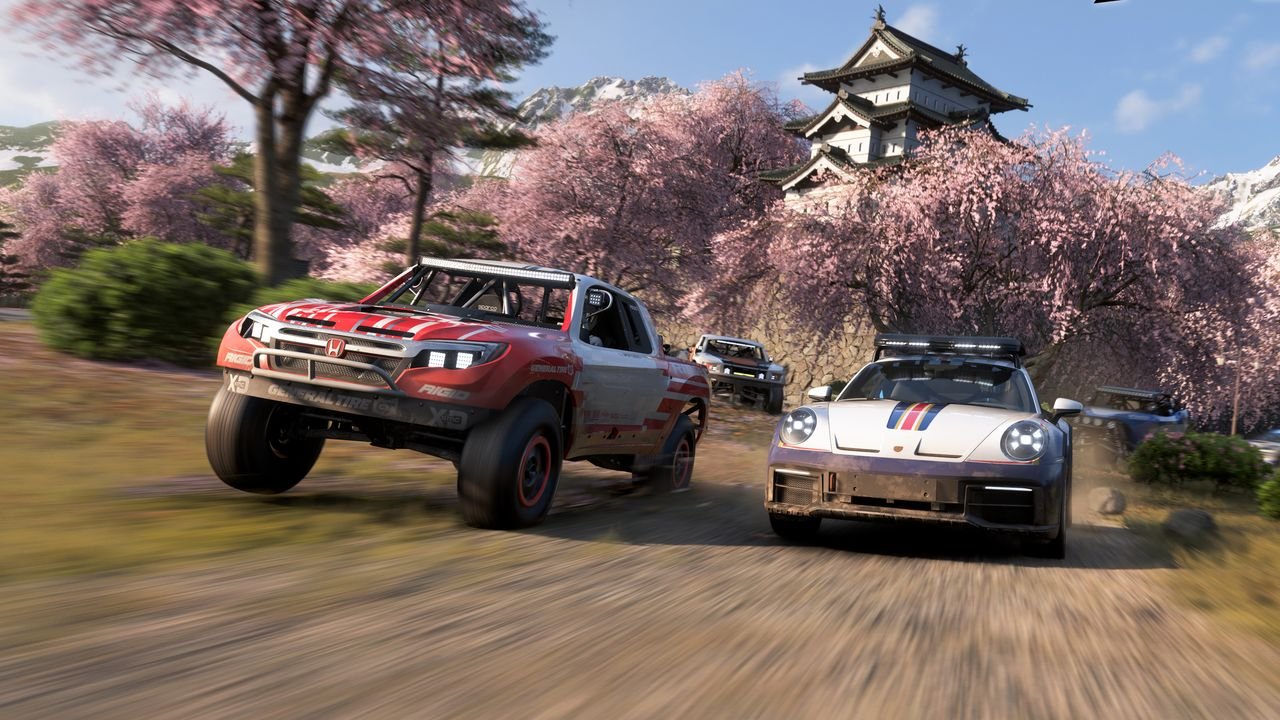
In the opening moments of Forza Horizon 6—the latest entry in Microsoft’s wildly popular open-world racing video game—the player’s guide, Mei, makes a promise: “Hey. I know you won’t hear this until you land… but you are going to love it here.”
Playground Games—the team behind the Forza franchise—had the authority to make this claim. Previous games in the Forza Horizon series took players to locations such as Mexico, Australia, and the French and Italian Rivieras, earning the series a reliable fanbase among gamers who wanted to drive the world’s most impressive cars around the world’s most tantalizing sandboxes. But when polled, fans had repeatedly requested—if not begged—that Forza Horizon take them to Japan.
The developers of the Forza Horizon franchise weren’t surprised. It wasn’t just that Japan had a robust car culture, obvious not just from industry giants like Toyota and Honda but in the long-running manga series Initial D. It was that the country also offered the diverse array of locations—massive cities, blooming fields, snow-capped mountains—that would make it a delight to speed around in the car of your choice. “Japan had been on our top five list, our final candidates list, for several games now,” concedes design director Torben Ellert. “But we don’t revisit locations, so we knew: You get one shot to do it.”
This is a racing game, so let’s talk specs. Tokyo City, the centerpiece of Horizon 6’s Japan, is roughly five times larger than any city in previous Forza Horizon games. It’s also more multilayered, with an emphasis on verticality inspired—in part—by the deliriously silly Hot Wheels DLC for Forza Horizon 5. And that’s just where you start the game. Horizon 6’s opening minutes include a quick, teasing montage of the regions you’ll be zipping through: highways, forests, fields, and mountains—each of which will change in accordance with the game’s dynamic seasonal weather system.
But while Forza Horizon 6 finds room for the series’ playful side—don’t miss your chance to race against a Gundam-esque giant mech—the game’s creators were also committed to taking the location seriously. Early in development, a group of developers traveled to Japan, seeking both inspiration and assets that might make their digital recreation of the country more accurate. “There’s nothing quite like going there. Getting the smells, the taste of it all, and then taking that back to the team,” says lead game designer David Orton.
That early-in-development trip proved instructive. Shortly after landing, the group hopped into a small convoy of cars to embark on day trips hosted by a friendly local—an experience memorable enough that a version of it appears in Forza Horizon 6. So does their experience visiting Daikoku, a Yokohama rest stop famous for the sheer number of gearheads who turn up to show off their tricked-out cars each day. Even the sky ended up making its way into Horizon 6. “We sent people out to capture real Japanese skies. The skies you see in the game are ones that were captured from Japan,” says Orton.
Other important details couldn’t be gleaned from observation alone. “I’m a game designer, so I tend to think of the game experience first. Being challenged on things is very helpful, because it helps us identify what we simply might not know,” says Ellert. To that end, the development team brought on cultural consultant Kyoko Yamashita to ensure that their enthusiasm for Japanese culture didn’t tip into inaccuracy—or, worse, into anything that would be unintentionally offensive.



