
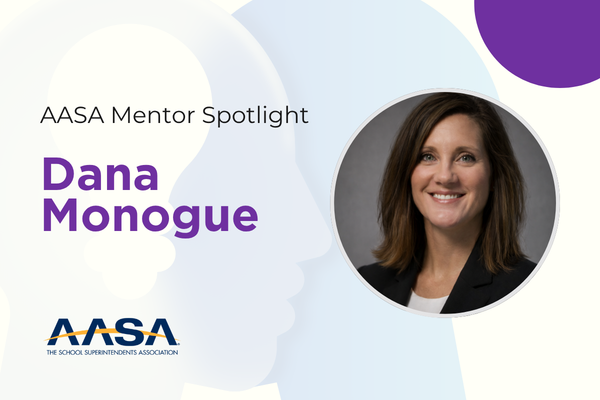
AASA mentors help district leaders see their own potential, navigate complex challenges, and stay focused on what matters most for students. In this conversation with Dana Monogue, superintendent of the Middleton-Cross Plains Area School District in Wisconsin and a mentor in AASA’s Aspiring Superintendents Academy® for Women Leaders, you’ll read why thriving superintendents lead with deep listening and trust — and how the right mentor can help you find the actionable message inside even the hardest feedback.
From your perspective, what are the qualities that make a good mentor?
Impactful mentors are gifted listeners.
They have an unwavering belief in others and their potential to succeed. They are willing to work at building trusting relationships in order to get personal and provide support, encouragement, direction and feedback that will make the most difference. Impactful mentors are positive – they cheerlead and encourage, while also being authentic and vulnerable.
What is the most valuable piece of advice you have received from a mentor?
A dear mentor of mine once told me, “Dana, it’s not always about you.”
What this was intended to do was to help me depersonalize constructive feedback so I could find the actionable messages that demanded my attention.
Having a consistent thought-partner and advocate to confide in, rely upon, and to hold me accountable to myself and to my team has made all the difference for me.
The educational landscape is changing rapidly — politically, culturally, and technologically. What does effective superintendent leadership look like in this moment?
I am actually co-authoring a book with a colleague on this very subject. We have identified the 9 leadership skills necessary for superintendents to thrive right now:
- Compassion – anchoring leadership in humanity
- Belonging – creating conditions for trust and shared purpose
- Deep listening – understanding the story beneath the story
- Trust-building – leading with integrity, reliability, and care
- Self-care and boundary-setting – sustainability as a leadership practice
- Personalization – building relationships that transform conflict
- Openness to giving and receiving candid feedback – learning in public, leading with humility
- Finding common ground – identifying pathways forward
- Depersonalization – staying grounded with the job gets personal
I believe these competencies, in concert with the historical facets of effective leadership are what differentiates thriving leaders from those that struggle.
How has mentoring changed the way you think about your own leadership?
I have always had a personal coach. I have benefitted so significantly from these relationships. They have not only helped me be effective in the role of superintendent, but they have kept me balanced, sane, and grounded. Having a consistent thought-partner and advocate to confide in, rely upon, and to hold me accountable to myself and to my team has made all the difference for me. Everyone needs a coach/mentor and modeling that for the organization – especially if you are trying to build a coaching climate – is absolutely crucial.



