
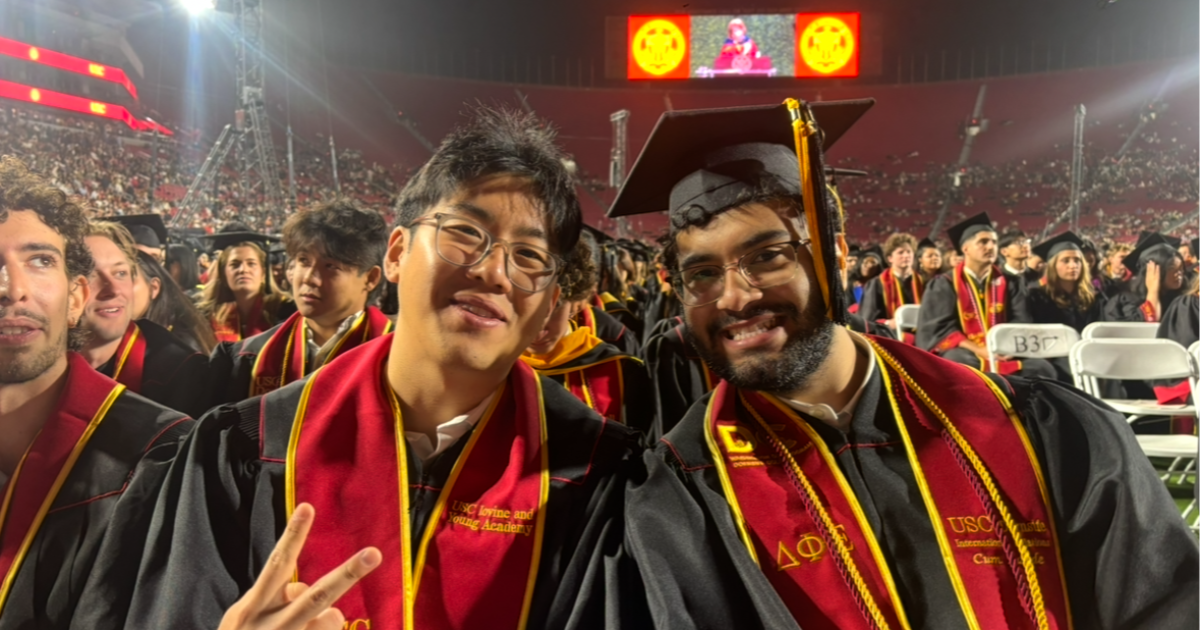
Matthew Kim’s undergraduate journey has been full of twists and turns, leading him from USC Dornsife to Marshall and finally to McKinsey & Company, where he’ll soon take on a full-time position as a business analyst. As the Marshall senior nears graduation, Kim is now looking back on the moments that led to his success, whether it was the support of the Trojan Family or his own decision to prioritize his mental health.
Interviewer: Why did you choose to attend USC Marshall?
Matthew Kim: I actually enrolled at USC Dornsife as a freshman and transferred into Marshall because I wanted deeper access to business education and a more collaborative environment. Growing up in L.A., I’d always heard about the strength of the Trojan Network, and I wanted to be part of a school known for both professional excellence and a genuinely supportive culture. Once I got to Marshall, the Career Services resources and recruiting access confirmed it was the right move — I felt like the school was investing in my success just as much as I was.
What surprised you most about your time at USC Marshall?
MK: How real the Trojan network actually is. I’d heard people talk about it, but experiencing it firsthand was different. Early on, I cold-emailed a Marshall alum named Sagar Tiwari, and that turned into a lunch, which turned into a mentorship that has shaped how I think about my career. That kind of generosity wasn’t an exception; it was the norm. By being proactive, I was able to connect with professors, fellow students, and alumni who were genuinely willing to invest their time in helping me grow.
What faculty and/or courses made the most lasting impression on you?
MK: I want to shout out a few people. Erin Kaplan [assistant professor of clinical finance and business economics] taught my first course at Marshall (ECON 351) and she was always available to help, incredibly friendly, and gave me a great first impression of the caliber of education at the school. Matthew Shaffer, my BUAD 280 professor, took the time to help me grow not only as a student but as a person. He’s since moved to the University of Virginia, but his impact stayed with me. And Madge Gaynor [adjunct professor of clinical business communication] who taught my business communications course (BUAD 302), helped me hone my communication and presentation skills — I even had the opportunity to lead a mini-lecture in her class.
What extracurricular activities most shaped your time as an undergraduate student?
ML: Two experiences stand out. At the USC American Language Institute, I led multiple conversation groups each week with international graduate students, helping them develop their conversational English. Beyond the teaching, it gave me a hands-on education in different cultures and communication styles that I carry with me today. I also worked throughout college as a community facilitator, supporting individuals with developmental disabilities one-on-one in their communities. Both experiences taught me that real growth happens when you step outside your own world and commit to showing up for others.
What achievement are you most proud of from your time at USC?
MK: I’m most proud of learning to prioritize my mental health and well-being. Balancing full-time work with full-time classes for years was demanding, and making the intentional decision to take care of myself — rather than just push through — took more courage than any exam or interview. It changed how I approach everything else.
What is the most important lesson you learned while a student at USC Marshall?
MK: Success never happens alone. Find your community, be vulnerable enough to ask for help, and support the people around you to be better every day. Marshall taught me that the people you surround yourself with matter just as much as the work you put in.



