
But this time, the Brazilian market is facing an uptrend, high real rates, and slowly but surely increasing de-dollarization, diversification and de-americanization.
Technical picture of The “Brazilian Train”
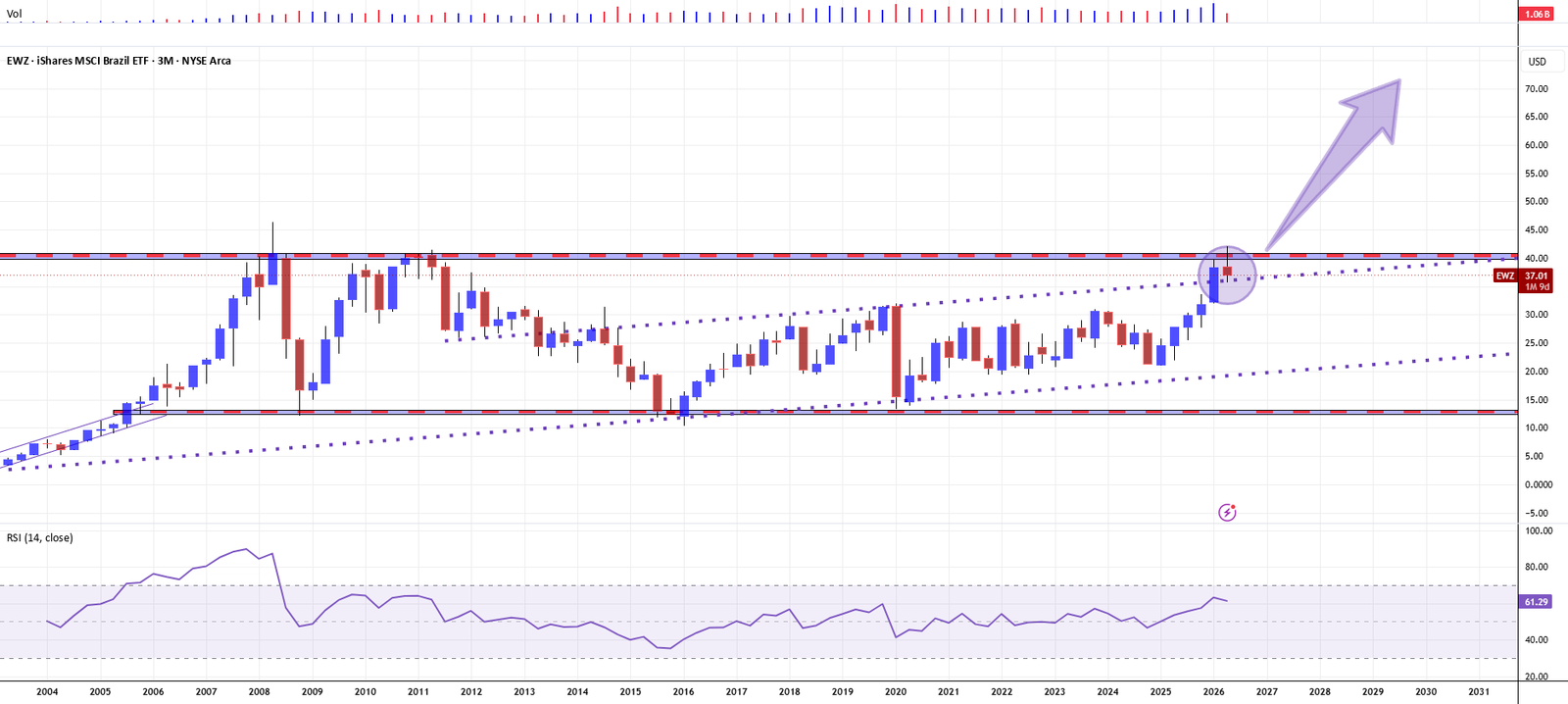
The quarterly chart of EWZ clearly shows the wide sideways trend from 2008 to 2026, where the $40-$42 zone served as flat resistance, from which the price had previously reversed for almost two decades.
The lower boundary of the corridor, located around $17-$18, forms a symmetrical range, within which an ascending sloping channel with a series of higher lows has emerged in recent years. The RSI has been holding above neutral for quarters, signaling medium-term buyer dominance but not extreme overbought conditions, leaving room for a final impulse.
In fact, we are witnessing a rare case for EM: an ETF that, in terms of total return (price plus reinvested dividends), has almost aligned with its all-time highs.
From a technical perspective, a sustained breakout of this flat resistance, supported by the strength of the rising trend at the quarterly close, would signal the final shift from the nearly two-decade-old regime to a new trend cycle, where the former ceiling becomes a supporting “trampoline” for the next wave of growth.
The Structure of the  EWZ and The “Brazilian Locomotives”
The MSCI Brazil EWZ fund is a concentrated bet on Brazilian megacaps: mining giants, oil and gas, banks, and fintech, which together account for the lion’s share of the weighting.
The top ten is dominated by Vale, Petrobras, Itaú Unibanco, Nu Holdings, and other systemically important issuers, whose dynamics essentially create the candlesticks on the chart. This concentration makes EWZ something between an index ETF and the good old “five-idea portfolio,” where two or three stories determine the fate of the entire product.
The commoditized nature of Brazil’s economy—iron ore, oil, and agriculture—turns EWZ into a derivative on the global commodity cycle. As soon as the market begins to price in a scenario of prolonged high commodity prices, the “Brazilian Train” gains additional momentum, despite the political news noise.
High real rates as insurance
Brazil remains one of the few major markets where real rates—that is, the difference between the key Selic and current inflation—look impressively positive.
Forecasts for the Selic (Brazil’s benchmark interest rate) through 2026 remain in the double digits, while inflation expectations have stabilized near the official target, creating a substantial real coupon for local bonds and a relatively comfortable backdrop for FX.
For equity investors, this means that the discount factor remains severe, but the EM risk premium is partially offset by strict monetary discipline.
It is precisely this mix—high real rates plus a stable current account—that has historically created a safety net for emerging currencies, reducing the likelihood of sudden collapses, which in the past have crushed the EWZ charts to zero in one or two quarters.
De-dollarization and global debt markets
The global narrative of de-dollarization, de-Americanization, and currency diversification, as we discussed earlier, is not about the “sudden death of the dollar,” but rather about the gradual redistribution of reserves and flows toward gold, commodity currencies, and regional blocs.
Central banks are increasing their gold holdings, and the total value of these reserves has already equaled official holdings in US Treasuries, symbolically marking a turning point in the global asset structure.
For stories like EWZ, this means the potential for a greater weighting in global portfolios as investors gradually reassess their US exposure and seek liquid alternatives in EM.
In this configuration, Brazil acts as a kind of “regional hub” for Latin America, offering a relatively developed capital market, deep FX, and a benchmark ETF recognized by global index providers. If the dollar continues to weaken structurally against the EM basket, even a moderate strengthening of the real will act as an additional boost to the EWZ
Geopolitics: Hormuz, Inflation, and Agricultural Shock
The closure or even partial blockade of the Strait of Hormuz is a classic “black swan” event for the oil market, instantly raising the risk premium in Brent crude and producing a secondary inflationary shock. For Brazil, a major exporter of agricultural products and raw materials, this configuration could paradoxically prove beneficial: the world is overpaying for energy while simultaneously seeking reliable sources of food and fertilizer.
Problems with sulfur and urea supplies from the Gulf countries, coupled with the blockade of Hormuz, paint a much less rosy picture for the global agricultural supply chain. Rising fertilizer prices are hitting farmers’ margins and potentially squeezing global food supply, further fueling inflation and pushing real rates even higher—thus increasing the appeal of EM currencies where the central bank is prepared to respond aggressively, as in Brazil.
Key Breakout: Scenario for EWZ
In summary, we have a structure where the technical factor—a test of flat resistance in the $40-$42 region within a rising wedge—is superimposed on a macro backdrop favorable for commodity-EM currencies.
A sustained breakout above the historical range, confirmed by volume and quarterly closes, transforms EWZ from a candidate, into a mid-term trend leader with a potential target of $70+, especially if the commodity cycle continues to heat up.
A failed breakout attempt and a return below the horizontal, on the other hand, could return the market to the good old range-bound sandbox, where EWZ previously became a “mean reversion” tool for those eager to sell “Darling Brazil” and buy back another crisis trough.
However, given the de-dollarization cushion, high real rates, and geopolitical pressure, the current approach to resistance looks like a much more serious candidate for a change of era than another random bounce—and that’s precisely why this chart deserves a spot on the front page of our PandorraResearch Team as “The Brazilian Train” bet that goes to double in price.
—
Best wishes,
PandorraResearch Team



