
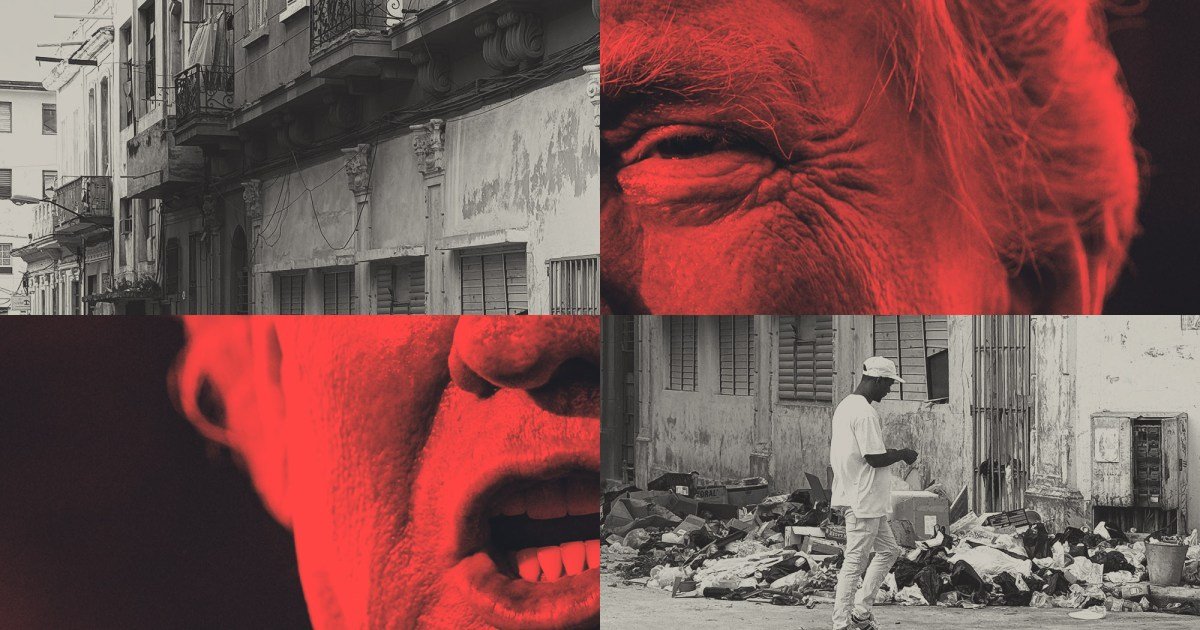
The failure to rouse popular protest—even against unpopular leaders—is increasingly familiar to the Trump administration.Mother Jones illustration; Paul Hennessy/SOPA/Zuma; Samuel Corum/Pool/CNP/Zuma
On Wednesday, the Justice Department unsealed an indictment charging 94-year-old former Cuban head of state Raúl Castro with murder and conspiracy to kill US citizens. It’s a move that may signal potential military action to abduct Castro from the country, as with Donald Trump’s January raid on the compound of Venezuelan President Nicolás Maduro.
The indictment targets Raúl Castro, the brother of the late Fidel, and five other members of the Cuban military, for the 1991 downing by Cuban forces of two aircraft operated by anticommunist Cuban exiles. While the indictment was filed last month, the unsealing coincides with Cuban Independence Day, celebrating 124 years since the US ended its military occupation of the country.
But Cuban Independence Day comes this year amid a debilitating oil blockade imposed by Trump, which has devastated Cuba’s already struggling health system and economic infrastructure and worsened living conditions across the board. This year alone, residents have dealt with nationwide blackouts, food shortages, hospitals without power to operate, and constant worry over their economic and political future. The Trump blockade and associated policies, which many humanitarian groups view as human rights violations, have deprived the country’s residents of basic necessities and exacerbated the impact of the decades-long US embargo on its neighbor.
“The paradox is, the US imposes crippling sanctions while also saying, ‘I’m going to liberate your people.’ ”
Cuba produces enough oil to meet about 40 percent of its needs domestically. It imports the remainder, mostly from Venezuela and Mexico. But following the US attack on Venezuela and additional tariffs imposed on countries that sell or provide oil to Cuba, both countries halted oil exports to the island. And while the Supreme Court struck down Trump’s tariffs, the president continued his naval blockade on Cuba, seizing many vessels that have sought to ship goods to, or that have simply been linked to, the country.
According to a March report by the Atlantic, the US attorney’s office in South Florida is building further indictments against Cuba’s military and government leadership, including Castro family members. The US cited a 2020 indictment against Venezuelan President Nicolás Maduro to justify his capture in January. In the week prior to the report, Trump said he believed that he would have “the honor of taking Cuba.”
And earlier, at the end of his first term, Trump added Cuba to the federal list of state sponsors of terrorism, a policy that “put the brakes on some private investment on the island,” Will Freeman, a Latin America fellow at the nonpartisan Council on Foreign Relations told me in an April email. “And [it] did no favors to tourism, which the Cuban regime had made the island’s economic engine.”

The Biden administration largely carried on Trump’s Cuba policy, further hindering Cuba’s tourism in 2022 by barring foreign travelers from visa-free travel to the US if they visited Cuba after the Trump-initiated state sponsor of terrorism designation went into effect in January 2021.
Claims of state terrorism, as M. Victoria Murillo, a professor of political science and international and public affairs at Columbia University, said to me last month, were the linchpin of US justifications for military assaults on Venezuela, and for the campaign of attacks on civilian vessels by US naval forces in the Pacific Ocean and Caribbean Sea.
In January, Trump declared Cuba an “extraordinary threat” to national security on the basis of its alignment with countries like Russia, China, and Iran and his allegations, made without evidence, that Cuba “welcomes transnational terrorist groups” like Hamas and Hezbollah. The executive order imposed additional US tariffs on goods from countries who supply oil to Cuba, which effectively eliminated all support for Cuba from Venezuela and Mexico.
At the end of his first term, Trump added Cuba to the federal list of state sponsors of terrorism.
These latest restrictions have been implemented amid a US embargo that has stopped US businesses from trading with Cuba since the 1960s. While former President Barack Obama eased many economic constraints on Cuba and allowed some travel, he ended the policy that gave Cubans arriving in the United States a guaranteed pathway to legal status. That, according to Murillo—along with Trump and Biden’s reimplementation of economic restrictions—led to growing inequality between Cubans with access to foreign currency and those who rely wholly on state salaries, wages that in 2025 amounted to about $18 a month.
The first group, who constitute an upper class, may have connections to private businesses, tourism, or remittances from relatives who live abroad.
“Cuba is in a situation similar to when the Soviet Union fell,” Murillo says. The US embargo, starting in the 1960s, led Cuba to depend on the Soviet Union, which supplied the island with oil at subsidized prices. Early oil shipments were delivered to US-owned refineries, but they refused to refine in part due to pressure from the US government.
“That started the escalation of nationalization,” Murillo says. “They had no energy, they had to bike places because they had no gas, [and] they lacked food.”
This time, Murillo says, it’s even worse: “Cuba is now on its own.”
The Trump administration’s “maximum pressure” campaign against Cuba to supposedly encourage popular rebellion against the island’s government has not worked. “Social movement theory says that when people are really desperate, they cannot protest. That requires certain resources,” Murillo says. “If you are spending all your time trying to get food, you don’t even have the time to protest.” Anti-government protests in Cuba are rare.
The failure to rouse popular protest—even against unpopular leaders—is increasingly familiar to the Trump administration, which expected an Iranian public uprising to follow its war on that country. In the immediate wake of the Iranian government’s violent crackdown on a series of protests that began in December, I had the opportunity to talk to historian Behrooz Ghamari, who explained the situation succinctly:
“The paradox is the US imposes crippling sanctions while also saying, ‘I’m going to liberate your people.’ This rhetoric about helping people contributes to delegitimizing the Iranian people’s legitimate protests. It gives the Iranian government the excuse to claim conspiracy and say that protesters are acting on behalf of foreign interests and can react severely and violently. If the US actually wanted to help, the only offer is to not intervene and allow these movements to unfold on their own terms.”
In 2021, President Miguel Díaz-Canel called large-scale protests then taking place “a plan orchestrated by the exterior,” claiming that the US government was directing protesters.
Why does Cuba think the US is directing opposition to its government? Historically, it has—Cuba is a longstanding fixation of US foreign policy, dating to generations before Castro. In 1898, Murillo explained, after winning the Spanish-American War, the US began driving towards hegemony, taking Puerto Rico, Guam, and the Philippines from Spain and establishing a protectorate in Cuba. Cuba had no choice but to sign off on the Platt Amendment, which guaranteed the US sweeping powers—including the right to intervene unilaterally in Cuba’s politics, as Trump seeks to do again now—in return for withdrawing its troops from the island at the end of the war.

US domination remained the status quo for more than half a century. At the time of the Cuban revolution, in the late 1950s, American companies owned or controlled 90 percent of Cuba’s electricity, as well as significant parts of its sugar, communications, and mining industries. In large part to take ownership of domestic industries, the Cuban revolution established a socialist political system—one that the US wanted rid of by any means possible.
The rush of exiles from that revolution, and the proximity between the two countries, helped facilitate the establishment of a powerful Cuban-American lobby, founded by Cuban elites who were exiled after the revolution—which got us our current Secretary of State.
Marco Rubio, the son of Cuban parents who fled to the US in the 1950s, announced in March that Cuba would “have to get new people in charge.” Rubio has become by far the most visible and influential face of the Cuban-American exile movement, pushing the Trump administration to heap pressure on the country. (Rubio’s family, ironically, fled the country under the US-aligned government of Fulgencio Batista—the one Castro toppled. Rubio has repeatedly claimed otherwise.)
“The reason you are forced to survive 22 hours a day without electricity is not due to an oil ‘blockade’ by the US,” Rubio said in a Spanish-language video message to the Cuban people Wednesday, but because Cuba’s ruling officials “have plundered billions of dollars” from the nation.
Although some Democratic US lawmakers have called for the end of the oil blockade, only one oil tanker has reached Cuba. “We have absolutely no fuel [oil] and absolutely no diesel,” Cuba’s energy minister, Vicente de la O Levy, said last week.
In February, United Nations human rights chief Volker Türk called for the lifting of US sanctions that impede oil deliveries to Cuba: “Policy goals cannot justify actions that in themselves violate human rights,” Marta Hurtado, Türk’s spokesperson, said at the time.
“It looks like I’ll be the one” to topple Cuba, Trump said. “I would be happy to.”
“Cubans should be able to exercise their rights freely, including their rights to political participation, and the Cuban government’s policies of repression and censorship should stop,” the Washington Office on Latin America, a US advocacy organization promoting human rights and social and economic justice in Latin America and the Caribbean, wrote in a statement last month. “At the same time, U.S. policy towards Cuba, focused on coercive measures such as the embargo and other sanctions, is outdated and has failed to produce U.S. policy goals, while causing severe harm.”
“It is the Cuban people, with the concerted support of the international community, who should determine their future and be a core part of any bilateral discussions,” the statement continued.
Since then, the Trump administration has increased sanctions on Cuba, and Wednesday’s news of Castro’s indictment is the strongest signal that the Trump administration is considering switching from mostly economic and diplomatic pressure to military assault. The US military has sent at least 25 intelligence-gathering flights since February and has begun to increase its number of ships in the area.
In response, Cuba President Miguel Díaz-Canel warned that US military strikes could lead to a “bloodbath” on Monday. A Sunday Axios report cited classified intelligence that Cuba had acquired more than 300 military drones and were discussing a possible attack on the US base at Guantánamo Bay.
In his public rhetoric, Trump appears to be framing Cuba and Venezuela similarly. On Wednesday, he called the indictment of Castro a “very big moment” for Cuban Americans but suggested that he didn’t expect there to be an increase in hostilities between the two countries; Trump surprised and upset much of the Venezuelan opposition by taking such a tack with Venezuela, leaving its ruling party in power after the initial assault that abducted Maduro. “Look, the place is falling apart,” Trump told reporters that same day. “[The Cuban government has] really lost control of Cuba.”
But Trump’s remarks on Thursday may be more revealing. “Other presidents have looked at [Cuba] for 50, 60 years, doing something,” Trump said. “And, it looks like I’ll be the one that does it. So, I would be happy to do it.”
If Trump—a teenager when Fidel Castro came to power—sees overthrowing Cuba’s leadership as part of the legacy he’s increasingly concerned with, then a US escalation may well be in the cards.



