
I’ve been drinking a bit less and praying a lot more than I used to. Now, that’s not to say I’m drinking less than most people—I’m not—nor that a doctor would sign off on my lifestyle as a healthy one—they wouldn’t—but self-betterment has to start somewhere, and for me, that means choosing sobriety occasionally.
As for the praying? Every once in a rare while, I find myself with my knees in the dirt reciting the Lord’s Prayer. Which is what I’m doing right now—though it should be noted that I’m on my knees because I’m hiding behind a bush. On top of all that, yes, I’m sober at the moment, though I’d rather not be, as I’m trying to avoid a railway police officer—known as a bull—who is slowly but steadily heading my way, and the stress of the situation is getting to me. In my mind, I put an emphasis on “And forgive us our trespasses…”
The plan was never to walk miles and miles on train tracks during a freezing day in early March—and it certainly wasn’t to hide from a cop, trying not to get picked up on loitering charges for strolling along a railroad that up until very recently I believed to be abandoned. There was supposed to be a trail. The Johnny Appleseed Trail of North Central Massachusetts, to be exact.
I had set out to walk its 34.2 miles. My journey would soon expand, as I chased Johnny Appleseed across the four states he once traversed, planting his apples and living off the generosity of friends and strangers alike. America, roughly 250 years after the folk hero’s birth, offered up pathways leading nowhere, drab stretches of freeway, fences, Beware of Dog and Private Property signs. Most of this country is no longer made for walking. I’d have to cross through people’s backyards and skirt along highways.
Most of this country is no longer made for walking. I’d have to cross through people’s backyards and skirt along highways.
During the early years of my life, my family lived in Boston. We were poor, and we walked everywhere, rarely taking public transportation. Our vacations were walks, too, my father taking me into the White Mountains in our beat-to-shit, hand-me-down, rust-tinged Toyota truck—the bed covered in a crumbling plastic shell.
But if the weather was right, my da and I would spend our nights in the woods, sleeping in a cheap, lightweight tent—or sometimes, when the temperature was perfect, in our sleeping bags under the stars. Once the sun came up, we would hike. Just the two of us, for miles and miles. My father telling long, elaborate stories to make sure my little legs kept pumping, putting one small foot in front of the other. Tall tales of Pecos Bill, which then made way for other American legends. John Henry. Paul Bunyan. Johnny Appleseed. Tornadoes were ridden and giant iron pans were greased by lumberjacks wearing blocks of butter as ice skates. Apple trees got haphazardly planted across the vast expanse of the American frontier.
My mother, a teacher, would do her best to counterbalance my father’s tales of fancy. Johnny Appleseed wasn’t a legend, nor was he the mythical pagan god my father made him out to be. He was simply a man: John Chapman. And he grew up just down the road from my ma’s run-down family farm.
Born right before the Revolutionary War in Leominster, Province of Massachusetts Bay, on September 26, 1774, Chapman was a pioneer nurseryman, planting apple trees across the American Midwest during the early 19th century. He was deeply religious, leading a simple—often barefoot—life, guided by spiritual convictions and a strong respect for nature.
Rather than randomly scattering seeds across the land as the legends suggest, though, Chapman strategically established nurseries—fencing them in to protect the saplings from animals—and partnered with local caretakers who would look after the trees, often selling them on Chapman’s behalf long after he had left town. His efforts helped supply apple trees to settlers expanding westward, especially in Western Pennsylvania, Ohio, and Indiana, where Chapman would die in the mid-1800s not far from Fort Wayne.
Like any child who hears that they have a tenuous (at best) connection to somebody famous, I became obsessed with both the man and the myth. My father filled my head with stories, while my mother brought me dusty encyclopedias full of primary sources, like this tidbit from historian Henry Howe:
His personal appearance was as singular as his character. He was a small, “chunked” man, quick and restless in his motions and conversation; his beard, though not long, was unshaven, and his hair was long and dark, and his eye[s] black and sparkling. He lived the roughest life, and often slept in the woods. His clothing was mostly old, being generally given to him in exchange for apple-trees. He went bare-footed, and often traveled miles through the snow in that way. [He] wore on his head a tin utensil which answered both as a cap and a mush pot.
Another from historian Paul Aron in his more modern book American Stories adds further nuance to the entertaining but embellished tall tales: “Chapman was actually a successful businessman. He bought many of the parcels of land on which he planted his seeds and ultimately accumulated about twelve hundred acres across three states. He wore pauper’s clothing by choice and not out of necessity.”
As a child who grew up in a homeless shelter but wasn’t aware yet how that had affected him—something I maybe still haven’t totally figured out—who was obsessed with the outdoors thanks to hikes with my father, and also raised religious, Johnny Appleseed became a personal hero. A patron saint.

“Why are you doing this again?”
My father and I are standing in his kitchen. It’s the night before I head out for what I think is the trailhead of the misleadingly named Johnny Appleseed Trail. Walking Chapman’s trail is just a cover—to come up north and see how my folks are doing—except that more and more, the way the man lived his life seems appealing to me. Feet on the ground, sleeping outside. Taking life’s problems one at a time, away from a desk, from responsibilities. My brain still full of those books and stories from my youth of people who go a-wandering. You only get one life. You can’t wait for some wizard to show up at the door of your hobbit hole and invite you on an adventure. The masculine urge to go out for a pack of cigarettes and never come back.
My father asks another question before I can answer his first one, which is probably for the best. Often the dreams in one’s head sound foolish at best—and gravely worrisome at worst—when spoken aloud.
“And your plan is to walk all the way back here? That’s something like 40 or so miles.” Thirty-four-point-two miles, to be exact. But I don’t correct him and take a different approach.
“You used to go on long backpacking trips all the time.” Which is true.
“When I go hiking, I bring proper gear. What gear do you have?”
I point to an old, beat-up green JanSport backpack I’ve had since middle school—so far, it has a sweatshirt and some toiletries in it. The number of safety pins holding the bag together is troubling. “Christ.” My father whispers the word, almost under his breath.
A prayer for me or a prayer for patience, I can’t tell. “Do you at least have some boots?”
Often the dreams in one’s head sound foolish at best—and gravely worrisome at worst—when spoken aloud.
I look down at the Timberlands I’m wearing—a footwear staple where I live in Brooklyn—and gesture at my feet as if to say, “Look, boots.”
“So, no. Okay, come with me,” my father says, as he heads down to the basement.
This is a familiar dance for me and my father. He often finds himself a bit bewildered by me, especially as I haven’t opened up to him about my recent growing interest in spirituality. I’m a drinker, whereas he is sober. A man of faith—best described as a practicing Catholic with healthy servings of Buddhism, Eastern Philosophy, and a deep understanding of Judaism and the Old Testament.
“Here, take these.” My father hands me a pair of tough-looking, well-broken-in leather hiking boots. Walking in my father’s shoes feels a little on the nose, but then again, it would beat the blisters my Timberlands would give me.
Like I said, this is a familiar dance between me and my father. He doesn’t quite know what to do with my choices most of the time, but if he can help me be less of an idiot, he tries.
“And you’re going to need a sleeping bag. Maybe my bivouac tent, too. Which’ll mean a proper rucksack—not that rag you’re still pretending is a functional bookbag. Do you have a tarp?” I shake my head no.
“Alright. Well, take this all upstairs and set up the tent in the living room. We want to make sure it isn’t missing any poles. I’ll grab a few more things that might prove useful and come right up.”
When my father joins me in the living room a few minutes later, he lets out a heavy sigh. “I don’t know, I,” he says, using his abbreviated, single-letter nick-name for me, as he gestures at the half-assembled bivouac tent sitting in the center of the room, which more resembles a modern art piece than a functional shelter. “This isn’t looking too good.”
Whether he means the tent or the chances that my walk is going to end in disaster, I’m not sure. Either way, he stays up late into the night with me, showing me how to assemble the bivvy and properly use the rest of his equipment.
“I promise to return it all safely,” I say, assuming he’s worried I might damage or wreck something.
“Nah, keep it. Not sure I’ve got too many camping trips left in me anyhow.” The statement sits there for a moment. The reality of death and loss and the passing of time. The fear of the unknown while contemplating this extremely common occurrence that each one of us will experience, but which none of us—not a single one of us throughout our entire human history—has ever fully understood.
My father and I look at each other. “You should get some sleep,” he says. “I’ll drive you to the trailhead in the morning.”
After my father turns out the lights, I sneak a flask of whiskey into my pack, among all his camping gear.
Like all children who grew up in Massachusetts—John Chapman’s home state—I was raised on the myth of the apple-seed-spreading, tin-pot-hat-wearing, animal-loving, Bible-thumping frontiersman who brought apples to the early pioneers not just by my parents, but by my teachers, too. Even the priests were in on it. An old short from Disney’s 1948 film Melody Time titled “The Legend of Johnny Appleseed” was an after-service favorite in the church basement, all of us doughnut-fueled kids encouraged to sing:
Oh, the Lord’s been good to me
And so I thank the Lord
For giving me the things I need:
The sun and the rain and the apple seed;Oh, the Lord’s been good to me.
You likely know the rest.

The Johnny Appleseed Visitors’ Center is that Disney song come cheerily to life. Right out front, where I’m standing, there is the “Big Apple of New England,” a 10-foot-tall red apple that is “the largest apple sculpture of its kind in all of New England.” Although how many others could there really be? Painted in white on the front of the apple is a message: “Visit North Central Massachusetts, Johnny Appleseed Country.”
“May I help you?” The woman behind the desk is every bit as New England as one would hope. A wool sweater, gray unfussed hair, eyeglasses hanging from a chain around her neck. At first, I think she’s being judgmental—I have a large beard and beat-up boots on and am gripping a backpack with a sleeping bag attached. Perhaps she’s worried I might knock over the row of ceramic mugs emblazoned with a Johnny Appleseed emblem that looks like it was designed by whoever switched the New England Patriots logo from “Pat the Patriot” to the “Flying Elvis.” Johnny is more cartoon than man—smooth, a bag floating behind him with his legs spread wide, midstride, an arm enthusiastically thrusting forward.
“I’m looking for the head of the trail,” I say, motioning to my rucksack.
“The head of the trail?”
“The Johnny Appleseed Trail of North Central Massachusetts,” I clarify, though I’m wondering why I should need to. There’s only one trail, and from what I read online, this visitors’ center is supposedly where it starts.
“Well, yes, the Johnny Appleseed Trail does indeed start here, but it’s simply what we call this stretch of highway. It’s to encourage tourism in the area,” she says, before adding, with an almost concerned tenor in her voice, “for motorists.”
“So there’s no hiking?”
“There’s hiking all around here, to be sure. But any trails that head out from this very spot? No.”
The Johnny Appleseed Trail was founded in 1996 by the Johnny Appleseed Trail Association, which is connected to the local chamber of commerce, to help “promote tourism and travel in the North Central Massachusetts region.” Like much of America as you stray from its major urban hubs, this part of my home state has been historically overlooked, despite the relative proximity to Boston and the picturesque Berkshires to the west. The tourism campaign is showing signs of progress, as there are now many popular orchards in the area, not to mention restaurants, breweries, and the aforementioned hiking trails—all of which are nowhere near where I am currently standing.
I thank the woman for her hospitality, buy a hot cider plus a couple of children’s books about Appleseed for my niece and nephews, and stuff them in my bag before heading out. The March sky is bleak, and the air outside seems harsher after some time spent indoors. Despite it technically being spring, winter isn’t quite over here in Massachusetts.

The visitors’ center is surrounded by a tall chain-link fence. I know this because I walked the entire perimeter while I sipped my already-cooling—nonalcoholic—hot cider. But if you should ever find yourself in the position I find myself in now, know this: There’s a hole in the fence. Right by the green dumpsters in the back.
After finishing my cider and tossing the empty cup in the large metal bin overflowing with trash, I throw my gear through the hole in the fence and scurry after my belongings. The forest behind the visitors’ center is still covered in fallen leaves from the previous autumn. No buds are out on the trees yet, and the air is frigid and damp. There are also a surprising number of tires littered around. Many people in these parts choose to dump their tires in order to avoid disposal fees. Or, even worse, individuals offer to collect and haul other people’s unwanted tires for a fee—promising to take them to a landfill or recycling center—but instead save money on both disposal fees and gas by simply tossing the tires in the woods. That all-American tradition of exchanging money for someone else to commit a sin for you.
Still, the tires are beautiful, in their way. A smattering of black rubber circles dotting the forest floor. I look at my iPhone’s compass and walk west, following the sound of passing cars on Route 2.
The legend of Johnny Appleseed is as large as the life of John Chapman is multifarious. A son of the American Revolution, his father was a Minuteman—apparently known for being ready for battle in a minute’s notice, not for how quickly they could run the 50-yard dash, despite what my father told me as a child.
In his late teens, after a rather impoverished childhood, Chapman was one of many colonists who pushed westward from the East Coast, which was becoming more crowded post-Revolution. That’s where the legend of the apple-tossing, rag-wearing, no shoes on his feet, and a cooking pot on his head man began—though the embellishments about his life wouldn’t come until years after his death. But the true story of John Chapman is much more complex—and booze-fueled—than even my ma’s history books had led me to believe.
The true story of John Chapman is much more complex—and booze-fueled—than even my ma’s history books had led me to believe.
For starters, despite what the Disney short portrays, Chapman’s Christianity was…complex. He was a devout follower of Swedish theologian Emanuel Swedenborg and practiced a small, unique, mystic Christian faith with one tenet at its center: The more we suffer in this life, the more we will be blessed in the next. This belief system is why many say Chapman embraced the difficulties of his transient lifestyle with such jubilation in his heart. As a person who was raised Catholic and still thinks if something in my life is going right, something else surely must be going wrong, I can relate.
Speaking of his nomadic way of living, you should also know that the whole “rags for clothes” thing (sometimes wearing old coffee sacks as shirts, though probably not the legendary tin pot as a cap, it pains me to say) and the owning of very little in terms of belongings was all a personal choice. As noted previously, Chapman had 1,200 acres across three states to his name when he died. Those orchards he planted throughout the area? Well, he was technically the owner of the land those trees were planted on. Which is all to say, Johnny Appleseed died—at least on paper—a rather wealthy man. But it was wealth he himself never touched, in accordance with his belief in Swedenborgianism.
In his book Johnny Appleseed: The Man, the Myth, the American Story, historian Howard Means says of Chapman, “He ached for land but couldn’t settle down long enough to claim it.” An inability to stay in one place, another feeling I’m all too familiar with.
Means puts forth a theory that Chapman’s notions of land ownership rested somewhere between those of his colonial brethren and those of the Indigenous peoples whose lands those brethren were stealing, often violently. Chapman “loved land,” Means writes, but “was never meant to own it.” His devout beliefs gave him, as Means puts it, a “missionary zeal,” alongside a “missionary’s disregard for dollar signs.”
As to the booze of it all? Those apple seeds Chapman roamed the land with—well, he got them from cideries, pulling them from the excess pulp produced while creating the ubiquitous alcoholic beverage, widely consumed due to the nonpotability of most water during that time. That brings us to our boozy second fact, which is that the trees that were planted from said seeds, and more particularly the fruit they bore, were not used for apple pies and apple tarts and applesauce to feed the pioneers moving west—no matter what Disney’s Melody Time would have you believe—nor were the apples used as snacks for said pioneers’ horses. No, those apples were mainly used to create alcoholic cider, and the harder liquor known as applejack, an apple brandy high in alcohol content.
The thought of applejack—or more so the Johnny Appleseed Trail turning out to be a regular stretch of highway—has me feeling for the whiskey flask in my bag. Nobody likes being wrong straight out of the gate. But given the long walk I still have in front of me, I decide to leave it be for now.

I climb over rusted, long-forgotten wire fences and carefully avoid deer scat, tromping through the woods until I come to a service road, which leads to an on-ramp. Constructed in the early 1900s, certain sections of Route 2 were previously called New England Interstate Route 7, and before that, it was a Native American path that was known as the Mohawk Trail—a trade route that connected Atlantic tribes with tribes in upstate New York and beyond.
It’s here that I also find a welcoming-looking set of train tracks. Well, perhaps not welcoming, as there are multiple Do Not Enter signs posted, but certainly more manageable than the tire-filled forest I was walking in before. The railway seems to stick relatively close to the highway, so I assure myself that those warnings look pretty old and that the railroad is probably long abandoned. I pretend not to see the postings and make my way down the gravelly path of wood and metal.
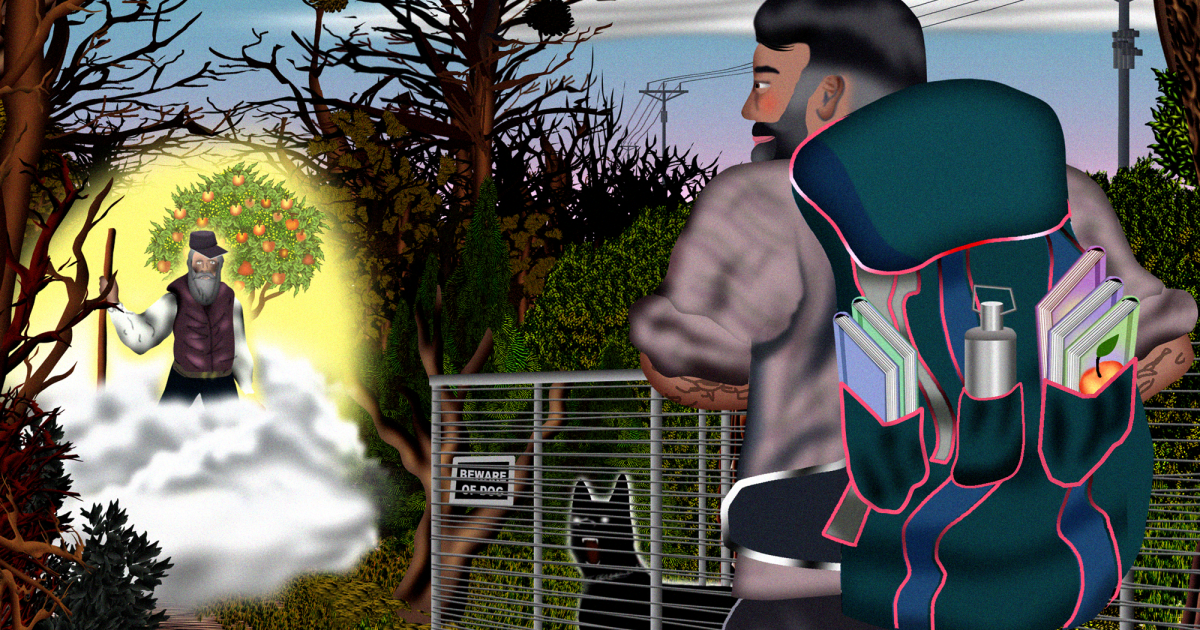
But soon a truck with lights on its roof is clearly approaching me on the track. Security. Train police. Railway cops. Or, to use proper hobo terminology, a bull. In previous centuries, it’s said, bulls would murder drifters and train jumpers. In the modern era, I am in no way fearing for my life, but the idea of getting brought into some holding cell just a few hours into my Johnny Appleseed walk doesn’t appeal to me. Neither does trying to explain why I have an as-of-yet untouched flask of whiskey in my backpack along with a stack of children’s books. The embankment here is higher than before, though, plus there’s a fence. Instead of making a run for it, I kneel in a nearby bush and mouth the Lord’s Prayer.
The truck gets closer, and I can see that instead of rubber tires, it has metal wheels—similar to those you’d see on a train—that allow it to travel along the rusted tracks.
There’s no way this bush is covering both me and my rucksack. So I figure it’s best to step up and put on a smile instead of being caught cowering in some shrubbery. I pray they don’t search my bag and swing out toward the approaching truck, giving my friendliest wave.
I only see into the truck’s cab for a moment. There is indeed a bull inside, with a security uniform and some semblance of a badge—but whether the man is sleeping, or looking down at his phone so hard that his eyes seem closed, or perhaps praying himself, I’ll never know. You don’t need to steer a truck that’s running on tracks. The bull’s lights don’t light, and his alarm doesn’t sound. He simply rolls blissfully along as my friendly wave drops to my side.
With the exhilaration of the minor but thrilling near miss warming me a bit against the cold, I continue down the railway, which passes close to a cluster of homes and backyards. Again I’m startled, but this time by a massive, furious dog. I can’t make out the breed, perhaps a Cane Corso, mastiff, or Great Dane. All I know is that it seems as big as a horse, is dark gray, and its barking scares me more than the bull and the previous train combined. As the dog leaps up on its hind legs, it pushes its paws against the straining metal of the fence, which I am grateful to for keeping us separated.
“What’s going on?” I hear a voice call out. “What’s that, Susie Q?” Is this dog’s name Susie Q?
“Susie Q, what’s out there, girl?”
“Hi, Susie Q,” I whisper. Susie Q stops barking momentarily, but only to look at me puzzlingly and then resumes barking.
“Susie Q! Come here, girl!” The voice belongs to a man, who steps out onto his back porch and puts me in his sights.
I wait for him to start yelling at me. Or to call the police, or at least threaten to. Or maybe go get a gun. Susie Q is still barking, and I don’t move, looking back at the man from the other side of the fence. After what must have been only a few moments, but which felt like an eternity, the man slowly raises his hand, which is holding a bottle of beer. My hand is empty, but I pull the flask I’ve been carrying from my bag, and raise it up in return.
“Come back, Susie Q! Leave that poor guy alone!” he yells, and the dog lets go of the fence and allows herself to be called back inside. The man gives one last long-distance cheers and closes his sliding glass porch door behind the lumbering beast as I pour a slug of whiskey into my mouth and raise a cheers back.
The sun is lower in the sky than it was, but the small amount of friendliness offered by Susie Q’s owner heartens me. I feel a flicker of appreciation for the kindness that John Chapman looked for in all of God’s creatures and walk on. I don’t know it yet, but I am starting a journey that will end up consuming the next year of my life.
This essay was adapted from Isaac Fitzgerald’s book American Rambler: Walking the Trail of Johnny Appleseed.




