
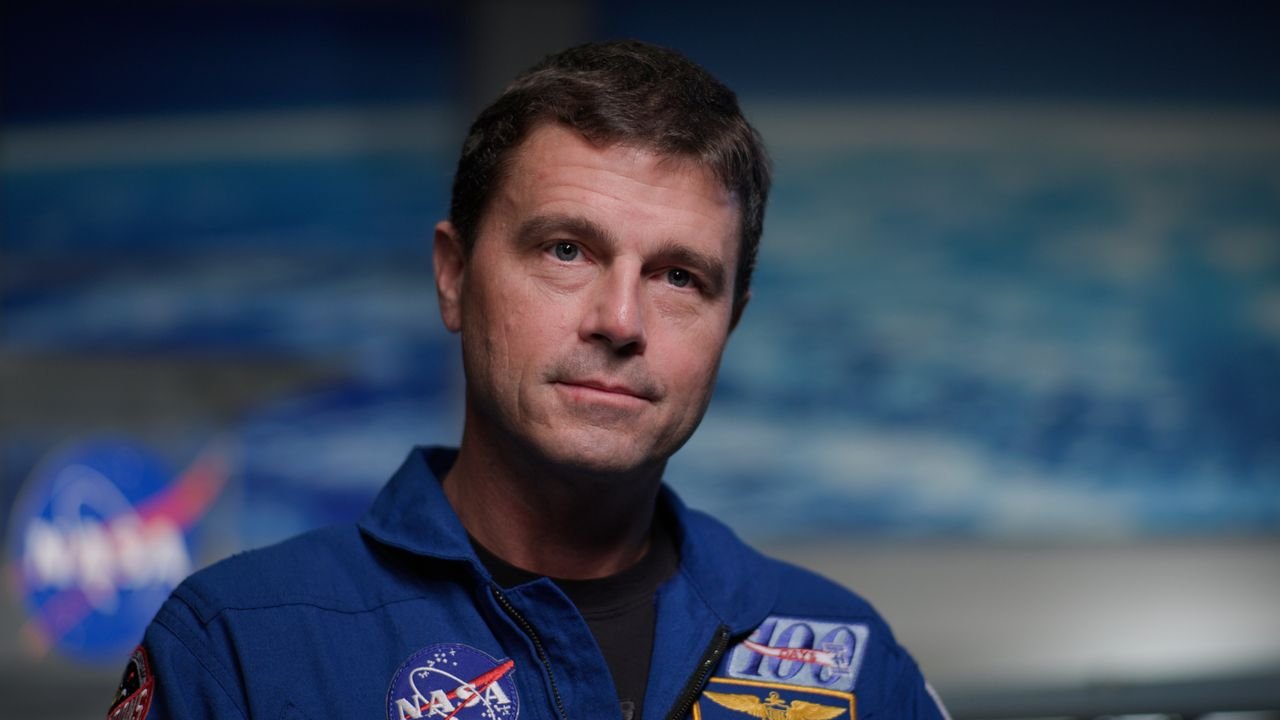
Last month, for the first time in more than fifty years, four astronauts flew to the moon and back. Their mission, Artemis II, was a test run for future endeavors, including the construction of a NASA base on the lunar surface. Reid Wiseman, a former U.S. Naval aviator who served as the mission’s commander, told me that the journey made him think about the Apollo astronauts of the nineteen-sixties. “I wonder if they were a little bit scared, because I’m a little bit scared,” he remembered thinking. “I bet they were.” NASA’s most powerful rocket hurled them more than a quarter-million miles into space—farther than anyone has travelled from Earth—and Earth’s gravity brought them home.
Wiseman and I met at the Johnson Space Center, in Houston, Texas. At fifty years old, he was fit and disarmingly earnest, wearing a blue astronaut jumpsuit over a pair of leather cowboy boots. He earned his NASA astronaut wings in 2011, before completing a six-month mission on the International Space Station. In 2020, his wife, Carroll, a nurse, died of cancer. He spent two years as the nation’s chief astronaut, an earthbound role that allowed him to raise two teen-age daughters. Then, in 2023, NASA chose him to command Artemis II. He would work alongside a pilot, Victor Glover, and two mission specialists, Christina Koch and the Canadian Space Agency astronaut Jeremy Hansen.
Wiseman, his fellow crew members, and their NASA colleagues essentially had to write their own how-to manual for twenty-first-century lunar missions. But they sometimes wondered if they would ever have a chance to use it. In the nineteen-nineties and the two-thousands, NASA’s plans to return to the moon were cancelled owing to anemic budgets. “We weren’t a hundred-per-cent sure if the nation was going to remain committed,” he told me. “We spent a lot of time in Washington, D.C.” I asked him when he realized that the mission was a go. “When the solid-rocket motors lit,” he told me. “That was when we knew we were going to the moon.” Our conversation has been edited for length and clarity.
Tell me about the moment you were selected for Artemis II. It sounds like it was as much a sobering moment as it was a joyful one.
It was also an embarrassing moment. My crew and I didn’t know that’s what was coming. We had all these meetings on our calendar. I just completely ignored this meeting with the chief astronaut because I thought it was about something totally different. I was downtown at a medical appointment. My boss at the time sends me a text: “Hey, I really think you should be in this meeting right now. We’re twenty minutes into it, and we miss you.” I tied in through Microsoft Teams. I just saw my bosses sitting there. I saw Victor and Christina sitting there. It turned out that they were both late as well.
You don’t feel like you won the Lotto. You don’t feel like jumping for joy. You just feel, like, Whoa, this is going to be a lot of work. This is going to be a very intense situation.
What did your selection mean for you as a single father? How did your daughters receive the news?
Before the formal announcement came out, we had about two weeks where we knew. I had talked to my kids about what I would be willing to do as an astronaut. I would only go back to the space station when they were in college. And if there was an opportunity to do an Artemis mission—we call them short durations, although it certainly didn’t feel like a short duration—I would be interested.
No kid wants their only parent to go do that. I felt a bit selfish. I also felt like this was a crew, and a mission, that would really be rewarding in the end. I talked to my kids about it: “This is something I would like to do, and I know it is going to be difficult for you.” The next day, my older daughter made moon cupcakes, and my younger daughter was all on board. She kept checking FamousBirthdays.com. She’s, like, “Dad, you went from No. 80,000 to No. 50,000 on Famous Birthdays.” She was happy with that. [Wiseman has now surpassed No. 6,500 on Famous Birthdays.]
Later, on the seventh day of the mission, I did a video chat with both of them. That was the day where I could tell, in the way they were looking at me and talking to me, that they understood why I’d said yes three years earlier. They understood the weight of this mission.
Help me understand how you fit training into the rest of your life. Is it, like, twelve hours of emergency scenarios—and then you’re helping your kids with their math homework?
That sounds about right. About a year prior to launch—April of 2025—we started to quiet down our lives. We stopped a lot of the public appearances. Even if friends were going and doing something, with very small exceptions, I started saying no. At the Johnson Space Center, we were working about eight hours a day. It was a fairly respectful schedule. We usually had Saturday and Sunday off, although as we geared up toward the mission, we were generally working voluntarily on Sundays. One daughter is in college, one daughter is in high school. I was very open with them: If you need help, it’s going to have to come from tutors, teachers, friends. It’s just not going to come from home.
In some ways, they are so much further along now than they would have been if I were there, nurturing them through this. A little of that makes me feel guilty that I wasn’t there. I could not have done this if they were six and eight. For many years, I didn’t fly in space because I was an only parent. It just was not an option for me. I think, in the end, they gave a lot of themselves to this mission. I’m very proud of them for doing that.



