
When Donald Trump descended his Trump Tower escalator to enter the political fray in June 2015, he made one big promise that stood out above the rest: “I will build a great, great wall on our southern border. And I will have Mexico pay for that wall.”
Like pharaohs and emperors before him, Trump has always been fixated on the symbolism of large physical structures. The wall served that purpose in his first term. For Trump’s supporters, it represented a promise to resolve all of the country’s problems, from the fear of immigration, crime, disorder and disease to the collapse of the middle class. And they wouldn’t have to pay a penny. Mexico would pay! But Mexico didn’t pay. Instead, U.S. taxpayers ended up with the $15 billion bill for a border wall that was never even finished.
You don’t hear so much about the wall from Trump anymore. Instead, he’s become fixated on the construction of a different monumental structure with symbolic resonance — that also comes with similar false promises that you won’t pay a dime.
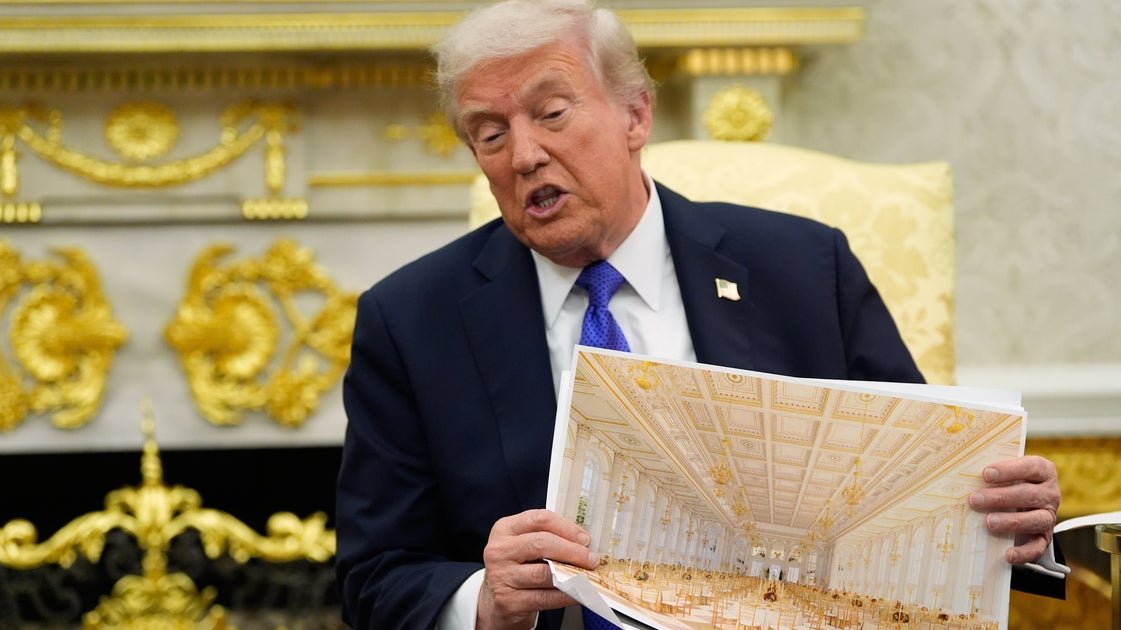
“If you take a look at this section, this is a Greek, more or less. It comes out of Greece. This is the ultimate facade for Greece. This face is the Treasury building. This face is a different facade — that’s Rome.”
This is Trump describing the columns that would adorn a 90,000-square-foot ballroom he plans to build atop the ruins of the White House’s East Wing, which he tore down in 2025, to a hastily called press conference on the ballroom construction site Tuesday.
SAUL LOEB via Getty Images
While Trump evaded any serious question lobbed during this impromptu presser — declaring that he doesn’t “really have enough time to explain” what’s going on with the war in Iran — he did go on at length about the ballroom and its many features: pipes, drones, a bomb shelter and the columns.
But if the wall was a symbol to Trump of his promise to save the country, at least in the eyes of his supporters, the ballroom now stands as a symbol that he’s only out to protect himself. Instead of promising that “I alone can fix it,” Trump now claims, “I alone.”
Trump’s monomaniacal ballroom focus began in February 2025 when Trump declared his desire for a ballroom while signing an anti-transgender executive order in the East Wing. This was not really a new dream for him — he had mused about a ballroom as far back as 2010 — but it quickly became a reality. In July 2025, Trump hired an architecture firm and stacked the National Capital Planning Commission with his own appointees. Construction began in September. On October 20, the surprise demolition of the East Wing, something never laid out in the plans, began.
The ballroom’s cost ballooned throughout the process. Trump initially promised it would be entirely privately financed through donations from corporations and rich benefactors and cost $250 million. Then it was $300 million. And then $400 million. By April 2026, after an apparent assassination attempt targeted Trump at the private-venue White House Correspondents’ Association Dinner, Trump asked Congress for an additional $1 billion in taxpayer funds, putting the total at $1.4 billion, and overwhelmingly financed by the American public.
As the process moved forward, Trump would frequently go off on tangents about the ballroom whenever he spoke publicly. During one of these tangents, while hosting a roundtable discussion with oil executives in January, Trump excused himself to stare out the window at the hole in the ground where his ballroom would be built. Like Gatsby’s green light, he looked out at his dreams, his hopes, his vision of America that still seemed out of reach.

Chip Somodevilla via Getty Images
But despite his protestations of a coming Golden Age, Trump’s vision is not meant for anyone but him. The ballroom is billed as a safety need for the administration, but in reality, it is just a safe haven, where the president can do what powerful elites, like the European nobility of yore, have always done in ballrooms — host lavish parties, state balls and dinners for foreign dignitaries outside of the public eye. The ballroom stands as a symbol of elite retreat from society and the anti-democratic reaction that grips the nation’s oligarchs at the moment. Trump’s wistful glances at the hole in the White House lawn show his desire to be securely encased from democracy in the glitz of a ballroom fit for Versailles.
This is the story of Trump’s second term. His ballroom then stands as a monument to his own narrow self-interest, elitism and disgust with the country’s longstanding democratic and republican culture that looks down on the trappings of monarchical excess.
Like a private equity vulture, he and his administration are stripping the country for parts while the president gets richer. They are taking away health care, food aid, medical aid to poor foreign countries, selling off public lands and gutting investments in new technologies and research, and then handing it all back to the rich in the form of massive tax breaks, merger approvals and contracts for those willing to bend the knee.
The symbolism of all of this, represented neatly by the ballroom, is a big reason why enough Republicans in Congress balked at the $1 billion Trump wanted from taxpayers. That rejection won’t end Trump’s ballroom tunnel vision or his efforts to build this monument to his true desires. That vision will beat on against the currents of mud slowly filling the construction site. It is what animates his politics more than anything else.



