
This article originally appeared on Inside Climate News, a nonprofit, non-partisan news organization that covers climate, energy and the environment. Sign up for its newsletter here.
Million-dollar condos are rising in Asbury Park, just off the legendary boardwalk in what used to be a blue-collar Shore town where Bruce Springsteen played as a young musician.
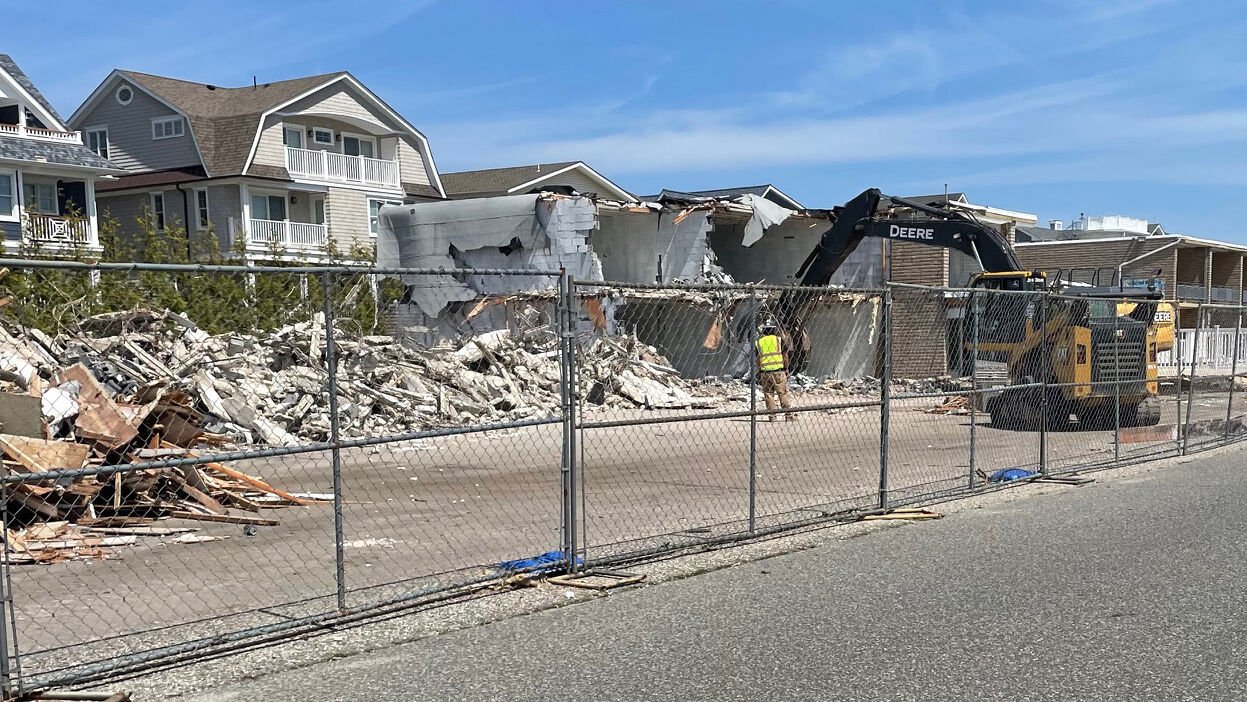
Half an hour south, excavation is making way for luxury homes in Seaside Park at the edge of Island Beach State Park, a mecca for fishers who cast lines on the pristine beach. Farther south, in Somers Point, contractors are building townhouses near marshes that were engulfed during Superstorm Sandy in 2012.
Warnings about sea-level rise haven’t stopped the building boom at the Jersey Shore even as scientific studies predict increased flooding in the coming decades that eventually will affect not only the shoreline but also inland communities.
New regulations that mandate more stringent construction standards and flood protections and factor in an ever-increasing rise in sea level by 2100 are facing strong resistance from business and political leaders up and down the coast. The battle is being fought in the courts and in the state legislature, where Senate President Nicholas Scutari, (D-Union), introduced a resolution that would essentially kill the new measures.
“It’s a really critical moment,” said Peter Kasabach, the executive director of New Jersey Future, a conservation advocacy group.
The regulations are part of the framework for ameliorating the impact of what could be existential threats, Kasabach said. “They really are the next step in how we manage both climate change and how we manage how and where we develop in the state,” he said.
Somers Point Mayor Dennis Tapp, a Republican who is opposed to the rules, said there is a lot of anticipation about whether Gov. Mikie Sherrill, a Democrat, might issue some kind of a reprieve. “Right now, everyone is waiting,” he said.
Counties in court
The rules were adopted in January but allow until mid-July for some projects to proceed under less-stringent standards.
At least four counties—Cape May, Monmouth, Cumberland and Ocean—are in court seeking to block the regulations, contending that the state Department of Environmental Protection exceeded its authority. The New Jersey Business & Industry Association and the New Jersey Builders Association have taken their case to appellate court, arguing the rules are too burdensome. Both cases are pending.

The Resilient Environments and Landscapes regulations are considered groundbreaking and a potential model for other states because they not only address the impact of past floods but also seek to prepare for repeats.
The most controversial provision requires new Shore residences and substantial remodels of existing houses to be built 4 feet higher than Federal Emergency Management Agency standards, which have caused many houses to be raised since Superstorm Sandy in 2012. Opponents say the new requirement will drive up costs and make homes so high they will be difficult to enter, especially for older people and those with disabilities.
The regulations integrate scientific calculations of sea-level rise projections into the updated land-use regulations and create “inundation risk zones” with revised maps that put more homes in flood zones. They mandate more stringent construction standards and analysis of projects planned in flood zones and also require better stormwater management and greater protections for wetlands.
Mayors, county officials and state legislators also are fighting the rules. Opponents, who include Republicans and Democrats, contend the rules are too onerous, rely on worst-case scenarios that may be wrong, will hurt property values and increase development costs.
Mike Mangan, the Democratic mayor of Manasquan, a Shore community about 64 miles south of New York City, said the rules should go further in addressing the need to raise existing roads, many of which will need to be higher so people and emergency responders can get around during flooding.
“That’s what we need,” said Mangan, one of dozens of mayors who oppose the new regulations. “Most of the houses are already elevated. The roads aren’t.”
Mangan said he has observed the sea level rise and knows that something must be done to ensure that the town will be viable when his children are grown. “If they’re going to live here in 30 or 40 years, we need to do this now,” said Mangan, who is about to implement a municipal plan to raise the roads in the eastern part of the town.
Tapp said Somers Point has taken steps on its own—with valves, pumping stations and bulkheads—to prepare. “Just like life, you roll the dice,” he said. “We have taken steps for that worst-case scenario. Is it going to be perfect? No.”
Somers Point is in the midst of a growth spurt, Tap said, with about 360 townhouses and single-family homes on the books for construction, so it must be proactive. “We’re definitely not sticking our heads in the sand,” he said.
High water, low ground
New Jersey is hardly alone in trying to plan for its coastline, but scientists say the state is especially vulnerable because it is experiencing the double threat of sea level rise, due mostly to melting glaciers, and a sinking terrain, due mainly to groundwater pumping. Greenhouse gases, fossil fuels and pollution will exacerbate what nature does.
The Jersey Shore sea level has risen 18 inches since the early 1900s—more than twice the global mean rate of about 8 inches, according to the New Jersey Climate Change Resource Center. Scientists who have been tracking the data have laid out a series of estimates of what is likely to happen in the coming years.
The projections chart shows an ever-increasing rise of sea level, with a possible 4.4-foot increase by 2100.
Tapp said the new sea-level projections focus too far into the future and are painting a far more ominous picture than necessary. “It’s always the worst-case scenario,” said Tapp, who figures that preparing for the next 20 years is more pragmatic than trying to anticipate what may happen in 75 years.
The long-term implications for the nation’s most densely populated state are significant and could have an impact everything from the ability to get on and off the barrier islands during flooding to property values, emergency services and tax revenue.
The rules, outlined in more than 1,000 pages, essentially lay out a new vision for Shore life, with smarter planning to discourage building in flood zones, stronger protections for wetlands and tidal marshes and updated stormwater standards designed to reduce flooding and erosion.
“I can’t think of a single place that is slowing down.” — Peter Kasabach
“We really need to be smart about where we are building,” said Danielle McCulloch, executive director of the American Littoral Society, a conservation group.
McCulloch and other environmentalists said the state Department of Environmental Protection has been reasonable in its estimates of how much the ocean waters will rise. Last year, for example, the department cut the added height requirement to 4 feet from 5 feet, based on revised data that suggested a slight reduction in expected sea level rise.
Looking to the next century is appropriate, she said. “We really need to think about, when we build something new, what’s it going to look like in 60 years?” said McCulloch.
‘We’ll adjust’
For all the talk about sea-level rise among scientists, environmentalists and government officials, there is no shortage of new homes up and down the coastline.
Kasabach said people just want to live near the ocean—and those who can afford the rising price of homes will take the risk of having to deal with flooding, even another superstorm.
“There’s just more development taking place. I can’t think of a single place that is slowing down,” he said. The only thing changing, he said, is the houses have gotten taller since Superstorm Sandy.
Some Shore communities are experiencing rising waters as tidal flooding — also known as sunny-day flooding — is becoming more common. It is a strange phenomenon to witness when water floods low-lying roadways, even in good weather. High tides, a new or full moon and offshore low-pressure systems can cause this, though scientists say carbon emissions and pollution are exacerbating what nature alone would do.
In Somers Point, Walter Gregory, who has a home a short distance from Great Egg Harbor Bay, said he doesn’t worry too much because his house is 15 feet above sea level and was undamaged during Sandy. The sea-level projections are exaggerated, Gregory said, and the Shore will be able to handle an eventual rise. “I think it will come up slow and we’ll adjust.”
In Asbury Park, a onetime decayed beach community that became a haven for artists and the LGBTQ community, old Victorians have been modernized. Construction is happening just off the boardwalk and in the restaurant district.
Jen Hampton, an artist who has a gallery in town, said she wonders who is buying the million-dollar condos in an area of town that is likely to flood. “I just worry about that,” she said.
Data doubters
In Cape May County, PJ Hondros, a coastal-risk analyst who runs a popular Facebook group, North Wildwood Coastal Processes, said the often-vitriolic online debates show how sea level rise has become a “political flashpoint” with many dismissing the data.
“I hope people come around,” he said.
Already, he said, rising waters are having an impact, with sunny-day flooding hitting low-lying areas of Atlantic City, Ocean City and Long Beach Island—all a harbinger.
Hondros, though, sees no decline in the popularity of having a place at the Shore.
“I don’t foresee the development dampening anytime soon,” he said.
McCulloch, of the American Littoral Society, said new homeowners are often shocked when they see what flooding can do and how quickly the waters can rise. “These rules are really about protecting New Jersey and our communities and taxpayers and making sure we’re building things that are going to last,” she said. “We need all resources and hands on deck right now.”



