
The battle for college baseball’s national championship heats up this week with the start of the NCAA tournament, and the selection committee unveiled the 64 teams in contention for the title on Monday.
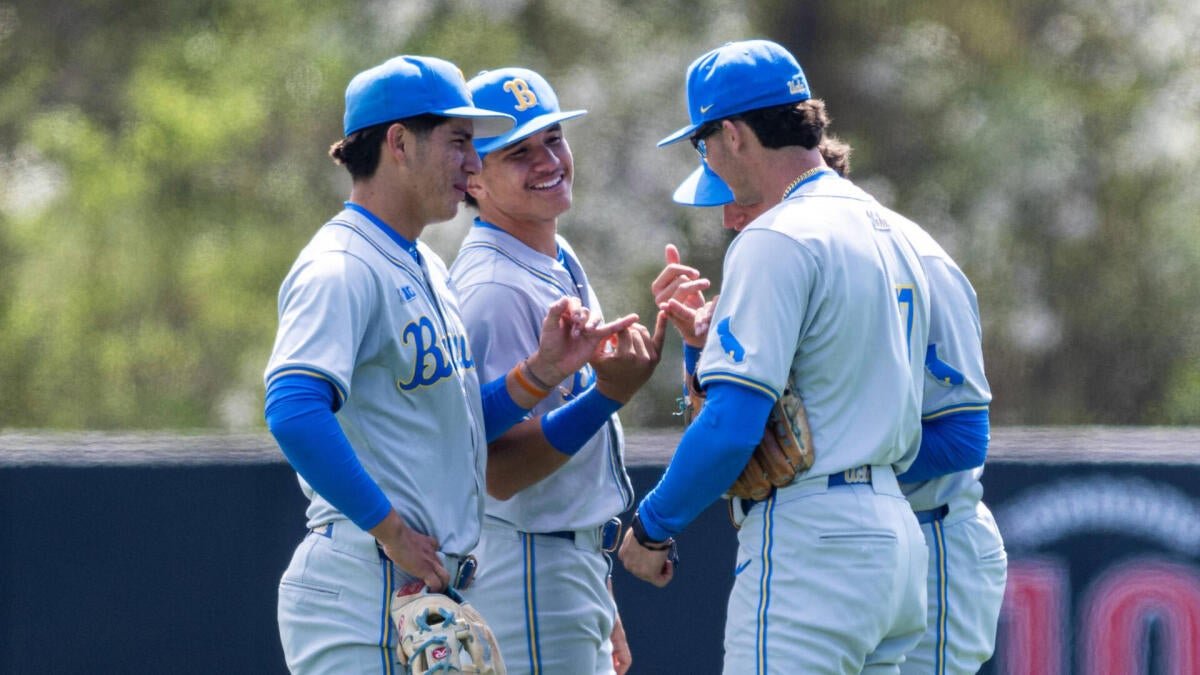
After it cruised through an increasingly competitive Big Ten and maintained a No. 1 ranking during the entire regular season, UCLA secured the top overall seed and the right to home-field advantage through the super regional round. The Bruins have company in the hunt for a College World Series crown, though, as each of the power conferences boasts multiple top-16 national seeds. No. 2 Georgia Tech from the ACC and No. 3 Georgia from the SEC present the biggest threats to John Savage’s club.
New this year is the seeding of the top 32 teams in the bracket. While there are no changes to hosting rights for the top 16 national seeds in the regional round and top eight in the supers, the expansion of the seeding process brings more transparency to the selection committee’s bracketing process and guarantees (on paper, at least) more favorable paths for the nation’s most prolific teams.
The journey to Omaha, Nebraska, begins Friday across 16 regional sites. Super regionals ensue the following weekend and set the stage for the CWS, which kicks off on June 12 at Charles Schwab Field in Omaha.
Below are the regional pairings, takeaways from the bracket unveil and odds for the most prominent national championship contenders.
Nebraska to host “regional of death”
Congratulations are in order for Nebraska, which secured hosting duties for the first time since 2008. Haymarket Park promises to deliver a special atmosphere. The Cornhuskers’ reward for playing on their home turf, however, is arguably the toughest regional field of them all. In order to advance beyond the first weekend, they will need to get past an Ole Miss squad whose pitching staff is more emblematic of a top-16 national seed rather than a regional No. 2 and an Arizona State lineup that hits the cover off the baseball.
Not only is the Lincoln Regional stacked with three realistic winners, but the team that emerges as the victor is likely to face a road super regional at Auburn. This path to Omaha is as tough as they come in 2026.
Mississippi State wins host bubble battle
A few fanbases ought to think there was a dereliction of duty on the selection committee’s part with regard to the hosting bubble. Those hoping to “call the hogs” in Fayetteville were particularly distressed when the committee unveiled the 16 host sites. Oregon State, a consensus top-10 team in the human polls, also missed out. USC finished ninth in RPI but must hit the road this weekend.
Meanwhile, Mississippi State secured the No. 14 national seed despite going 4-6 in SEC series, losing each of its last three weekends and being swept in two others. They also lost a head-to-head series with the Razorbacks.
“Mississippi State had a very strong conference schedule, grade-A RPI when you look at all the metrics they had,” selection committee chair Michael Alford said on ESPN. “And it was more than that. It wasn’t really comparing Arkansas to Mississippi State. You had West Virginia in the fold, and they really did a good job in their conference tournament, finishing second in a very competitive conference. You look at Kansas; we rewarded them. They won the regular season and the conference title.”
SEC reigns supreme in otherwise balanced field
Each of the four power conferences has multiple regional sites, and seven leagues sent at least two teams into the field. Every corner of the country will be represented well, and all of the biggest conferences should feel as though they have real shots to reach the CWS.
SEC | 12 | 7 |
ACC | 9 | 3 |
Big 12 | 6 | 2 |
Sun Belt | 5 | 1 |
Big Ten | 4 | 3 |
Conference USA | 3 | 0 |
Big West | 2 | 0 |
Still, the SEC remains the conference to beat. Each of the last six national champions hailed from the dominant league, and nearly half of the top 16 national seeds this year call the SEC home.
Regional fields, pairings
Check out the official NCAA bracket for scheduled start times for all games.
Los Angeles, Calif. | UCLA (1), Virginia Tech, Cal Poly, Saint Mary’s | Morgantown, W. Va. | West Virginia (16), Wake Forest, Kentucky, Binghamton |
Atlanta, Ga. | Georgia Tech (2), Oklahoma, The Citadel, UIC | Lawrence, Kan. | Kansas (15), Arkansas, Missouri State, Northeastern |
Athens, Ga. | Georgia (3), Boston College, Liberty, Long Island | Starkville, Miss. | Mississippi State (14), Cincinnati, Louisiana, Lipscomb |
Auburn, Ala. | Auburn (4), UCF, NC State, Milwaukee | Lincoln, Neb. | Nebraska (13), Ole Miss, Arizona State, South Dakota State |
Chapel Hill, N.C. | North Carolina (5), Tennessee, East Carolina, VCU | College Station, Texas | Texas A&M (12), USC, Texas State, Lamar |
Austin, Texas | Texas (6), UC Santa Barbara, Tarleton State, Holy Cross | Eugene, Ore. | Oregon (11), Oregon State, Washington State, Yale |
Tuscaloosa, Ala. | Alabama (7), Oklahoma State, SC Upstate, Alabama State | Tallahassee, Fla. | Florida State (10), Coastal Carolina, Northern Illinois, St. John’s |
Gainesville, Fla. | Florida (8), Miami, Troy, Rider | Hattiesburg, Miss. | Southern Miss (9), Virginia, Jacksonville State, Little Rock |
National championship odds
Odds via FanDuel
UCLA (+500)
No team in the D1Baseball rankings era (since 2015) had ever gone wire-to-wire as the No. 1 team until UCLA accomplished the feat this season. A loaded lineup, including projected top overall MLB Draft pick Roch Cholowsky, made the Bruins an obvious force that delivered on lofty regular-season expectations. Already at 51 wins, they enter the tournament having lost just two Big Ten games. A relative lack of elite starting pitching could catch up to them eventually, but the bullpen is as strong as they come. If staff ace Logan Reddemann returns to the mound after a five-week bout with arm fatigue, the rotation will no longer be much of a question mark.

Georgia Tech (+650)
It was obvious from the first series of the year that Georgia Tech boasted the most explosive bats in the nation. The Yellow Jackets drove across 10 or more runs in each of their first six games and remained hot all season to post the sport’s highest team batting average (.358), OPS (1.105) and run total (603). The star tandem of Vahn Lackey and Jarren Advincula spearheaded that offense and more than made up for some inconsistent pitching on the back end of the rotation, and guided this program to its second consecutive ACC title and first conference tournament trophy since 2014.
Texas (+750)
Dylan Volantis’ move out of the bullpen and into the Friday night starter role is a credit to Texas’ top-three pitching staff in the SEC. The reigning National Freshman of the Year enters the tournament with the fourth-best ERA among qualified pitchers at 2.00 and anchors a rotation that stymied elite offenses. While Texas leaned on its starting pitchers to open the season at 16-0 and win all but two series, an offense prone to droughts and a volatile bullpen limits the Longhorns’ margin for error in pursuit of its first national championship under Jim Schlossnagle.
Georgia (+1200)
In an unpredictable SEC where seemingly any team could and did sweep any other, Georgia emerged as the commanding frontrunner to win the league by 3.5 games. The Bulldogs went 5-0 in road series, which quieted any concerns about their strength of schedule after they played one of the weakest non-conference slates in the Power Four. The lineup is absurdly strong, even with mashing outfielder Henry Allen suffering a season-ending knee injury on May 1. While that loss would hamstring most teams, the Bulldogs went 10-1 without him and scored at least 11 runs in their first five Allen-less contests.
Auburn (+1400)
Between drawing most of the SEC’s top teams and playing the 10th-toughest non-conference schedule in America, Auburn posted the No. 1 strength of schedule in college baseball this season. To win 38 games against a slate that difficult is a commendable feat and one that earned the Tigers the No. 4 national seed. Chase Fralick is one of the biggest reasons why Auburn came away from that gauntlet relatively unscathed. In what has been dubbed “the year of the catcher” nationally, Fralick stands among the best at his position with a 1.009 OPS and 14 home runs.
North Carolina (+1400)
If North Carolina finally breaks through for its first national championship, the pitching staff will be the catalyst. This is arguably the deepest staff in the sport — one that includes a true ace in Jason DeCaro, a solid weekend trio, dominant midweek starters and tremendous young bullpen arms like freshman Caden Glauber and sophomore Walker Duffie. That staff neutralized Georgia Tech’s nation-leading offense to win the regular-season series, showcasing the Tar Heels’ championship ceiling. It also has a top-10 defense by fielding percentage, which makes UNC as elite in run prevention as any team in the field.
Texas A&M (+2200)
Texas A&M suffered its first shutout loss of the campaign in its lone SEC Tournament outing, but that result was not indicative of the tremendous season-long numbers its offense posted. The Aggies rank fifth nationally with a .988 team OPS and feature seven players with individual OPSs of 1.000 or better. Veterans Gavin Grahovac and Caden Sorrell stir the pot for one of the deepest lineups in baseball. The question — and it is a big one — is whether the arms can prevent enough runs to sustain a push to Omaha.
Florida (+2200)
Sophomore Aidan King, with his league-best 0.93 WHIP in the regular season, became the first underclassman in Florida history to win the SEC Pitcher of the Year award. He leads a fantastic pitching staff that boasts electric heat, and that ranks eighth nationally in strikeouts. The Gator bats can lag behind against tougher competition, but they rarely need to produce more than a small handful of runs to win.
Mississippi State (+2200)
Mississippi State is a prime example of how playing in the SEC greatly increases a team’s margin for error when it comes to bracket placement. The Bulldogs lost more conference series (six) than they won (four) and went a mediocre 13-17 against Quad 1 and Quad 2 opponents, but because their strength of schedule was so bold, they secured a home regional with room to spare. Their floor is extremely high, so a CWS berth is certainly attainable. They will need to take things to another level if they are to win the whole thing, though.



