
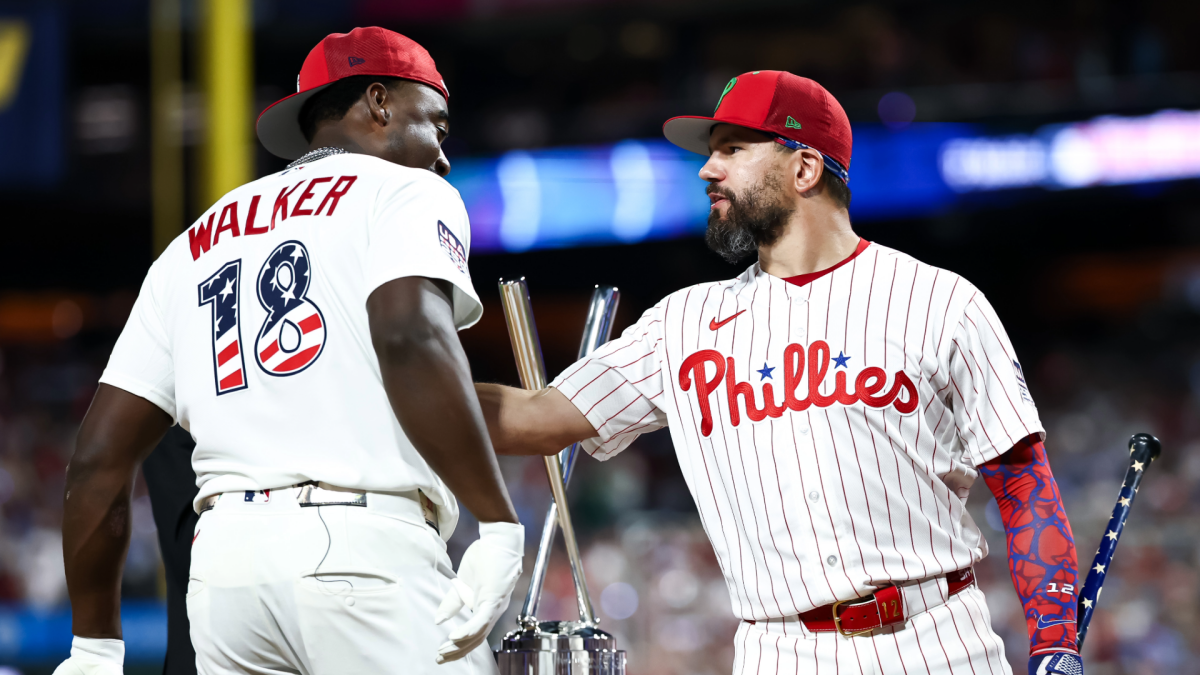
PHILADELPHIA — I was ready to be angry. Hell, I was angry. I wrote a whole column about how mad I was at myself for getting angry regarding the Home Run Derby format change. I still prefer the clock, but Monday night’s event in Philadelphia had positives. A good number of them.
Phillies slugger Kyle Schwarber and the Citizens Bank Park crowd sprang to life and stole the show late, making it an incredibly fun night before Cardinals breakout star Jordan Walker made an unlikely late surge to win it. This Derby was a rousing success.
The potential problems with this Home Run Derby format
On the negative side, a new solution to a nonexistent problem is never a good idea. You know the old saying, “if it’s not broken, don’t fix it?” Yeah, the Home Run Derby was not broken. It had been great ever since slapping a clock on it. The players and crowd making the event fun doesn’t mean the format change was necessary.
You see, the Derby used to have a problem. By 2014, it had become a relative bore. The hitters were taking far too many pitches, either because they wanted a mini-rest in the batter’s box or because they were far too selective on the pitches they were seeing — really, it was a combination of the two. Then, Major League Baseball, prior to the 2015 Midsummer Classic in Cincinnati, decided to fix the problem. The league put a clock on the Home Run Derby, creating an urgency and preventing the players from taking pitches. It was a glorious recovery of an event that had gone sour.
Now, here in 2026, the format of the event was changed. For the worse, in my opinion.
Fortunately, it wasn’t nearly as unwatchable as the 2014 version, and there were plenty of fun moments early. It’s a Home Run Derby. Of course there will be fun moments. Schwarber said after the event that this new format “gives us a little bit of a breather” and allows players to “pace it out a bit.” That’s fair. If someone said something along the lines of, “we don’t need to exhaust these guys just for our entertainment in a meaningless event,” I wouldn’t have a great rebuttal to that.
Further, the taking of pitches was not nearly as big of a problem as it had become in the 2011-14 Derbies. There were pitches taken, but it wasn’t excessive. Willson Contreras took too many pitches in the second round, but he was facing off against a Philllies player, and the crowd booed lustily every time he didn’t swing. That part was actually funny. There was a repeat of this in the final round when Walker batted. We’ll get back to this fun. The final two matchups — Schwarber vs. Contreras and Schwarber vs. Walker — salvaged an event that looked doomed to disappoint.
In all, the event didn’t drag on. It wrapped up in about two-and-a-half hours. The last few years, as the league continued to add extra time bonuses, the Derby probably went a bit too long. There’s a shelf life for watching bomb after bomb and once you hit the three-hour mark, you start to lose the crowd’s energy a little bit. Even Monday night in Philadelphia, the Junior Caminero and Walker portions of the second round were met with a veritable yawn from the crowd, and these are two of the most exciting, young sluggers in the game. There’s only so long you can cheer watching the same thing over and over.
The place felt sleepy.
How the Philly crowd helped save the night
Enter Schwarber and the Philly Phaithful.
The Schwarber vs. Contreras bout in Round 2 was excellent theater, and the crowd was a big reason why. Sure, they were cheering a bunch for Schwarber, but Contreras’ turn was the most fun of the night. The crowd was booing the entire time he was up, quite loudly, until he’d hit a home run (they’d quiet) or swing and not hit a homer (raucous explosion). It was the most fun I’ve had with a Home Run Derby crowd since Todd Frazier walked things off in Cincinnati the first year with the clock.
Then came the finals, and the crowd wasn’t done. It was absolutely electric for Schwarber’s entire turn (and the MLB homer leader hitting 11 home runs in 15 swings before finally falling short on his 16th swing had a lot to do with it). They never had time to settle down. He just kept launching ball after ball into the night.
“Philly, I just wanna say thank you guys for all the support,” Schwarber said afterward. “You guys were amazing. I was trying to represent you guys the best I can. You guys showed out tonight. I can’t wait to see you guys tomorrow at the All-Star Game.”
Then came Walker’s turn and, again, the crowd was incredibly loud with the boos, quiet during homers and loud again during balls that fell short. It was top-notch entertainment. The crowd only deflated when Walker hit six home runs on his last six swings to steal the win from Schwarber.
“My thought was ‘Philly is brutal,’ honestly,” Walker said with a smile as he held a press conference with the trophy sitting in front of him. “But I think it’s pretty special because they love their players. That’s what you want from your home — where you play. I’ve never heard people cheer so loud for Schwarber and (Bryce) Harper. And those guys did their thing, for sure. But, you know, I can’t hate ’em because that’s their hometown guys.”
Contreras loved the scene, too. “I feel like I won,” he said (via Boston Globe).
Should the clock come back?
We also had a chance to enjoy the majesty of the most prodigious of home runs. Without the clock, the pitchers were able to give a little time between pitches and the hitters could watch their shots fly into the stands. Everyone in the crowd — and at home — could watch the full flight path of the balls in the air without worrying about losing the next shot. We didn’t need to be overly reliant on the scoreboard and were able to easily count the number of home runs versus the number of remaining swings.
It felt less frantic, too.
You know what, though? I liked the frantic nature of action provided by the clock. It was a feature for me, not a bug. As an in-person product, I sure missed the drama of the clock. This is a once-a-year event with some of the strongest power hitters in the world. I loved that balls were flying all over the yard at a pace that most humans couldn’t keep up with. I liked being able to look at the scoreboard and think, “oh wow, he’s already to 13?” I liked glancing back and forth between the ball flying out of the yard and the clock and trying to figure out how many more home runs the hitter could squeeze in there.
Now, there was some urgency at the end of the first round, notably involving both Phillies. Schwarber needed a late surge to surpass Munetaka Murakami, and then Bryce Harper made a run at taking out his teammate for the fourth and final spot. It was fun. The finals with Walker storming back to take out Schwarber with the four straight home runs was incredible, too.
I just found myself clamoring for the clock. Even the Contreras and Walker rounds, when they faced Schwarber, having a clock wouldn’t have eliminated the fun the crowd was having. It still would’ve been a funny mix of boos and cheers.
Not everyone is going to agree with me. Plenty of people were excited about the format change and enjoyed a return to just leisurely watching bombs leave the yard with time before the next pitch.
Me? Gimme back the clock and all the chaos with it. I enjoyed Monday night for the most part; I just missed the clock. But man, the Philly crowd fueled by the Schwarber run to the finals salvaged things before Walker took the air out of the place.



