
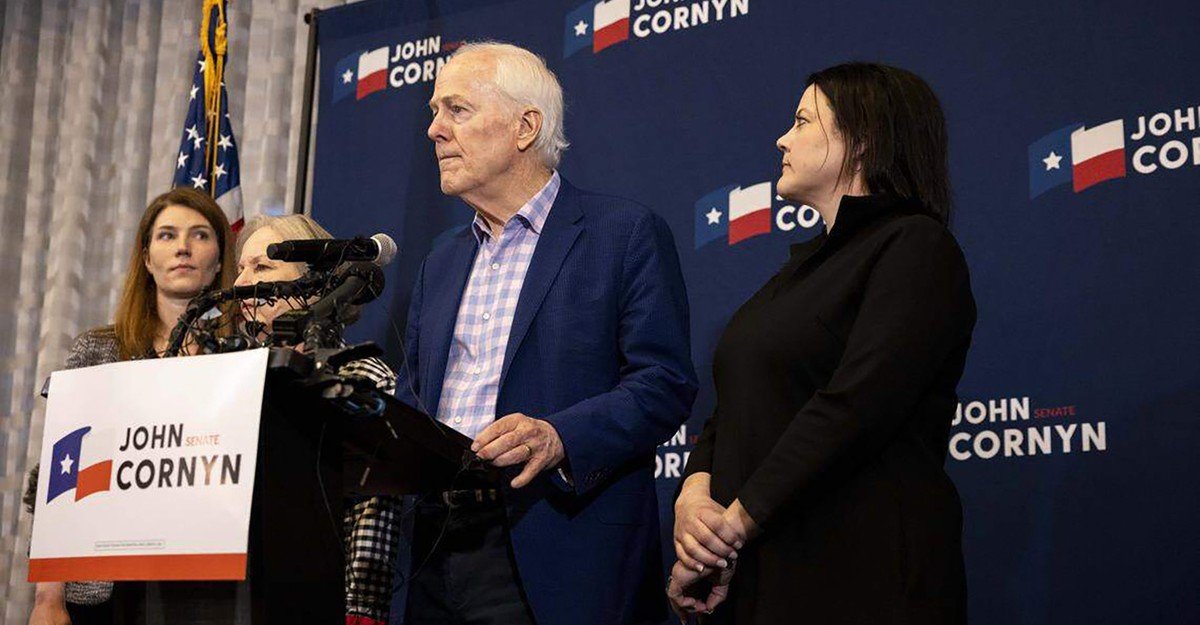
Just like nearly every other Republican has gone once Donald Trump decided to terminate their political career, John Cornyn went quietly.
The senator from Texas, one of his party’s most effective fundraisers and influential legislators, devoted his losing campaign and most of the past decade in politics to a wan effort to portray himself as the president’s faithful servant. He tweeted out a photo of himself reading The Art of the Deal, introduced a bill to rename a highway the “Trump Interstate,” and even set up a campaign page reiterating his fealty that boasted, among other facts, that he had a “more than 99.2% voting record with President Trump—higher than Ted Cruz.”
Ah, but that 0.8 percent made all the difference. Cornyn had warned in 2016 that Trump’s presidential nomination could hurt the party. He voted to certify Joe Biden’s 2020 election victory. And he privately urged Trump not to run in 2024. Even though Cornyn opposed both impeachments of Trump, ultimately backed him in the 2024 primaries, faithfully advanced his legislative agenda, and supported all of his controversial nominees, Trump could smell the faintest signs of discomfort or reluctance.
Ken Paxton, who defeated Cornyn in yesterday’s Republican primary, has pledged complete loyalty to the president. Paxton’s liabilities include a list of ethical and legal violations too lengthy to summarize. Senator Susan Collins of Maine fretted earlier this month over the political risks of nominating a candidate she delicately called an “ethically challenged individual.”
Yet from Trump’s standpoint, Paxton’s record constitutes an advantage. The president seemingly both relates to, and badly needs to rely on, allies who share his predilection for violating laws and human decency. Throughout his career in business and politics, Trump has surrounded himself with what Collins might call Americans experiencing ethical challenges. Cornyn’s history of mild hesitation in the face of Trump’s gravest offenses marked him as someone at risk of developing a genuine conscience.
Trump successfully targeted a spate of Republicans for elimination this year: Cornyn, Senator Bill Cassidy of Louisiana, Representative Thomas Massie of Kentucky, and five Indiana state legislators. The class of 2026 joins a roster of Republicans who either lost to Trump-supported challengers (Mark Sanford, Liz Cheney, Jaime Herrera Beutler, among others) or, more common, retired in the face of certain defeat for the same reason (Jeff Flake, Bob Corker, Richard Burr, Pat Toomey, to name a few).
Trump ended the career of virtually every Republican officeholder who voted to impeach him after his attempt to overturn the 2020 election. Now he is going after other Republicans guilty of even minor deviations from his commands. As he has relentlessly hunted the dissident Republicans to extinction, his prey has, like Cornyn, tried to depict the president’s opposition as a tragic misunderstanding between friends. Even Massie put himself forward as a true Trump ally.
Cornyn, like so many of his fellow soon-to-be-ex-politicians, staked his survival on the hopeless tactic of trying to beat Trump’s team in a contest over who loves Trump more. Overcoming Trump’s hold on the rank and file is not easy, but the method his victims have chosen—essentially to beg for Trump’s mercy, and then not receive it—saps them of their dignity without meaningfully increasing their odds of political survival.
The 1940 novel Darkness at Noon is a fictionalized but highly realistic account of a Soviet official who is arrested under Stalin, is charged with wild anti-Soviet conspiracies, and ultimately chooses to give a public confession. The author, Arthur Koestler, wrote it to explore how a dedicated Communist could bring himself willingly to admit to absurd crimes. The answer—spoiler alert—is that the protagonist’s ideology convinces him that his own false arrest must be a correct, scientific application of the Marxist dialectic.
Trump’s intraparty victims are not true believers in MAGA thought, if such an ideology even exists. But they seem to have accepted Trump’s claim to inhabit the will of the party and the nation, at least to the extent that they cannot bring themselves to break fully with him when he casts them out. They prefer to maintain the Republican part of their identity, even if that means prostrating themselves before their tormentor.
After losing in a blowout, Cornyn immediately pledged to support the ticket, including the opponent he had described as a fraud and a moral leper. Nobody expected anything else of him. The senator from Texas died, politically speaking, with his boots off.



