
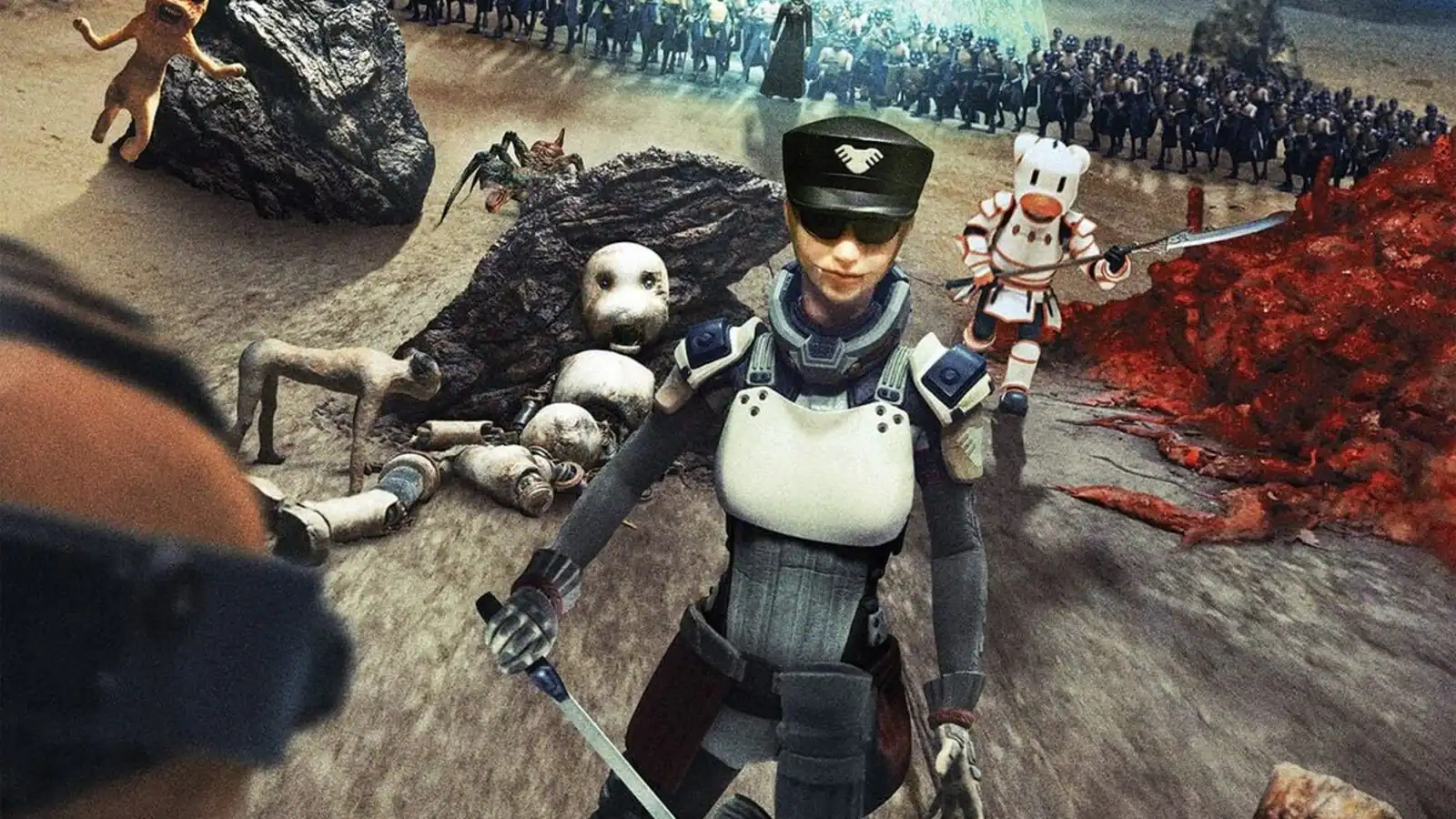
Almost ten years after the stunning “Junk Head”, Takahide Hori is back with its prequel, “Junk World”, another mind-bending stop-motion extravaganza that will leave audiences clamoring for even more.
When the final version was released in 2021, “Junk Head” – first completed in 2017 before being substantially re-edited – represented the culmination of more than a decade of work, much of it carried out by Hori himself. Self-taught and initially working largely on his own, the 40-year-old interior designer decided to spend four years in a proverbial garage to create the short film “Junk Head 1” (2013). With a small team (three staff members), he then expanded the project into a feature-length movie, an enormous undertaking given the painstaking demands of stop-motion animation. The result was extraordinary: a visual feast packed with wildly inventive and exhilarating sequences. Amazingly enough, Hori has managed to repeat the feat with “Junk World”.
Check the review of the initial film
The setting remains the same: a post-apocalyptic wasteland inhabited by grotesque creatures and mutated beings who chase, exploit, consume and abuse one another with relentless cruelty. Visually, the film is every bit as compelling as its predecessor, introducing new nightmarish organisms that seem to have wandered out of a painting by Hieronymus Bosch. Yet what is immediately apparent is the increased budget (in relative terms – Hori is now working with six staff members…). Where the first picture often unfolded within a maze of narrow, repeating underground corridors to cut costs, “Junk World” opens up its universe with larger environments set outside and significantly more ambitious action sequences, resulting in a kinetic spectacle that constantly surprises.
The end credits function as a kind of making-of documentary, revealing how many of the scenes audiences have just witnessed were painstakingly assembled by hand. Like its predecessor, “Junk World” is a triumph of practical craftsmanship, relying on puppets, miniatures and physical sets rather than digital imagery (computer-generated elements and green screens were used for wider landscapes, but kept to a minimum). Hori once again wears an astonishing number of hats, serving as director, writer, producer, editor, cinematographer, production designer, art director and co-composer (with Erina Koyama). The sheer scale of his contribution is visible in every frame.
This creative omnipresence recalls other great puppeteers and animators, from the pioneering Richard Teschner to the Quay Brothers and Jan Švankmajer. Hori’s use of dark surreal imagery and unsettling symbolism places him firmly within that tradition (Tsutomu Nihei’s manga “Blame!” also comes to mind), while his imagination remains distinctly his own. If anything, “Junk World” demonstrates that he still has an abundance of startling images and ideas left to share.
Narratively, the film marks a significant departure from “Junk Head”. Whereas the earlier movie often resembled a meandering journey that could at times feel repetitive and monotonous, “Junk World” offers a far more structured and engaging story that is anything but padding. Plotting was arguably the one area in which “Junk Head” occasionally faltered, its emphasis on visual invention sometimes coming at the expense of narrative momentum. Hori appears to have taken that lesson to heart. This time, rather incredibly, the picture’s narrative is every bit as compelling as its imagery.
The complicated story (conveyed this time by actual dialogues) unfolds as a wildly inventive ride that mirrors the creativity of the stop-motion animation itself. The first film already hinted at intriguing ideas concerning religious devotion and the death of god. “Junk World” (technically a prequel) develops those themes considerably, weaving them into a narrative filled with increasingly bold twists and thoughtful reflections on fanaticism and belief. It also injects a lot of dark humor in the proceedings, making you laugh at the most squalid developments you could (not) imagine. Prequel or not, “Junk World” is thoroughly enjoyable on its own and can absolutely work as an introduction to the twisted world concocted by Hori.
The less said about the plot, the better. Suffice it to say that after the first 30 minutes or so, the movie suddenly jumps into a madcap, thrilling insanity that recalls some of the best time loop features from Japan. By introducing a dimension-hopping sense of reckless adventure, Hori expands the scope of his universe without sacrificing its distinctive atmosphere. The result is an experience that is as intellectually stimulating as it is visually dazzling.
In many ways, “Junk Head” now feels like a remarkable proof of concept for what Hori was ultimately capable of achieving. “Junk World” refines and expands that vision in almost every respect, transforming an already impressive achievement into something genuinely extraordinary. If the promised third instalment (tentatively called “Junk End”) reaches the same level of ambition, it will be worth however many years Hori and his collaborators need to bring it to life.



