
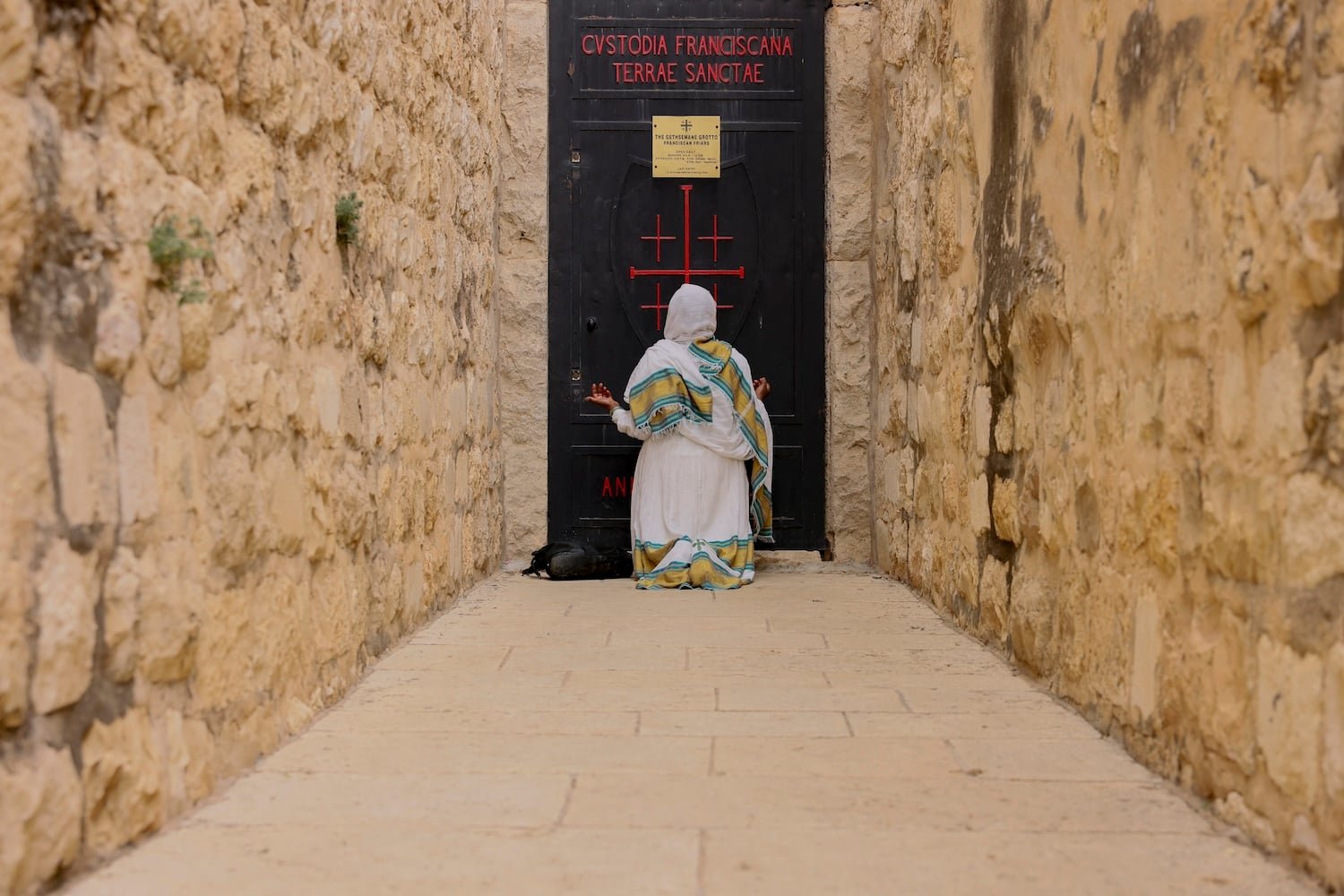
A recent violent and unprovoked attack on a French nun in Jerusalem has cast a spotlight on the rising hostility toward Christian communities in Israel.
In a viral video from April 28, a man runs up to a nun and forcefully pushes her onto the street, causing her to narrowly miss hitting her head on a stone. The man then kicks the nun as she lies on the ground, stopping only after a passerby intervened.
The attacker, clad in a Jewish kippah and ritual tassels, was later identified as a 36-year-old Israeli settler living in the occupied West Bank. According to Israel’s state attorney’s office, police detained the suspect and charged him with assault motivated by hostility toward a religious group.
The attack drew almost unanimous condemnation from Israeli government officials, in addition to criticism from France, Spain, and Italy. The Israeli Foreign Ministry called it a despicable and shameful act “in direct contradiction to the values of respect, coexistence, and religious freedom upon which Israel is founded.”
This has brought widespread attention to a recent growing pattern of hostility toward Christians in Israel. Such violence tends to go unpunished, and critics have accused authorities of treating these incidents as isolated acts rather than symptoms of a broader problem of religious extremism and impunity.
Beyond the immediate danger to Christian communities, these attacks risk eroding Israel’s international standing and straining key ties in Europe and the wider Christian world, where concerns over religious freedom in Israel—and Jerusalem, in particular—carry significant diplomatic weight. In response, religious leaders, civil society groups, and some Israeli politicians are calling for stronger law enforcement, educational initiatives to counter religious hatred, and expanded interfaith engagement to stem the growing hostility.
Verbal and physical harassment against Christians, coupled with the desecration of church symbols and sites, are placing a significant strain on the delicate balance between religious communities in Israel. That balance has long been shaped by the unique significance of the Holy Land for Judaism, Christianity, and Islam—and is now threatened by the recent rise of Jewish nationalist and extremist movements, particularly in Jerusalem’s Old City, where clergy and worshippers from multiple faiths live and practice in close proximity.
Christians represent roughly 2 percent of Israel’s 10.2 million residents, and 79 percent of Christians are Arabs. Approximately 2,700 Christian clergy currently reside in Israel, the majority of whom are not Israeli citizens, according to the Rossing Center, an interreligious organization based in Jerusalem.
Aggressive incidents toward Christians have increased since Hamas’s attack on Oct. 7, 2023. The Religious Freedom Data Center (RFDC), a Jewish Israeli organization of volunteers that runs a hotline for Christians, recorded 181 hostile incidents—including spitting, verbal abuse, vandalism, physical violence, and online harassment—in 2025, compared with 107 incidents in 2024.
Yiscah Harani, RFDC’s founder and director, said that many cases of harassment against Christians go unreported, which means her statistics are likely an underestimate of the total phenomenon. She also said that although the organization files complaints to Israeli authorities, most of them go answered.
“If there is no enforcement, then it is a green light to do it again, a sort of passive encouragement,” she said. “If that spitter is not caught and indicted, next time it’s going to be worse. … What are we waiting for? Murder?”
Analysts, along with religious and secular organizations, blame the increasing hostility on Israel’s ruling coalition government, which they say fosters religious nationalism and a sense of impunity among Jewish extremists. They also point to a broader climate of hate, fear, and polarization pervading the country since the beginning of Israel’s war on Gaza.
Joseph Sievers, professor Emeritus at the Pontifical Biblical Institute in Rome, said messianic views within specific Israeli circles can fuel aggressive attitudes toward those perceived as “others.” “Even if Christians have nothing to do with Hamas or Hezbollah, some people may feel authorized to act against all that are not perceived as ‘their people,’” he said.
A 2025 survey by the Rossing Center on Jewish Israeli attitudes toward Christians found that “as the level of religiosity among respondents increases, so too do levels of discomfort toward Christianity … and lower willingness to engage in learning, openness, or tolerance.”
Hana Bendcowsky, the program director of the Jerusalem Center for Jewish-Christian Relations at the Rossing Center, said that Israel’s government and citizens have felt increasingly isolated over the past few years. Consumed by wartime priorities and constant tensions between settlers and Palestinian communities in the occupied West Bank, security authorities are less keen to enforce the protection of minorities, she said, resulting in those with nationalist tendencies to “allow themselves to be aggressive.”
The Israeli authorities’ swift arrest of the perpetrator of the recent attack has been taken by some Christians as a sign that the situation may improve. Still, more constructive efforts are needed to promote peaceful coexistence, especially in the Holy Land, said Ibrahim Faltas, a Franciscan priest and head of schools for the Custody of the Holy Land.
Faltas noted that Israeli authorities tend to listen to the requests of the Christians and often intervene. “However, there is still a lack of strong and genuine political will to resolve the conflict [over the Holy Land] that fuels this difficult coexistence,” he said. “Above all, there is a lack of authoritative involvement from the international community to address a situation that is worsening day by day throughout the Middle East.”
Although Christians hold little direct political leverage over Israel, the religion wields significant diplomatic influence and moral authority globally via its extensive networks. Christian pilgrimages and tourism are economically important to Israel, and anti-Christian violence could alienate potential travelers.
Further, growing awareness of these incidents is raising alarm among Israel’s key allies in Europe, which is home to vast Christian communities. In March, for example, Italian Prime Minister Giorgia Meloni condemned Israeli police for preventing Cardinal Pierbattista Pizzaballa, a top Catholic leader, from entering the Church of the Holy Sepulchre to celebrate Palm Sunday, a Christian holiday marking the start of Holy Week. (Jerusalem’s holy sites have been closed to worshippers since the start of the U.S.-Israeli war on Iran.) Washington also expressed its concerns to Israel regarding the incident, according to White House spokesperson Karoline Leavitt.
Israel’s relationship with Europe has already vastly deteriorated over the country’s wartime conduct in Gaza. Some members of the European Union have pushed the bloc to suspend a pact governing its ties with Israel, although the movement has not yet garnered sufficient support.
In a May 13 hearing at the Knesset, Israeli lawmaker Gilad Kariv argued that while incentives to address rising anti-Christian violence are often framed in terms of Israel’s diplomatic standing, the deeper concern is that hostility toward Christians undermines Israel’s commitment to its own fundamental values. He called the recent incidents an “educational failure” and leveraged for action beyond Knesset discussions.
“These incidents cast a moral stain on the state of Israel and Israeli society,” Kariv said. “As a rabbi in the Reform community, I am ashamed of them.”
Education and increased intergroup contact may be key tools to address these issues. Researchers have long found that sustained interpersonal contact can reduce prejudice by increasing familiarity with marginalized communities. Post-conflict societies from Northern Ireland to the Balkans have demonstrated the success of dialogue programs and shared community initiatives in lowering tensions over time, even if they do not eliminate deeper political conflicts.
These dynamics appear to hold in the Israeli context, as well. The Rossing Center found that about half of its survey respondents held inaccurate views about Christian customs and beliefs, and that higher levels of education correlated with more positive attitudes toward Christians—suggesting that knowledge and exposure can reduce hostility toward “othered” groups. The Rossing Center runs workshops and school programs designed to reduce misconceptions about Christianity, while other initiatives in Jerusalem bring together rabbis, priests, imams, students, and residents for joint dialogue and community activities.
It will take time for such efforts to have a broad impact. For now, rising awareness—bolstered by the Knesset hearing—could improve the situation. Archbishop Giorgio Lingua, the Vatican’s ambassador to Israel, said there is “always a gap between the idea and reality,” but he believed efforts are being made to find solutions to the tensions.
Aghan Gogchyan, chancellor of the Armenian Patriarchate, said the hearing showed that “someone is following hate crimes against Christians in Jerusalem” and urged the Israeli government “to call these acts by their name: hate crimes.”
The April attack has heightened scrutiny of a worsening trend, and Israeli authorities appear to recognize the need to take Christian concerns, and those of the international community, more seriously. But stronger enforcement is only part of the task. Bold educational action and deep societal reflection will be necessary in a polarized society already devastated by years of war and fear. Otherwise, rifts between communities will widen and cycles of violence will continue, leading to even greater fragmentation and mistrust.



