
People incarcerated in New Jersey’s state prisons and county jails have complained for years about dirty drinking water, buggy food, moldy bathrooms, inadequate healthcare, abuse by guards, intolerable heat, and other inhumane conditions of confinement.
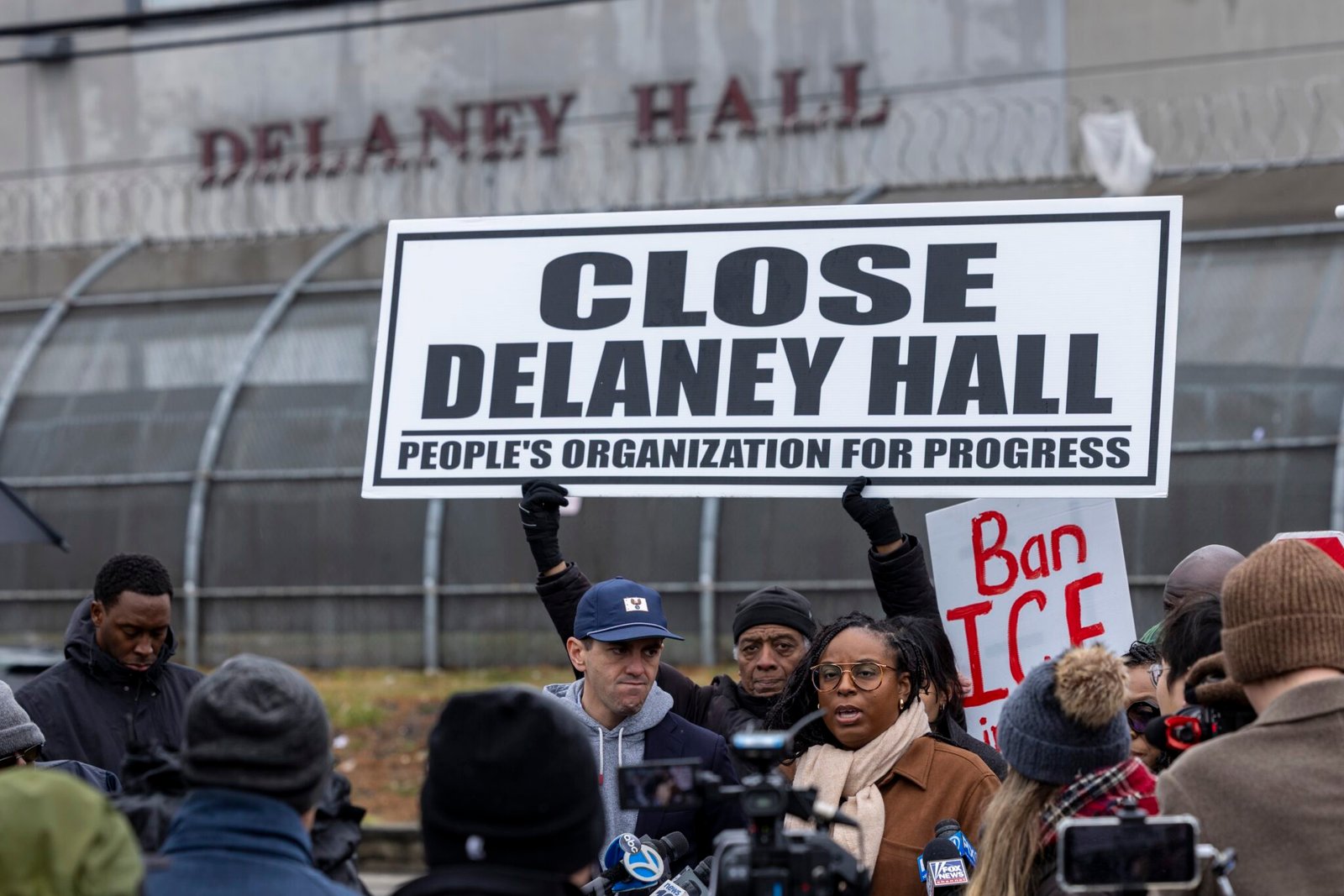
So they’ve had one question in mind as they’ve learned of the escalating protests and growing parade of visiting politicians outside Delaney Hall, the federal immigrant jail in Newark where about 300 detainees say they’re on a hunger strike over poor conditions.
Why aren’t the public and politicians protesting outside New Jersey’s state prisons and county jails, where about 23,000 people live daily in conditions one incarcerated man called “hazardous even to a dog?”
“We are all frustrated because there are hundreds of people turning up to protest issues that we have come to accept,” said Michael Doce, who’s incarcerated at the New Jersey State Prison in Trenton.
Doce and his fellow prisoners are getting backup from an unlikely source.
The ignored, long-festering conditions of local lockups, contrasted with the furor over Delaney Hall, have become a favorite gripe of Republicans at all levels.
Assemblyman Robert Auth (R-Bergen) derided the differing responses as “hypocrisy,” while Assemblywoman Dawn Fantasia (R-Sussex) mocked the ICE protest as “the moral outrage of this generation.”
“I don’t ever remember a statewide crusade over correctional facilities that NEW JERSEY actually owns, operates, & controls,” she said on social media Tuesday.
On Wednesday, federal Homeland Security Secretary Markwayne Mullin blasted the Delaney protests and visits as “political theater” in testimony to a House committee on President Donald Trump’s new budget request for the department.
Mullin ticked off problems found recently in several of New Jersey’s state prisons, including filthy kitchens, spilled sewage, pest infestations, and expired fire extinguishers. Such conditions drove a state watchdog in 2024 to urge legislators to establish minimum habitability standards for prisons — something they still have not done.
“Not one of these individuals have ever protested about what’s happening in their own state yard or backyard,” Mullin testified of Delaney Hall’s critics.
Prison justice advocates, too, lament a lack of wider outrage over local lockups.
“These systems are two sides of the same coin,” said Marleina Ubel, a senior policy analyst at the progressive think tank New Jersey Policy Perspective. “There has been a significant amount of activism, rightly so, around immigrant detention, but this kind of thing has been going on always in our state prisons and jails.”
Much of the ire has been directed at Gov. Mikie Sherrill, who has vowed to continue former Gov. Phil Murphy’s strategy of not cooperating with federal immigration officials in Trump’s ongoing mass deportation effort. Sherrill tried to inspect Delaney Hall last week but was denied entry. On Tuesday, the state sued the jail’s operator, Geo Group, for barring state health officials from inspecting many areas of the facility.
Sherrill’s spokespeople did not respond to questions the New Jersey Monitor asked them Wednesday about whether Sherrill has visited or personally inspected any state prisons or county jails or has any concerns about local lockups’ conditions, transparency, or oversight.
The state Department of Corrections inspects county jails annually and drafts lengthy reports that cover everything from code violations and staffing levels to inmate grievances and in-custody deaths. Those reports aren’t posted publicly, but are public records available upon request.
Inspections of state prisons are more fractured, with fire safety, food safety, and other conditions and operations inspected by different state agencies that do not produce a single comprehensive facility inspection report nor publicly release their findings.
That leaves Terry Schuster, the state’s corrections ombudsperson, as the only independent watchdog authorized to inspect state prisons and report prison conditions publicly.
He agreed Delaney Hall has received far more attention and action — both from the public and policymakers — than local lockups.
But he predicted the focus on Delaney Hall eventually will benefit people incarcerated elsewhere in New Jersey. He pointed to Edna Mahan Correctional Facility for Women, where brutality and sex abuse scandals ultimately led to systemic changes that improved responses to such complaints at all facilities.
“The thing that needs the most attention is not always the thing that gets the most attention, but it’s a really valuable thing when lawmakers are paying attention to any part of the correction system,” Schuster said.
Still, he does see a call to action here.
County jails in New Jersey don’t have independent oversight, and legislators could remedy that, he said. Federal migrant jails don’t either, outside of the Congress members empowered to inspect them — but Congress members might not have the time or subject-matter expertise to do so, he added.
“It would be great to work with members of Congress on federal legislation that would create something like my office for immigrant detention centers,” he said. “It’s not like my office exists in every state — it really doesn’t — so New Jersey can be a model for the federal government on what would that look like. I think we’ve actually been very effective. Even while there are some big recommendations out there that haven’t gotten traction yet, at least there’s transparency around them.”
In the meantime, prison justice advocates hope the Delaney drama will spur policymakers to look more closely at correctional facilities elsewhere in New Jersey.
“It’s hard not to feel a little bit cynical that, as things reach national levels of news, that’s when we see politicians show up,” said the Rev. J. Amos Caley, an organizer with New Jersey Prison Justice Watch and a pastor at the Reformed Church of Highland Park. “I also remain hopeful that there is a moral prick of conscience that’s happening with our democratically elected leaders, that they do recognize that there’s a battle line being drawn between those committed to brute force over and against those who are vulnerable, and they know at least which side of the battle line to stand on.”
He added: “Hopefully they will move on to stand out in front of any place where abuses are taking place — and remain standing not just for the cameras, but on putting forward bills and enforcing laws that protect people on the inside.”

Ubel agreed, pointing to the state’s failure to police itself even in following its own laws, such as a law restricting the use of solitary confinement. Schuster’s office found in a 2023 report that state prisons routinely flout that 2019 law, isolating people for weeks or even up to a year for disciplinary infractions or to accommodate staffing shortages and lockdowns.
“It is up to us and to our legislators to use this information to take the next step, to demand change and show up for people as we have done for those in Delaney Hall,” Ubel said.
In Trenton, Doce said the power went out at his prison, the oldest operating prison in America, with one section dating back to the early 1800s, the same week Delaney Hall’s detainees began their hunger strike. Back-up generators failed, leaving those inside with no hot water or water pressure — and a warning from staff that the problem could take almost a week to fix, he said.
“They could really care less,” Doce said. “There are horrible conditions in NJSP that have been ignored for decades. People often feel that since people who are incarcerated committed a crime, it is expected that their living conditions be horrible and their food unedible. Don’t let the name of the meals they serve fool you. The sloppy Joe, for example, has no meat in it. It is a BBQ-flavored soy byproduct that often has cockroach parts in it.”
But, he added, “the loss of liberty is the punishment. I think people often forget that.”
GET THE MORNING HEADLINES.



