
“Being Towards Death,” originally titled “10 jiān gansidui” (Ward 10 Suicide Squad), is a comedy with some more serious undertones from the People’s Republic of China. Director Chen Sicheng, highly successful with the incredibly popular, rather crude and loud “Detective Chinatown” franchise (2015–2025), had already hinted with the spy thriller “Decoded” (2024) that he wanted to move in a somewhat more ambitious direction in the future.
His new film, “Being Towards Death,” is also a considerably less spectacular undertaking compared to “Detective Chinatown.” However, the film’s box office results in the People’s Republic are rather disappointing. It opened on the prime date of May 1st, including the following public holidays, and had to settle for a rather meager $5.4 million in its opening weekend. After three weeks, it had only grossed $10.2 million at the box office. Theatrical releases in New Zealand and Europe will follow successively.
Being Towards Death is set to release in selected Odeon UK cinemas on 5th June 2026
In any case: When has there ever been a comedy whose (English) title derives from a famous sentence by the German philosopher Martin Heidegger? “Factual Dasein exists as born; and, as born, it is already dying, in the sense of being-towards-death,” he writes in his major work “Being and Time,” and in Chen’s film, this is quoted, albeit somewhat more simply, by the wise and very humane Dr. Yi (Tian Wu). Dr. Yi works in a hospital, and Ward 10 is the place for terminally ill cancer patients. That women, men, and children lie in the same room there—that, of course, can only happen in a comedy.
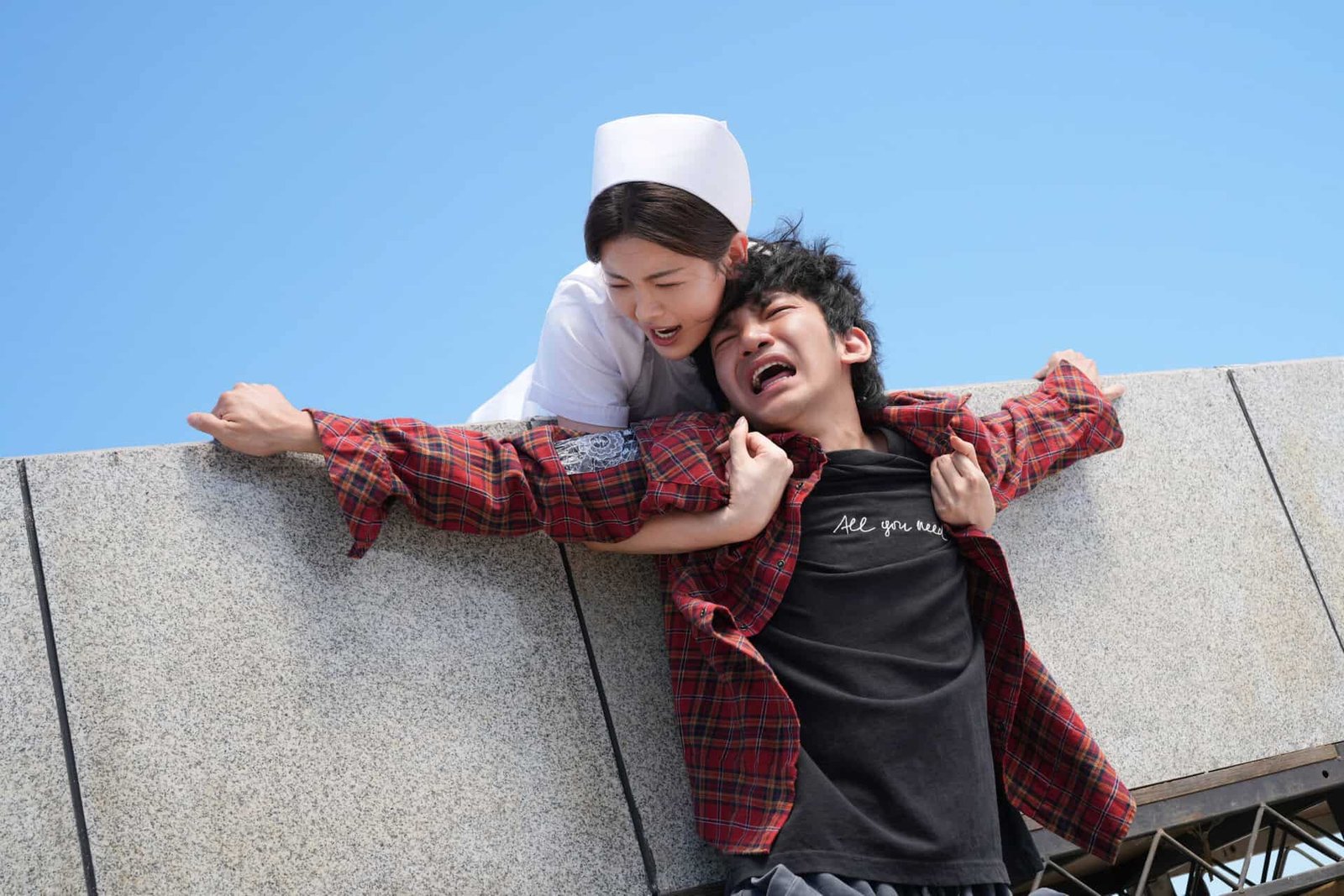
Not a patient, but the main character is the young Zhang Xiaobing (played by Jiang Long), who is there to visit his beloved aunt, who raised him. He bought a few care robots, which he’s now trying to resell, with little success. As a result, three debt collectors are on his tail. In desperation, he tries to jump from the hospital roof but is rescued by nurse Xie Xie (Yang Chaoyue), who’s taking a smoke break. (There’s a lot of smoking going on in the film, which is rather unusual these days.)
Dr. Yi takes pity on the young man and hires him, essentially as an amateur psychologist. He’s supposed to interview the cancer patients about their feelings and expectations. In the process, we get to know all the inmates of Ward 10. Among them are a little girl, also named Xiaobing, who has been seemingly abandoned by her parents, the somewhat eccentric Sister Ma (Cai Ming), the young lawyer Zhao Bowen (Huang Yi), and, yes, the film director Jia (Wang Zichuan), who’s struggling to make progress on his (likely final) screenplay.
Instead of filling out the questionnaires as instructed, Zhang Xiaobing has an idea: with Jia’s help, he wants to turn the tedious task into a documentary film that will confront cinema audiences with the final days and weeks of cancer patients. Initially somewhat skeptical, but then increasingly enthusiastic, the terminally ill set about implementing this crazy plan.
Anyone who thinks that life in a deathbed can’t be turned into a feel-good movie or a comedy will be proven wrong. Chen Sicheng and his actors manage to do just that, with the occasional lapse into the soapy and kitschy. Nevertheless, there’s enough human warmth and some genuinely funny situations that prevent the story from becoming banal. The characters, and there are quite a few of them, are well-developed and each gains their own distinct profile. Not all of them are equally likeable, and the relatives, some of whom can hardly wait for “their” patients to die, certainly get their comeuppance.
Towards the end, the patients take a cheerful bus trip. There, they meet, lo and behold, the two acclaimed Chinese directors Guan Hu and Jia Zhangke, and, as if that weren’t enough, one of China’s top pop stars, Jay Zhang. The documentary is released in theaters and becomes—did anyone doubt it?—a success. Among other things, such as the very coherent production design and the hospital setting, the cinematography by German cinematographer Florian Zinke, who has lived in the People’s Republic of China for many years and has worked with, among others, Li Yu and Lou Ye, deserves special mention.
Whether the real-life “Being Towards Death” will achieve the same level of success as the documentary in the film is rather doubtful. Perhaps the whole thing is too mild or not biting enough, not “dark” enough for the tastes of Chinese audiences. For interested Western viewers, however, the film should be a good, not too intense introduction to the world of Chinese comedy.



