
Welcome back to World Brief, where we’re looking at stalled Russia-Ukraine peace talks, the European Union’s potential expansion, and U.S. sanctions on Cuba.
‘I Am Proposing a Meeting’
Ukrainian President Volodymyr Zelensky published an open letter to Russian President Vladimir Putin on Thursday offering to hold in-person negotiations on ending the war between their two countries.
With U.S. negotiators having so far failed to secure a lasting cease-fire in the war, FP’s Sam Skove reported last month that both Russia and Ukraine have soured on Washington as a mediator and begun looking for alternatives. In his letter, Zelensky suggests cutting out the middlemen altogether.
“We see that the United States is fully focused on the issue of Iran, and it would be wrong to simply wait until the war in Europe returns to the center of its attention,” Zelensky wrote. “Ukraine proposes ending this war through direct engagement between us—and you. I am proposing a meeting.
However, the rare direct address wasn’t all diplomatic niceties. Zelensky oscillated between championing Kyiv’s resilience and mocking the 73-year-old Russian leader, from his age (“After 26 years in power, age is beginning to take its toll. And with time, the fatigue with you will only grow”) to his reliance on North Korea and China for support (“You are the first ruler of Russia to turn to Pyongyang for assistance”).
Zelensky also called out Moscow’s shrinking resources, citing Ukrainian attacks on Russian oil facilities. “You will not have enough money or political capital to keep buying the loyalty of Russians the way you have for the past 26 years,” he wrote.
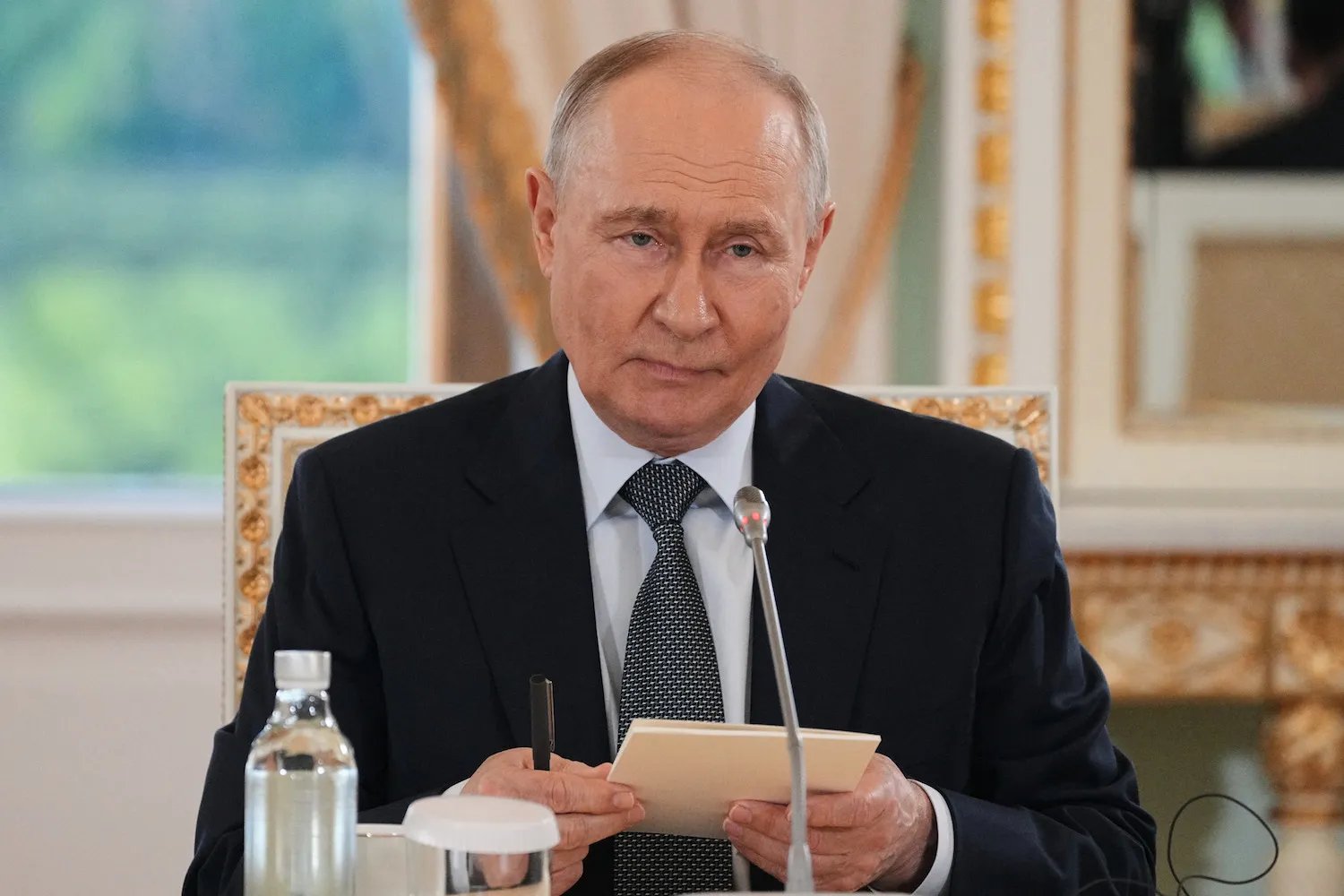
Putin was not amused. Speaking at Russia’s annual economic conference in St. Petersburg on Friday, the Russian leader rejected Zelensky’s overture. “I don’t see the point in meeting,” Putin said, accusing Kyiv of seeking dialogue to prevent the further advancement of Russian troops. “Let the experts get to work and come up with some solutions. After that, we can meet.”
He dismissed Zelensky’s taunts, saying, “The most important thing is whether you are capable of functioning properly, doing your job properly.” Putin expressed gratitude for U.S. President Donald Trump’s efforts to end the war, but he insisted that there was still “work to do” and vowed to strengthen Russia’s air defenses in the interim. On Wednesday, a Ukrainian drone strike hit an oil terminal in St. Petersburg, right as the economic conference was getting underway.
Putin also rejected Zelensky’s claims that war fatigue, high inflation, and rising internal discontent were taking a toll on Russian citizens. Although he admitted that Moscow’s deficit may increase this year, he stressed that “inflation has slowed down significantly and it keeps going down,” adding that these rates are expected to be around 5.2 percent in 2026.
Meanwhile, the international community appears more open to Zelensky’s demands. Trump welcomed the idea of in-person talks. “It would be very good if they met,” the U.S. president told reporters on Thursday. “They should get it done.” The following day, France announced that French President Emmanuel Macron, British Prime Minister Keir Starmer, and German Chancellor Friedrich Merz will hold talks with Zelensky in London on Sunday.
Today’s Most Read
What We’re Following
Six new members? More than 30 leaders gathered in Montenegro on Friday to discuss advancing six Balkan states’ European Union membership bids. Albania, Bosnia and Herzegovina, Kosovo, Montenegro, North Macedonia, and Serbia appear set to join a new Franco-German initiative that creates incentives, such as privileged access to the bloc’s single market, for the hopeful countries to pursue faster reforms.
“For us, the enlargement, namely to the Western Balkans, is the most important geopolitical investment that the European Union is doing,” European Council President António Costa said on Thursday ahead of the summit. “It is not just an opportunity. It is a geostrategic necessity for Europe.”
Costa said EU expansion is vital to counter Russian and Chinese influence in the region, which he warned threatens the wider continent’s security. Of the six states seeking membership, Montenegro is viewed as the most promising candidate, followed closely by Albania, though the EU still harbors concerns over the latter’s ability to tackle organized crime. Meanwhile, Serbia’s prospects appear far less promising, as far-right President Aleksandar Vucic has pulled Belgrade closer into Moscow’s orbit.
Pressure on Havana. The U.S. State Department on Thursday imposed sanctions on Cuban President Miguel Díaz-Canel, his wife, and three other individuals, citing the regime’s “decades-long campaign of political, ideological, and institutional warfare against the United States.” The penalties signal growing U.S. pressure on Cuba’s leadership as part of the White House’s wider regime-change ambitions for the island nation.
Díaz-Canel denounced the sanctions on Thursday, saying that they’re intended to reinforce the U.S. blockade of the country. “This political blindness is added to the coercive measures applied in recent weeks against our country, designed to harm the Cuban people,” Díaz-Canel wrote on X. These measures likely refer to a recent executive order expanding sanctions on the island as well as U.S. criminal proceedings against former Cuban President Raúl Castro.
When a reporter asked Trump on Thursday whether the latest sanctions were meant to accelerate Cuba’s collapse, the U.S. president sidestepped the question. “We just want them to be a nicely run country,” Trump said, adding that “we’re going to handle that as soon as we’ve finished” U.S. military operations in Iran. “I like to do one thing at a time.”
Seeking oil opportunities. India sought to deepen energy cooperation with Venezuela during a second day of high-level talks on Friday. Indian Oil Minister Hardeep Singh Puri “reaffirmed India’s strong support for Venezuela’s energy reconstruction, adding that Indian companies are ready to deepen their presence in Venezuela,” New Delhi’s oil ministry said on Friday, adding that Venezuela was one of India’s largest crude suppliers in April and May.
India halted all Venezuelan crude purchases last year after Trump ordered a 25 percent tariff on countries that bought the South American nation’s oil. However, the easing of U.S. sanctions in February allowed New Delhi to resume purchases. According to shipping data seen by Reuters, India was the second-largest importer of Venezuelan oil in May, with purchases hitting 427,000 barrels a day.
This week’s meetings came as economists warn that global growth could hit critical lows if supply chain disruptions in the Strait of Hormuz are not resolved soon.
What in the World?
An international panel of arbitrators formally announced on Monday that it had rejected a multimillion-dollar claim by Rwanda against the United Kingdom concerning a scrapped deal over what?
A. Refugee resettlement
B. Military funding
C. Public health aid
D. Rare-earth mining
Odds and Ends
In today’s economy, even some royals are looking for a second income. According to a report from Britain’s public spending watchdog on Friday, former British prince Andrew Mountbatten-Windsor sublet three royal cottages in the city of Windsor while living there rent-free. As a British royal, Mountbatten-Windsor was required to pay only “peppercorn rent,” worth—in practice—zero pounds. Income from renting out the cottages went to the former prince, though the exact amount charged is unclear. Mountbatten-Windsor was stripped of his royal title and asked to leave the estate in February over his ties to convicted sex offender Jeffrey Epstein.
And the Answer Is…
A. Refugee resettlement
Rwanda argued that it had spent considerable funds preparing to host migrants who had arrived in Britain as part of the deal, FP’s Nosmot Gbadamosi reports in Africa Brief.
To take the rest of FP’s weekly international news quiz, click here, or sign up to be alerted when a new one is published.



