
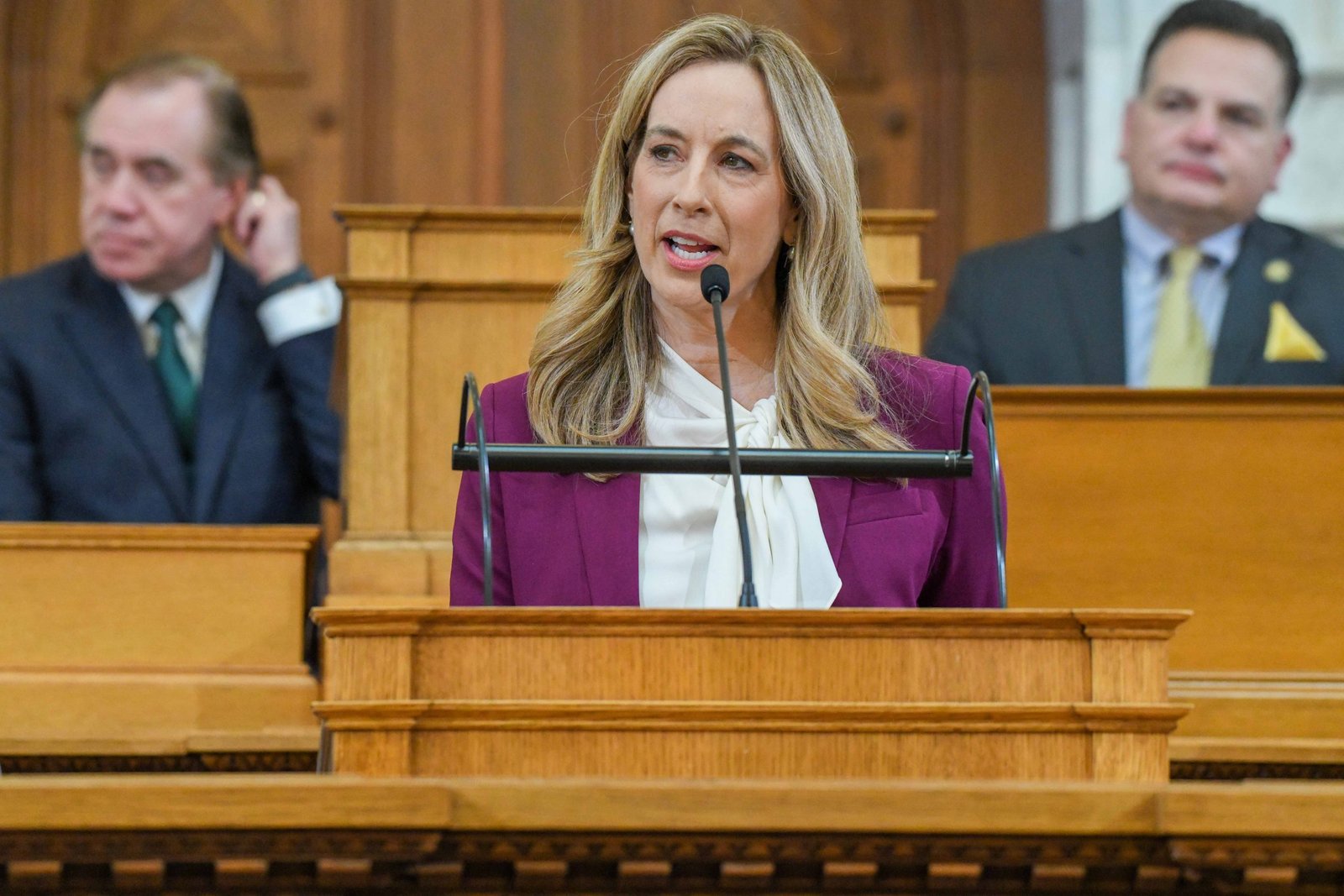
Gov. Mikie Sherrill said her first budget will more than double the funds available for low-income people to legally challenge unconstitutional detention and deportation actions, drawing criticism from state Republicans.
Sherrill and legislative leaders said they’ve agreed to bolster the Detention Deportation Defense Initiative’s funding to $20.2 million, a $12 million increase. The DDDI provides free legal assistance to low-income residents facing deportation — Sherrill said the new funds will allow all low-income people detained in Delaney Hall, the ICE facility at the center of recent protests, to receive legal help.
“As the Trump Administration makes it more difficult for members of our community to challenge detention and deportation, access to qualified legal representation has never been more important,” Sherrill said. “Here in New Jersey, we are helping ensure more New Jersey residents receive due process under the law and more New Jersey attorneys are mobilized to stand up for the fundamental human rights of detainees and their families.”
State Senate Minority Leader Anthony M. Bucco condemned the funding increase, which he argued shows incorrect priorities.
“We’re told there’s not enough money for our schools as districts weigh cuts to basic skills programs, sports, and student services,” Bucco said. “But there’s $20 million available for projects like this? Funding our children’s education should be the top priority. This tells us exactly where the Governor’s priorities lie.”
But opposition from legislative Republicans is unlikely to stop the budget item from moving forward. Senate President Nicholas Scutari and Assembly Speaker Craig Coughlin praised the budget item alongside Sherrill, and state Senate Majority Leader Teresa Ruiz said she authored the budget resolution.
“No one should have their fate decided in a proceeding lasting mere minutes, without legal representation, while detained in inhumane conditions,” Ruiz said. “Since its founding in 2018, DDDI has been a lifeline for low-income residents navigating one of the most complex and consequential legal processes imaginable—often without counsel. Fully funding this program will double its capacity and ensure that hundreds more individuals have a fighting chance to be heard.”



